Was it the Third Intifada?
First Intifada
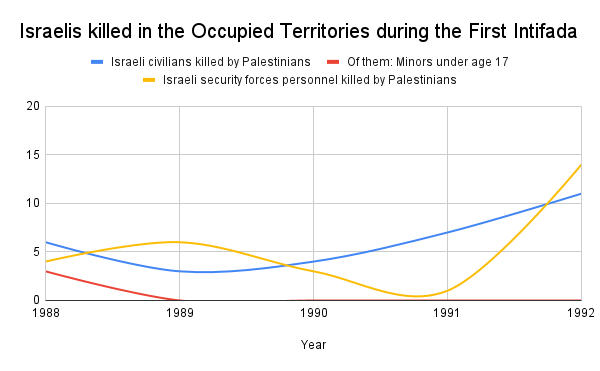
In December 1987, collective Palestinian frustration erupted in the popular uprising against Israeli rule known as the Intifada, or “shaking off.” At first a spontaneous outburst, the Intifada developed into a well-organized rebellion. Masses of civilians attacked Israeli troops with stones, axes, Molotov cocktails, hand grenades, and firearms supplied by Fatah, killing and wounding soldiers and civilians. Israeli troops, trained for combat, were not prepared to fight this kind of war. Amid confusing directives, some abuses occurred.
The Intifada petered out by 1990, with most of its leadership arrested. Nonetheless, it had a tremendous impact on Israeli public opinion and policymaking throughout the ensuing decade. While many Israelis were outraged by the Palestinian violence and angered by the danger Israeli soldiers encountered in the territories, the Intifada intensified the Israeli longing for normalcy and an end to the conflict, creating consensus for the peace negotiations of the 1990s.
For the Palestinians, the Intifda created a new cadre of leadership based in the West Bank and Gaza Strip. These youths were supporters of the PLO leadership in Tunis, but did not consider themselves accountable to it. Many of the youths most active in the Intifada later became officials in the Palestinian Authority.

Second Intifada
What made this episode different from previous rounds of major violence between Hamas and Israel in 2008-9, 2012, and 2014, and what were likely to its ramifications? Can it be labelled as the Third Intifada?
This time the exchange led to riots in Arab-Jewish mixed cities inside Israel. Also significant was that Hamas's ordinance reached deeper into Israel and in greater numbers, placing the population of relatively large Israeli metropolitan areas, notably Ashkelon and Ashdod, under greater and more frequent threat of rocket fire.
Sites of Protest:
Nablus
Haifa
Jaffa
Ramallah
This page has paths:
- Timeline of events Khushboo Bhutani