Scalar's 'additional metadata' features have been disabled on this install. Learn more.
Decoding Diaspora: Mapping J. A. Rogers' Mythic Africa
Main Menu
Table of Contents
Explore and Navigate the Different Facets of the Decoding Diaspora project.
Project
An Introduction by Dr. Richard Newton
Researchers and Community Partners
Participants and Partners in Decoding Diaspora
Data
Access the Data for Your Own Research
Interpretations
Use Digital Tools to Explore How J. A. Rogers Understood "Africa"
Essays
Experimental Studies Using the Data and Interpreations Featured Here
References
Project Bibliography and Recommended Readings
Use and Permissions
Terms and Conditions Governing the Creation and Use of the Project
Richard Newton
fb088bedcfb114b3db559719e7c8c878c6a9066b
Physical Digital Archive Class
1 media/Physical Digital Archive_thumb.jpg 2023-04-27T08:29:53-07:00 Richard Newton fb088bedcfb114b3db559719e7c8c878c6a9066b 42151 1 plain 2023-04-27T08:29:53-07:00 Richard Newton fb088bedcfb114b3db559719e7c8c878c6a9066bThis page is referenced by:
-
1
media/Title Page- FN- x.jpg
2023-02-09T08:55:16-08:00
Project
35
An Introduction by Dr. Richard Newton
plain
2025-01-23T10:42:03-08:00
While a doctoral student, I grew fascinated by African American cultural history. My interest was less in the actuality of the past and more in the need for it. The links between what did (or did not) happen and what could or --as more often expressed--needs to happen, beckoned my attention. As Douglass and Du Bois have taught us, the "color line" is in fact an alluring prism refracting the politics of identity. Hence much of my scholarly attention has been devoted to what Paul Gilory termed the "chronotopes" of Black social formation. In my first book, Alex Haley and the Anthropology of Scriptures (Equinox 2020), I examined how the novel, multimedia phenomenon that was Roots reflected, modeled, and shaped how modern people work though cultural texts.
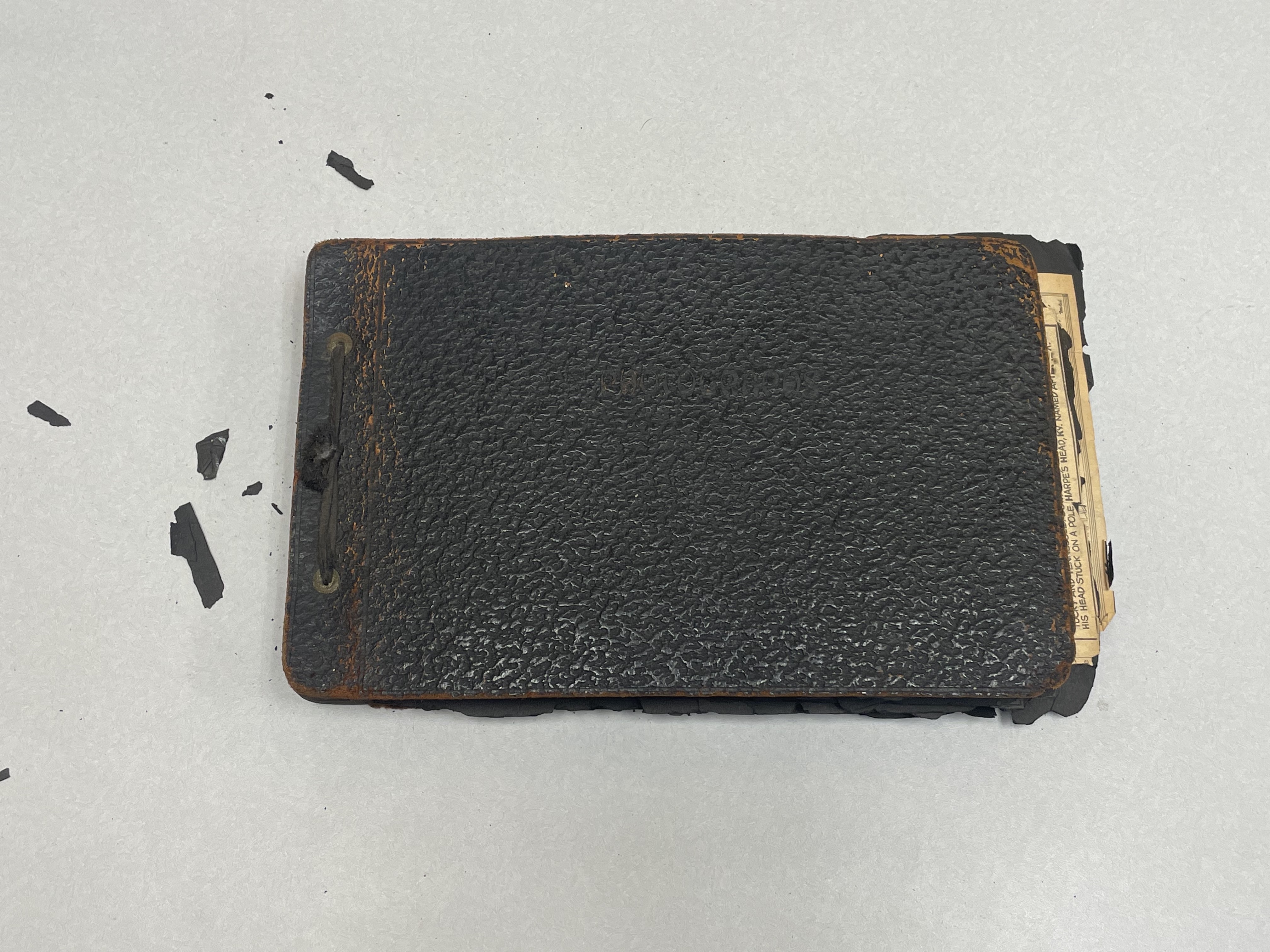
As my family glimpsed my emerging research, they offered me the "oblique offering" that is food for thought. The most haunting example came from my mother in the form of a crumbling scrapbook of newspaper clippings and the question, "What do you think of this?". She had received it from her late mother. Lucille Rice, who had assembled it from a collection of her late son, John Rice. Over the years I began to investigate the scrapbook, its pages deteriorating with each viewing.
Though I have gained some insight into what this book is, I am still determining what I think of it. The scrapbook is a collection of roughly 300 newspaper clippings from a mid-twentieth century serial called Facts About the Negro. These were created by Joel Augustus Rogers, a Jamaican-American journalist and amateur historian. Rogers', who immigrated to New York in 1906, observed that the discourse on race in the United States was not only different than in Jamaica but in desperate need of revision. Rogers' launched a number of projects to achieve this, including his 1917 book From Superman to Man, which refutes the notion of the "ubermensch" in white supremacist ideology. Rogers' Facts About the Negro argued for the persistent, pervasive, and prodigious presence of African-descended peoples in world history.
Riffing on Ripley's Believe It or Not, the short, illustrated articles presented evocative snippets of what Rogers initially titled Your History. The crux of the argument was that there could be no discussion of civilization without discussing the history and contributions of the African diaspora. Its images were initially drawn by George Lee, and later Ahmed Samuel Millai. Rogers' penned the commentary and published the syndicated column in Black newspapers. The archive in my possession does not contain the entirety of Facts About the Negro, but it is a collection that raises a number of questions for students of the African diaspora, specifically, and culture, more broadly.
Recent scholarly commentaries on Rogers' oeuvre by Claire Parfait and Thabiti Asukile have noted its importance in ushering a new consciousness about Africana history, with Rogers' expansive--though non-academic--study of world history being applauded. At the same time, such commentaries also raise issue with the veracity of many of Rogers' claims. Henry Louis Gates, whose own public intellectual projects honors and pays homage to Rogers', cautions contemporary readers from simply accepting Rogers' "facts" as gospel. In Gates' own 100 Amazing Facts About the Negro, he writes, "The best way to honor [Rogers], I think, is to follow his example by taking nothing we are taught for granted; to be ever curious, open, and advice; and to take ourselves to task for being too easily impressed by what is handed to us."
As a scholar of religion, I contend that one crucial way of doing this is by stepping aside from the question of historicity as truth and taking a moment to consider history as using the past to advance a social agenda. So rather than glossing over Rogers' work as myth in the popular sense, we should pay all the more attention to historian of religion Bruce Lincoln's thesis about "myth as ideology in narrative form." How does Joel Augustus Rogers understand Africa, its political boundaries and its descendants? What moments in their past does he find noteworthy? What expressions are remarkable? What does he expect readers to do with all of it? And what does all of this teach us about how myth works? Decoding Diaspora is an accessible data set for studying this and more.
As a collaboration between faculty, graduate students, and undergraduate students in the Department of Religious Studies at the University of Alabama, we invite you to join us in considering what we learn from studying J.A. Rogers' mythic Africa.
Dr. Richard Newton
Project DirectorNAVIGATION
Table of Contents
Researchers and Community Partners