Thanks for your patience during our recent outage at scalar.usc.edu. While Scalar content is loading normally now, saving is still slow, and Scalar's 'additional metadata' features have been disabled, which may interfere with features like timelines and maps that depend on metadata. This also means that saving a page or media item will remove its additional metadata. If this occurs, you can use the 'All versions' link at the bottom of the page to restore the earlier version. We are continuing to troubleshoot, and will provide further updates as needed. Note that this only affects Scalar projects at scalar.usc.edu, and not those hosted elsewhere.
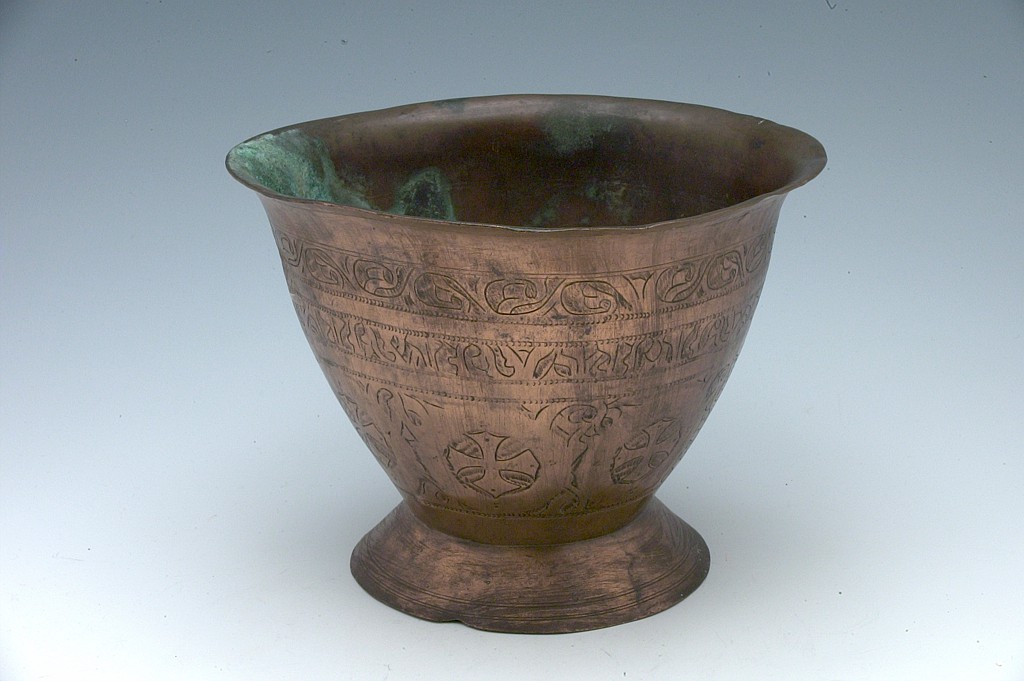
The Chertsey Tiles: So-Called Crusader’s Bowl by Gracyn Benck ’23
12023-01-17T10:17:32-08:00Brooke Hendershottb0a907cd0f989ee79e94592378a1545647719cfb394471For more information about the Chertsey tiles and associated medieval objects, visit https://chertseytiles.holycross.edu.plain2023-01-17T10:17:33-08:00Brooke Hendershottb0a907cd0f989ee79e94592378a1545647719cfb
This vessel seems to have been made in Muslim-ruled Fatimid Egypt for a Christian patron, because of the inclusion of the row of Christian crosses toward the bottom of the vessel. Above the row of crosses is a pseudo-Arabic inscription. These forms look like Arabic letters but do not have any actual meaning. This type of ornament reflected how important Arabic writing was, even for a Christian audience.
This object could have been brought home by a crusader as a souvenir. The Seventh Crusade (1248–1254) went to Egypt. On the other hand, this could have been kept in a Christian (either crusader or local Christian) community in the eastern Mediterranean. In Syria and Egypt, for example, there were large local Christian populations. Objects like this bowl did not need to travel far to be valued.