Thanks for your patience during our recent outage at scalar.usc.edu. While Scalar content is loading normally now, saving is still slow, and Scalar's 'additional metadata' features have been disabled, which may interfere with features like timelines and maps that depend on metadata. This also means that saving a page or media item will remove its additional metadata. If this occurs, you can use the 'All versions' link at the bottom of the page to restore the earlier version. We are continuing to troubleshoot, and will provide further updates as needed. Note that this only affects Scalar projects at scalar.usc.edu, and not those hosted elsewhere.
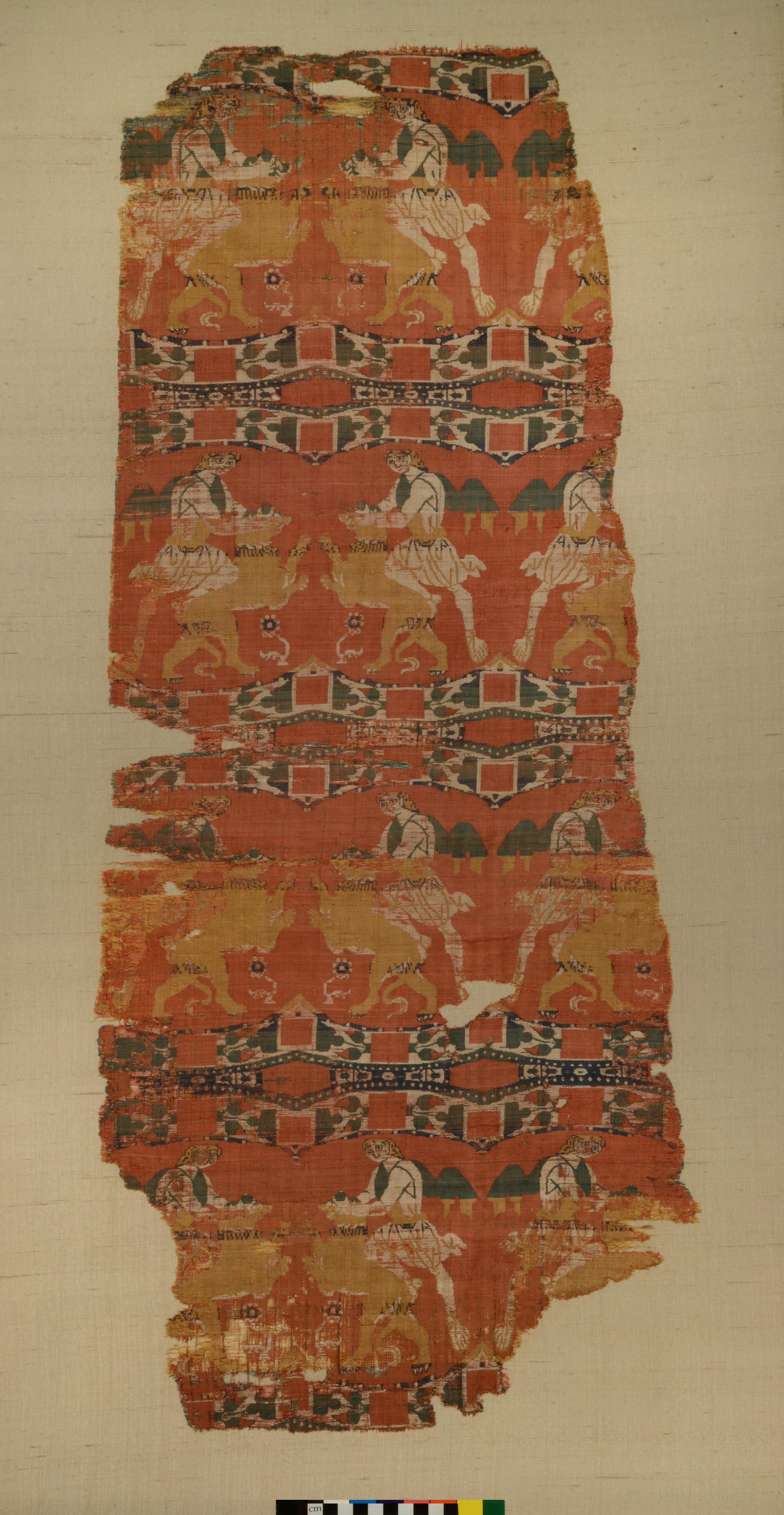
The Chertsey Tiles: Man Subduing Lion/”Hero and Lion” Silk by Chris Smith ’22
12023-01-17T10:19:20-08:00Brooke Hendershottb0a907cd0f989ee79e94592378a1545647719cfb394471For more information about the Chertsey tiles and associated medieval objects, visit https://chertseytiles.holycross.edu.plain2023-01-17T10:19:21-08:00Brooke Hendershottb0a907cd0f989ee79e94592378a1545647719cfb
The well-known strength of lions signifies that this man – who dominates lions – must be even stronger. He is dressed in a classical short toga and sandals. His long hair and action of tearing open the lion's jaws suggest that he represents Samson, a religious hero from the Hebrew Bible (Christian Old Testament). People from Jewish, Christian, and Muslim traditions appreciated Samson, since the text that Christians call the Old Testament is foundational for all three religions. The weft-faced technique (weaving crosswise threads) reached the eastern Mediterranean from China via the silk roads. This textile could have served as a curtain or hanging in a home of a wealthy person or in a church, or as part of a garment worn at ceremonies. The English king Henry III, the probable patron of the Chertsey tiles, owned a textile showing an image of Samson similar to this one.