Scalar
Scalar projects support a wide variety of web-compatible digital files – images, audio, video, text – as well as the linear and non-linear organizational conventions of paths and tags, respectively. As far as the database is concerned, these things are all equivalent and may exist in any designated relationship to any other element in the database. Another way of saying this is that the database does not rely on traditional hierarchical structures such as parent-child relationships or sets and subsets – each element in a project can be defined as having any kind of relationship to any other object. For example, authors may be familiar with the basic practice of annotating a video file with text or using tags to identify and retrieve elements of content. In Scalar, it’s possible to annotate a video with another video or create a tag that is a critical pathway unto itself. The creative potentials enabled by this type of flexibility in information architecture are best recognized in the reverse engineering of the critical processes it enables. That is to say, the affordances of Scalar’s flat database ontologies include the ability to ask different kinds of questions and respond with different kinds of answers. [The real potential of Scalar is realized when it is used to rethink the potential structures of scholarly argumentation.]
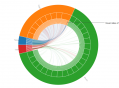
Historically there has been a divide between "close" and "distant" reading within humanities scholarship; with close textual analysis often perceived as a casualty of the movement to computational analysis of large collections of media. Scalar was deliberately architected to support both types of analysis, inviting authors to consider not just one or the other, but parts in relation to wholes. The platform offers built-in visualization tools for mapping the broad contours of a media archive as well as tools for doing analysis that may be as granular as commentaries attached to individual frames of video or pixels in an image.
This page has paths:
- Critical Interfaces Steve Anderson
- Introduction Steve Anderson