Critical making and social engagement
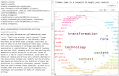
This was the core of the Vectors experiment: to empower humanists to engage a deeper level of digital authoring and to thereby invite them to ask different kinds of questions of their discipline and objects of study. Accompanying the journal’s stated commitment to “publish only works that need, for whatever reason, to exist in multimedia,” the journal’s interactive editorial statement expands upon this sentiment of experimentation:
The socially engaged ethos of critical making also infused Vectors at the level of project selection. Proposals were considered by a combination of the Vectors editorial staff (McPherson and I) and the design team (Loyer, Kelley, Dietrich). The sophistication of an author’s critical project was weighed alongside design potentials. In addition, the selection process was, from the beginning, disposed to favor work that engaged social issues especially related to feminism, critical race theory or ethnic studies. In part, this represented an effort to remediate the discourse of disembodiment and dematerialization of early net culture. It was also an extension of McPherson’s own work as a co-founder and co-organizer of the Race in Digital Space conference that took place at MIT and USC in 1999 and 2000, which was explicitly devoted to foregrounding issues of race and ethnicity as constitutive of digital culture. Vectors – and later Scalar – may therefore be understood as coextensive with movements in the realm of both critical race and feminist theory to propose digital culture as a space of possibility rather than one of exclusion toward historically underrepresented groups.With one foot in the academic publishing world and the other in the creative matrix of design, graphics and code, Vectors invites scholars to move beyond text and to push the boundaries of academic scholarship by including images and sounds as they imagined their "essays" taking shape; similarly, designers work to imagine alternative strategies for embodying ideas.
To what extent may the ethos of engagement associated with critical making translate into socially engaged scholarship? Vectors’ commitment to developing and publishing work that is both formally innovative and socially engaged constitutes a reflection of its editorial and design staff’s ideological commitments more than an inherent aspect of the software itself. As critics of open source software have shown, the mere fact that a tool is developed via open protocols does not guarantee its deployment on behalf of a liberatory political agenda. As tempting as the symmetry of action on the world or intervention in material circumstances might be, I cannot argue for an inherent politics associated with making. Instead, I believe that the politics of making are nothing more nor less than what each individual author, designer or project brings to bear on a given topic.