Scalar's 'additional metadata' features have been disabled on this install. Learn more.
BodiesMain MenuForewordA brief introductionIndexA stylistic catalog of contentWhat is Body?What is Body? (1/5)What is Self?What is Self? (1/3)What is Gender?What is Gender? (1/1)Who am I?Who am I? (1/1)Amanda Liaw8f1ce7dd0123985bc062c4070739891182ee722e
Zombie horde
12019-03-15T20:07:39-07:00Amanda Liaw8f1ce7dd0123985bc062c4070739891182ee722e328381GIF from World War Zplain2019-03-15T20:07:39-07:00Amanda Liaw8f1ce7dd0123985bc062c4070739891182ee722e
This page is referenced by:
12019-03-13T22:01:55-07:00Intruder Alert!10What is Body? (2/5)plain2019-03-19T06:02:07-07:00
The Body as a Landscape of Fear
In attempting to define the limits of one's own body, it necessarily follows that the body of the other must also be defined. The self is essentially "produced through those boundaries which distinguish inside from outside." [8] Conceptions of self and body are firmly intertwined in ways that reinforce the need for one to be self-conscious in owning one's body.
This is most obvious in the biological horror subgenre that contorts the body beyond our regular acceptance of it. Where the horror of mummification speaks to a fear of unrecognizable bodily decay, for example, zombification on the other hand expresses the metaphor of the virus. Vampires, too, infect, but the rational mind remains intact and physical features are often even enhanced. Zombies, however, are lost in hordes, bodies without owners nor consciousness.
The mindlessness of the horde is a highly specific fear. Zombies, whether fast or slow, move on animalistic instinct alone and, worse, lack any sense of self-preservation. Reflecting the parasitic urge to replicate itself regardless of the condition of its host body, the central horror often leveraged on in the zombie movie is to be subsumed into the collective, whether this is through getting bitten and subsequently transformed into a zombie in some state of mutilation, or through being overwhelmed by the horde that disregards individual zombie bodies in reaching the collective end goal.
Yet another distinctive fear produced by the zombie is that of excess, which lends itself well to other critiques of, say, economic systems that are already challenged by the apocalyptic setting. The zombie as a standalone provokes a fear that stems from its consumption - zombies want brains, and they always want more. Getting shot in the leg or arm, when its own body already ceases to exist to itself, will not deter a zombie from its goal. It takes violence to kill a zombie. An excessive visual consumption of gore that remains deeply satisfying once the idea of foreign entity is rid.
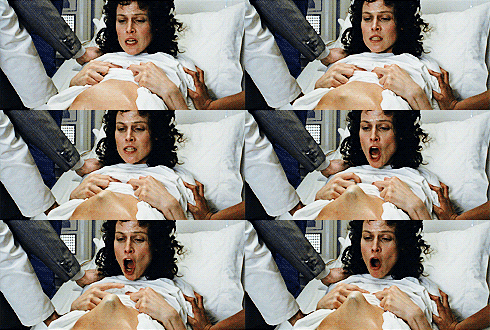
Science fiction horror films like Invasion of the Body Snatchers (1956) and its legacy similarly capitalize on the fear of a body without self. Others like Aliens (1986) and its various spinoffs express the fear of a body being out of control, though the implication of such movies depicting the mutilation of women's bodies through "childbirth" should not be ignored.
We are that which is foreign. "A body is not something inherently human." [9] Why does this gap exist? And how do we bridge it?