Thanks for your patience during our recent outage at scalar.usc.edu. While Scalar content is loading normally now, saving is still slow, and Scalar's 'additional metadata' features have been disabled, which may interfere with features like timelines and maps that depend on metadata. This also means that saving a page or media item will remove its additional metadata. If this occurs, you can use the 'All versions' link at the bottom of the page to restore the earlier version. We are continuing to troubleshoot, and will provide further updates as needed. Note that this only affects Scalar projects at scalar.usc.edu, and not those hosted elsewhere.
12017-10-15T13:39:56-07:00Irene Smitheaf68dcb4cb5259d8f2207e75ee56865474c72992442011plain2017-10-16T19:38:00-07:00Irene Smitheaf68dcb4cb5259d8f2207e75ee56865474c7299At the time of the Spanish conquest of Peru in 1530 (check date), both the Inca and the Europeans produced fine tapestries for their elite (citation). When the Spanish took over Peru, indigenous tapestry weavers continued producing tapestries under Spanish patronage (citation). These weavers adopted new European weaving techniques that had drastic practical and cultural implications for the weavers: transitioning from interlocking every weft color to making dovetail joints between regions of different colors allowed multiple weavers to work on the same piece simultaneously, and cutting the warp threads at one end instead of chaining off warp loops at both ends gave weavers room for errors in their calculations for how long to make the warp and made the last inches of weaving much easier. Additionally, the introduction of new weaving materials, such as silk and sheep's wool, expanded the options available to indigenous tapestry weavers, but their willingness or unwillingness to incorporate these new materials reflects a consistent concern for quality, rather than wholesale adoption of all things European.
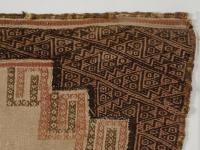
This exhibit focuses on tapestry, but there are many other types of textiles that could be discussed. The indigenous backstrap weaving tradition and Colonial obrajes, textile factories which employed indigenous women in dismal working conditions, would each warrant an exhibit of their own. While there are connections and similarities across different types of textiles—as evidenced by the object below, which incorporates embroidery in addition to three distinct types of weaving—there are also differences, and the arguments put forward here apply specifically to tapestry and should not be extended to other types of textiles.
12017-10-15T13:42:00-07:00Irene Smitheaf68dcb4cb5259d8f2207e75ee56865474c7299Bibliography3List my sources in Chicago styleplain2017-10-16T19:26:02-07:00Irene Smitheaf68dcb4cb5259d8f2207e75ee56865474c7299