Scalar's 'additional metadata' features have been disabled on this install. Learn more.
Digital Exhibits: Ancient Art 203
Main Menu
Ancient Art
Table of Contents
Sample Exhibit - Herakles in Greek Art
Depictions of Herakles in Greek Art
Angyal- The Culture of Pre-Columbian Times
This exhibit displays the important symbols culture during ancient Pre-Columbia.
Aversa- Ancient Faces
The collection includes portraits of many Ancient faces made of marble, limestone, bronze and black basalt.
Brookes - Sculptures Of The Gods
A look at Sculptures of Gods during the classical and hellenistic period of Greek history. This will tell you the stories of the Gods being shown and the growth of realism during this period.
CERMINARA-Ancient Greek Figurines
Exploration of different Terracotta figurines from ancient Greece
Cooke -- Black Figure Art from Ancient Greece
This page will highlight some works that were made using black figure, which is named for the color of the figures depicted in the art.
Costa- Death and Afterlife
Foley - Statues and figures of Greek Mythology
My theme is Greek Mythology in the forms of statues and figures
Fowler
How the human body is depicted through Ancient Art
Harris - Greek Athletes
The Olympian games began in Greek times. These pieces will depict Greek Athletes doing the games
Joseph - Hellenistic Art
The Hellanistic art style focuses on realistic, natural human forms. Straying away from the rigid unnatural forms of ancient sculpture styles before it.
Lamon- Mythical Creatures in Greek and Cycladic Art
This exhibit will take a look at how Mediterranean civilizations depicted a few mythical beasts throughout different periods.
Leszczynski - Late Minoan, Creature, Covered, Gems
A collection of Lentoid gems engraved by Minoan craftsman. Some served a useful purpose as seals. This collection spans the Late Minoan I-II period to the Late Minoan II-IIIA period.
McDonough - Medusa in Ancient Greek Art
A look at one of Greek mythology's most feared creatures
Meehan - Ancient Spartan Art
Popular Art and Customs of Sparta and Laconia
Nelson - Ancient Egyptian Statues
This digital exhibit displays a collection of statues from Ancient Egypt
Ramos- Marble Figurines
Females figurines are an important part of ancient Greeks art history .
Raquet- The Acropolis Reunited
Putting the Parthenon back together
SHORT - Representations of the Minotaur and His Story
SmithKali - Depictions of the Human Body
Starrs--Art of the Trojan War
A sampling of pottery inspired by the mythical Trojan War.
Wible - Aphrodite
My theme is the representation of Aphrodite through different types of art.
Danielle Bennett
672675c081461104799d4151a54a1faf0c800419
Limestone sarcophagus
1 2017-10-13T20:46:47-07:00 VANNA COSTA fc4bf60a12a20b5a7b3abc3377c1ff54932a2411 21307 1 plain 2017-10-13T20:46:47-07:00 VANNA COSTA fc4bf60a12a20b5a7b3abc3377c1ff54932a2411This page is referenced by:
-
1
2017-10-13T18:36:15-07:00
COSTA- Death and After life
16
plain
2017-10-13T22:57:56-07:00
Introduction
The Ancient Greeks believed that after death there was afterlife, this was well established by 6th century B.C. Homer, a famous philosopher of that time wrote a book called the Odyssey, where he described the afterlife being the Underworld. In the Underworld, it was dark, gloomy, miserable and a life of shadows and slavery under the ruling of God Hades, brother of Zeus, and his wife Persephone. The Ancient Greeks had ceremonies and burials for those who died and crossed over to the afterlife. They believed that the moment of death the psyche, spirit of the dead, would leave the body as a puff of wind. Then their bodies would be prepared for burial and rituals. Their tombs and sarcophagus's would then be decorated with various paintings or carvings of their memory.Preparation of the Bodies
The ones who prepared the bodies were typically the relatives of the deceased, and mainly women. There are 3 parts that are typically customarily to these burials. The prosthesis, laying out the body, the ekphora, funeral procession, and the cremation of the remains. They washed and oiled first then dressed it and paced it on a high bed within the house. during prosthesis, relatives and friends come to mourn the body and pay their respects.
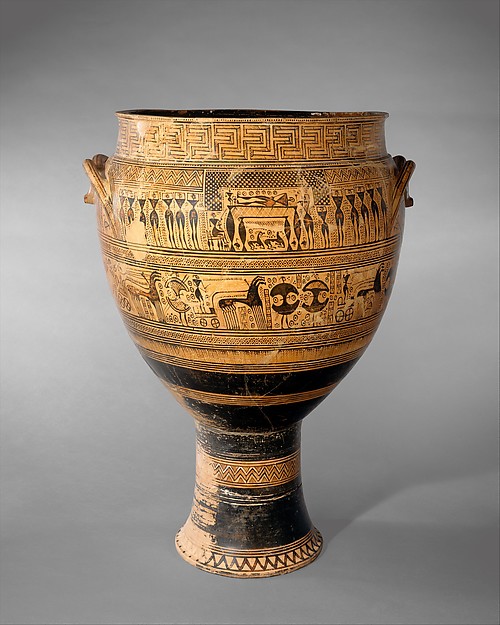
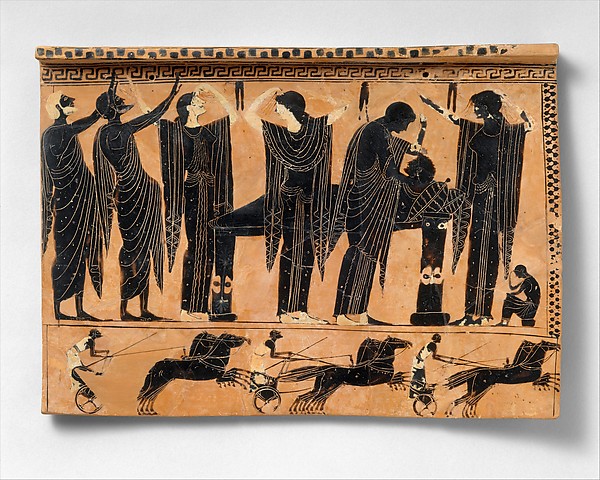
Lamentation of the dead is featured in early Greek art as early as the geometric period.The vases were decorated with scenes portraying the deceased surrounded by mourners.Sarcophagus
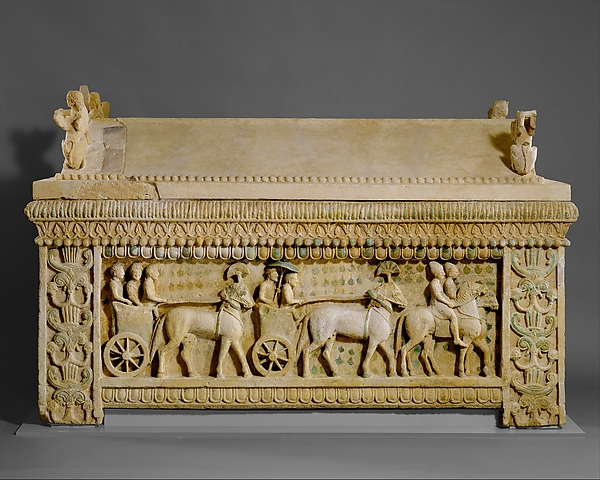
At the end of the 5th century BC, Athenian families buried their dead ones in a simple stone sarcophagi. They placed them in the ground within their grave precincts that were arranged in terraces. The first sarcophagus, limestone sarcophagus: the Amathus sarcophagus, is from the Archaic period, 2nd quarter of the 5th century BC. It is made of hard limestone. This is one of the most important objects and is unique among ancient Cypriot sculptures. It shows a procession of chariots escorted by attendants on horseback and being followed by foot soldiers. Th sarcophagus is said to have belonged to one of the kings of Amathus. The procession scene on it is meant to provide a glimpse into his world.
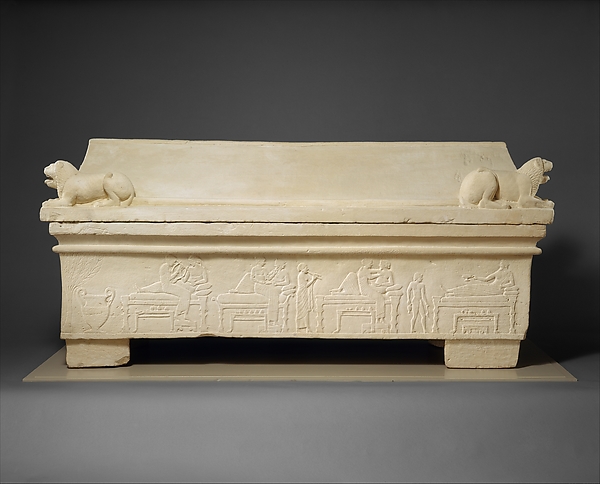
The second sarcophagus, Limestone Sarcophagus, is from the classical period, 475-460 BC and is made of Limestone. On the long sides of the sarcophagus is an image of hunting and on the other side is an image of a banquet. On the short sides, there are images of a chariot scene and on the other side Perseus departing with the head of Medusa. The scenes on this sarcophagus have similarities in Greek art but show variations in style and in detail. The archer presented in all four scenes may be the deceased. It is unknown.Plaques
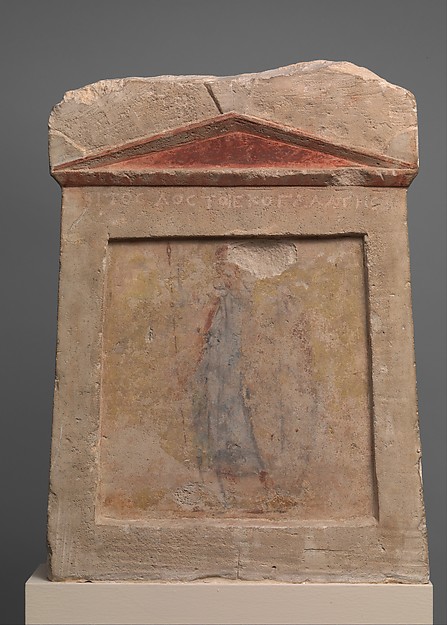
There is a group of 6 painted limestone funerary monuments from Alexandria that are well preserved survivals of Greek painting from 4th and 3rd century BC. these monuments were discovered in a large hypogeum tomb in the necropolis of Alexandria. this is where they must have buried and commemorated the mercenaries in the service of the Ptolemaic Kingdom. the focus on the painting on each monument is the deceased, who is identified by inscription. The deceased is either presented in a private domestic setting with family members, or in public presented against a generic background with the attributes of his civic role emphasized.
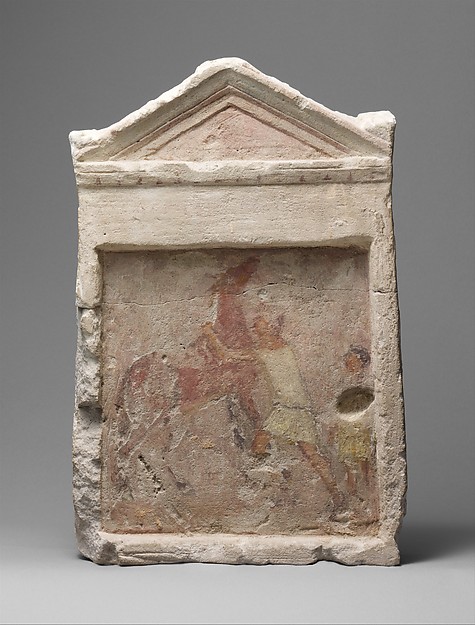
The painted limestone funerary slab with a man controlling a rearing horse, is from the Hellenistic period, 2nd half of the 3rd century BC. It is from the Greek culture, made of limestone and paint. It is a lively depiction of a man trying to bridle a horse, while a young boy stands behind him, possibly a son.
The painted limestone funerary slab with a soldier standing at ease, is from the Hellenistic period. Also 2nd half of the 3rd century BC. Greek and made of limestone and paint. It is a soldier wearing a long blue cloak standing alone with a spear in his right hand and a tall ovoid shield in his left. He was a mercenary soldier. This stone depicts a mercenary against a plain background showing his civic role.
The Terracotta Funerary plaque is from the archaic period, 520-510 BC. It is from Greece, Attic. It is made of Terracotta and black-figure. in the latter 6th century BC the elaborate series of funerary plaques set into walls of rectangular tombs were replaced by single plaques with holes for attachment.This plaque presents a chariot race, it may represent the funeral games held in honor of the legendary heroes who were deceased.
Works cited
Abbe, Mark B. “Painted Funerary Monuments from Hellenistic Alexandria.” In Heilbrunn Timeline of Art History. New York: The Metropolitan Museum of Art, 2000–. http://www.metmuseum.org/toah/hd/pfmh/hd_pfmh.htm (April 2007)
Department of Greek and Roman Art. “Death, Burial, and the Afterlife in Ancient Greece.” In Heilbrunn Timeline of Art History. New York: The Metropolitan Museum of Art, 2000–. http://www.metmuseum.org/toah/hd/dbag/hd_dbag.htm (October 2003)