Scalar's 'additional metadata' features have been disabled on this install. Learn more.
ADHD: Alternative Treatments
Main Menu
ADHD: The Fact and the Fiction
This project is intended to make connections between media portrayals of ADHD and their impacts on alternative treatments such as neurofeedback, behavioral therapy, parent training, and diet-alteration therapy.
ADHD Medications
Today, the use of ADHD medications such as Ritalin and Adderall is still the most popular treatment method for ADHD. Let's explore the adverse side effects of the medications, which are a reason alternative treatments have been gaining more attention recently.
Common Misconceptions
How YOU Can Avoid Parent Shaming
This page is designed to promote an active learning style for parents to avoid feeling shamed by media surrounding ADHD. The media often uses fear and anxiety to shame parents into trying treatments they are not comfortable with or spreading false information. I will teach you how to spot these things and avoid them!
Neurofeedback
Behavior Therapy
Behavior therapy is the most common alternative treatment for ADHD. It is currently recommended as a supplement to drugs but some parents believe that this treatment alone may be just as effective as a supplementation.
Parent Training
Diet Restriction
Diet restrictions are gaining popularity as an alternative treatment for ADHD. The Feingold Diet has stood out as a diet that improves behavioral issues with manipulation of diet.
About Me
Katy McCarthy
52d4dc2d6cf99de1642c9855dd2bae6c30ec3e42
Scalar1
1 2017-04-24T13:38:56-07:00 Katy McCarthy 52d4dc2d6cf99de1642c9855dd2bae6c30ec3e42 16394 1 plain 2017-04-24T13:38:56-07:00 Katy McCarthy 52d4dc2d6cf99de1642c9855dd2bae6c30ec3e42This page is referenced by:
-
1
media/background2.jpg
media/Screen Shot 2017-04-20 at 11.50.35 AM.png
2017-04-06T08:42:48-07:00
ADHD: The Fact and the Fiction
36
This project is intended to make connections between media portrayals of ADHD and their impacts on alternative treatments such as neurofeedback, behavioral therapy, parent training, and diet-alteration therapy.
image_header
2017-04-24T13:53:10-07:00
Welcome! My name is Katy McCarthy and I am a student studying Physiology at Michigan State University. This is my senior capstone project.
Throughout my last semester of college I have been researching different media representations of ADHD and their effects on parents and children. I am particularly interested in media representations of alternative treatments for ADHD such as neurofeedback, behavior therapy, parent training, and diet restrictions. I use both scholarly and media sources, which I have extensively categorized and studied, to help you (parents) think about how they are represented in the media and if you think they may be a useful treatment for your child who struggles with ADHD or ADHD-like symptoms.
1) Teach YOU about the misconceptions surrounding alternative therapy as well as the common misconceptions associated with defining ADHD.
2) Teach YOU how to spot credible media sources.
3) Provide an understanding of four alternative therapies (neurofeedback, behavior therapy, parent training, and diet restriction).
4) Help YOU decide if your child may benefit from an alternative treatment for ADD/ADHD.Throughout this website I will be referencing a dataset I created, which consisted of academic sources from scholarly journals and media sources, which were comprised of news broadcast, newspaper, and social media encounters with alternative treatments. I assessed 11 of these types of media by determining if various themes showed up in the article. There were 9 themes I looked for in my dataset; focus on children, the mention of parents as a source of ADHD, recommendation of medication to supplement alternative treatments, mention of mood or threats if ADHD is not treated, mention of adulthood ADHD, the usage of a chart to determine the effectiveness of the alternative treatment, a mention of the differences between how ADHD presents in boys and girls, the acknowledgement of diet as a treatment, and a mention of the controversy surrounding ADHD, its treatments, and its causes. My findings will be mentioned throughout the website.
Before we begin, here's a quick note on Scalar (the software used to create this website):
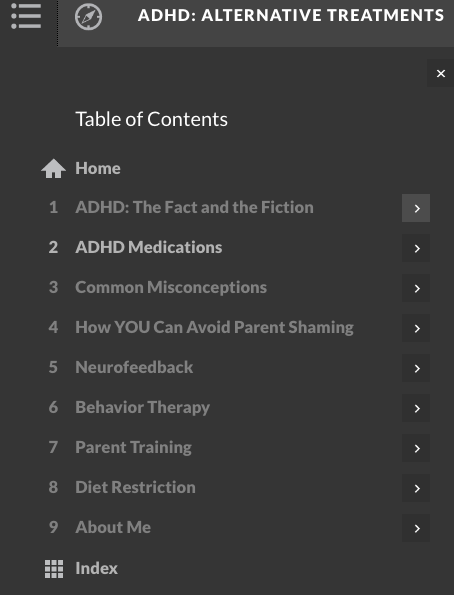
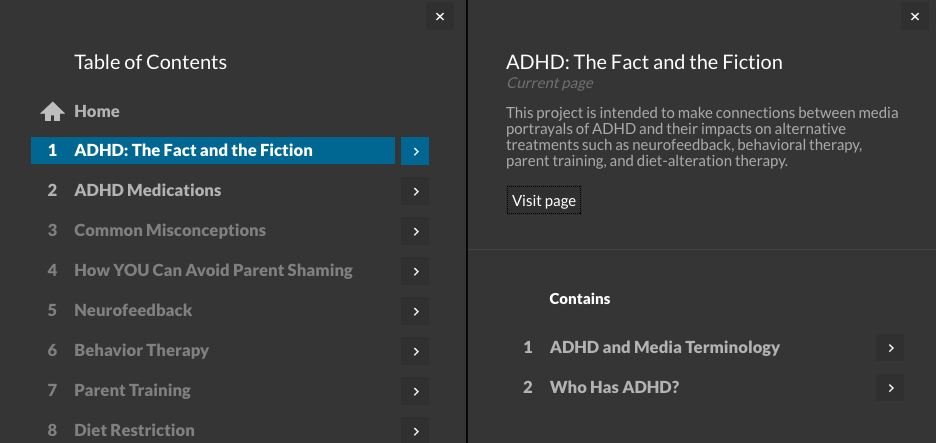
The table of contents is located at the top left corner of each page, symbolized by three horizontal lines, and may be used to navigate to any page on this website.Within each section, there are subsections that may be accessed from the table of contents by using the arrow to the right of the topic.
The website is presented in the same order as shown in the table of contents. At the end of each page there will be a blue button that gives you the option to go on to the next topic if you prefer to not use the table of contents.
Enjoy!