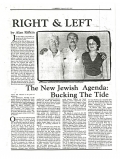
New Jewish Agenda
The Los Angeles branch of the New Jewish Agenda was formed 1981 with the intention of serving as a progressive, secular voice within the Jewish community. By the mid-1980s, the organization had turned its attention towards the Beverly-Fairfax neighborhood. Led by a small cohort of volunteer and professional activists such as Richard Silverstein and Ruth Egger, the New Jewish Agenda believed that large-scale commercial development and the MetroRail would, by way of raising property values, and displacing lower-income residents, ruin the “ethnic-small-scale character of our community,” and turn the Beverly-Fairfax into a premiere shopping and residential destination for “young urban professionals.”
In an effort to mobilize residents against massive, potentially disruptive projects, the New Jewish Agenda created an economic justice task force. The task force, as activist-organizer Richard Silverstein noted, was “designed to inform the residents of the dangers that development and the means they have to control the fate of the neighborhood.” As such, the New Jewish Agenda organizers encouraged residents, mostly seniors, to write to and testify in front of Councilmembers and city planners, which would ideally pressure public officials to regulate development in a manner that was consonant with the interests of residents. "Our loyalty to the neighborhood can even be compared with the feeling Jews once had for the Shtetl… The developers tell us they want to give us ‘Tivoli Gardens’ in Los Angeles, with ice-skating all year around. I ask them what good is ice-skating to me and my fellow seniors, when what we really need is low-income housing and discount shopping,” explained local senior Sheila Weissman.
The New Jewish Agenda initially received much positive publicity for its efforts to fight the wave of gentrification consuming the Beverly-Fairfax neighborhood. And yet, because many of its volunteers were evicted from the neighborhood, the New Jewish Agenda’s grassroots mobilization model and neighborhood preservation initiatives were unable to sustain themselves through the late 1980s.

In an effort to mobilize residents against massive, potentially disruptive projects, the New Jewish Agenda created an economic justice task force. The task force, as activist-organizer Richard Silverstein noted, was “designed to inform the residents of the dangers that development and the means they have to control the fate of the neighborhood.” As such, the New Jewish Agenda organizers encouraged residents, mostly seniors, to write to and testify in front of Councilmembers and city planners, which would ideally pressure public officials to regulate development in a manner that was consonant with the interests of residents. "Our loyalty to the neighborhood can even be compared with the feeling Jews once had for the Shtetl… The developers tell us they want to give us ‘Tivoli Gardens’ in Los Angeles, with ice-skating all year around. I ask them what good is ice-skating to me and my fellow seniors, when what we really need is low-income housing and discount shopping,” explained local senior Sheila Weissman.

The New Jewish Agenda initially received much positive publicity for its efforts to fight the wave of gentrification consuming the Beverly-Fairfax neighborhood. And yet, because many of its volunteers were evicted from the neighborhood, the New Jewish Agenda’s grassroots mobilization model and neighborhood preservation initiatives were unable to sustain themselves through the late 1980s.
This page has paths:
- Revitalization and Gentrification Max Baumgarten