Needlework Picture Display & Performance
Haymarket Theatre, Boston, September 28, 1798
Display & Performance
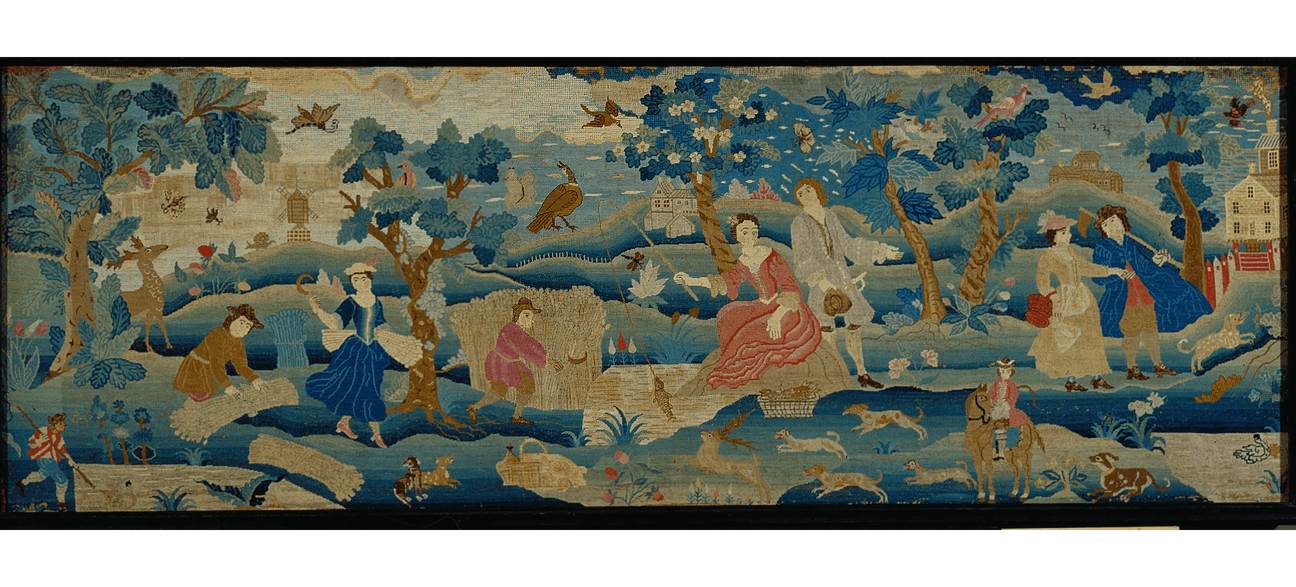
Needlework Picture is a large embroidery (about 21 inches tall and 58 inches wide) that was passed down through the Lowell family and was on display at Elmwood in the 19th century (Historic New England). Because of its size and function at James Russell Lowell's home, the embroidery likely served as a "conversation piece"; polite people often displayed conversation pieces in their homes to facilitate socializing, with the understanding being that guests could react to the pictures and discuss them (Bushman 1993, p. 87). Conversation pieces were generally paintings of domestic scenes, exhibiting the taste of its owner (Bushman 1993, p. 87). The display of conversation pieces upheld upper-class gentility and expedited social practices. Consequently, the performance of Needlework Picture as a displayed work of art inevitably assisted the Lowell family's endeavor of upholding their social status. Indeed, the Lowell family rose to prominence in Boston by the 19th century and continued to establish itself as an accomplished family after Francis Cabot Lowell brought the first power loom to the United States (Amory 1947, p. 43).
Ultimately, the embroidery's depiction of the landscape and its motifs of domestic courtship were put in social performance by being on display for the Lowell family. Though the original artist is unknown, the use of an embroidered approach to create romantic depictions of the landscape and 18th century courtship practices pushed its viewers to recognize the Lowell family's higher status in Bostonian society.
This page has paths:
- Needlework Picture, 1747-1750 Fahim Rahman