Island Inspirations
The island depicted in Robinson Crusoe is fictionally located in the Caribbean. Prior to describing the shipwreck, Crusoe relays:
I was positively against that; and looking over the charts of the seacoast of America with him, we concluded there was no inhabited country for us to have recourse to till we came within the circle of the Caribbee Islands, and therefore resolved to stand away for Barbadoes; which, by keeping off at sea, to avoid the in draft of the bay or gulf of Mexico, we might easily perform, as we hoped, in about fifteen days' sail; whereas we could not possibly make our voyage to the coast of Africa without some assistance both to our ship and ourselves.
During his early encounters with Friday, Crusoe attempts to get more information about the island and his whereabouts:With this design we changed our course, and steeredaway N. W. by W., in order to reach some of our English islands, where I hoped for relief; but our voyage was otherwise determined; for, being in the latitude of twelve degrees eighteen minutes, a second storm came upon us, which carried us away with the same impetuosity westward, and drove us so out of the way of all human commerce that, had all our lives been saved as to the sea, we were rather in danger of being devoured by savages than ever returning to our own country.
With this design we changed our course, and steered away N.W. by W., in order to reach some of our English islands, where I hoped for relief. But our voyage was otherwise determined; for, being in the latitude of twelve degrees eighteen minutes, a second storm came upon us, which carried us away with the same impetuosity westward, and drove us so out of the way of all human commerce, that, had all our lives been saved as to the sea, we were rather in danger of being devoured by savages than ever returning to our own country.
In this distress, the wind still blowing very hard, one of our men early one morning cried out, "Land!" and we had no sooner run out of the cabin to look out, in hopes of seeing whereabouts in the world we were than the ship struck upon the sand, and in a moment, her motion being so stopped, the sea broke over her in such a manner that we expected we should all have perished immediately; and we were even driven into our close quarters, to shelter us from the very foam and spray of the sea.
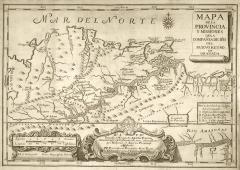
The reader does not get much more information about the exact whereabouts of the islands. Eighteenth-century maps that depict the Orinoco River and the region in which the island in Robinson Crusoe is located include Jesuit priest Jose Gumilla's map of the Orinoco River originally published in "El Orinoco Ilustrado" in 1741, called "Mapa De La Provincia Y Missiones De La Compañia De IHS Del Nuevo Reyno De Granada," translated to "Map of the Provinces and Missions of the Society of Jesus in the Kingdom of New Granada."I have told this passage, because it introduces what follows; that after this discourse I had with him, I asked him how far it was from our island to the shore, and whether the canoes were not often lost. He told me there was no danger, no canoes ever lost; but that after a little way out to sea, there was a current and wind, always one way in the morning, the other in the afternoon. This I understood to be no more than the sets of the tide, as going out or coming in; butI afterwards understood it was occasioned by the great draft and reflux of the mighty river Orinoco, in the mouth of which river, as I thought afterwards, our island lay; and that this land which I perceived to the W. and N.W. was the great island Trinidad, on the north point of the mouth of the river. I asked Friday a thousand questions about the country, the inhabitants, the sea, the coast, and what nations were near he told me all he knew, with the greatest openness imaginable. I asked him the names of the several nations of his sort of people, but could get no othername than Caribs; from whence I easily understoodthat these were the Caribbees, which our maps placeon the part of America which reaches from the mouthof the river Orinoco to Guiana, and onwards to St. Martlia. He told me, that up a great way beyond the moon (that was, beyond the setting of the moon, which must be west from their country), there dwelt white-bearded men like me, and pointed to my great whiskers, which I mentioned before; and that they had killed much mans, that was his word; by all which I understood he meant the Spaniards, whose cruelties in America had been spread over the whole country and were remembered by all the nations, from father to son.
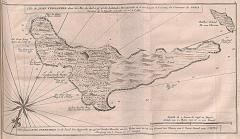
Some sources suggest that Daniel Defoe's inspiration for Robinson Crusoe was based on the story of real-life Scottish castaway Alexander Selkirk, who was stranded for four years on the island of Más a Tierra, since renamed Robinson Crusoe Island in 1966. The island is one of three volcanic islands that comprise the Juan Fernández Islands off the coast of Chile. The other two islands are called Alejandro Selkirk Island (formerly "Más Afuera") and Santa Clara Island.
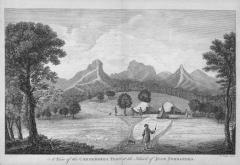
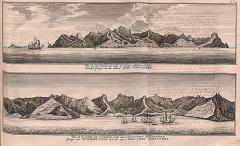
British Commodore George Anson circumnavigated the globe from 1740-1744, and his travels brought him to the Juan Fernández Islands. Some of the engravings in his A voyage round the world, in the years MDCCXL, I, II, III, IV depict what is now known as Robinson Crusoe Island, including engravings of Anson's tent pitched on the island.
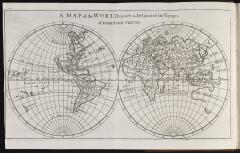
Also in 1719, Daniel Defoe published a sequel to Robinson Crusoe titled The life and strange surprizing adventures of Robinson Crusoe, of York, mariner : who lived eight and twenty years, all alone in an un-inhabited island on the coast of America, near the mouth of the great river of Oroonoque : having been cast on shore by shipwreck, wherein all the men perished but himself : with an account how he was at last as strangely deliver’d by pyrates / written by himself. The text's frontispiece includes a map of the world onto which Crusoe's voyages are overlaid.
This page references:
- "A Map of the World, on which is Delineated the Voyages of Robinson Crusoe" (1719)
- Map of the Juan Fernández Islands
- The Juan Fernández Islands
- "A View of the Commodore's Tent at the Island of Juan Fernandes."
- Plate 10: Isla Robinson Crusoe from George Anson's "Voyage autour du Monde"
- Citation in Washington Square Classics edition of Robinson Crusoe
- "Map of the provinces and missions of the Society of Jesus in the kingdom of New Granada" (1741).
- Citation in Washington Square Classics edition of Robinson Crusoe