Thanks for your patience during our recent outage at scalar.usc.edu. While Scalar content is loading normally now, saving is still slow, and Scalar's 'additional metadata' features have been disabled, which may interfere with features like timelines and maps that depend on metadata. This also means that saving a page or media item will remove its additional metadata. If this occurs, you can use the 'All versions' link at the bottom of the page to restore the earlier version. We are continuing to troubleshoot, and will provide further updates as needed. Note that this only affects Scalar projects at scalar.usc.edu, and not those hosted elsewhere.
USC Illuminated Medieval ManuscriptsMain MenuAbout the ProjectProject DevelopersBrowse ManuscriptsBrowse Manuscript FeaturesWorks in ProgressPolymathic Teaching With Rare MaterialsGlossary of TermsBibliographyBibliography of Scalar Book
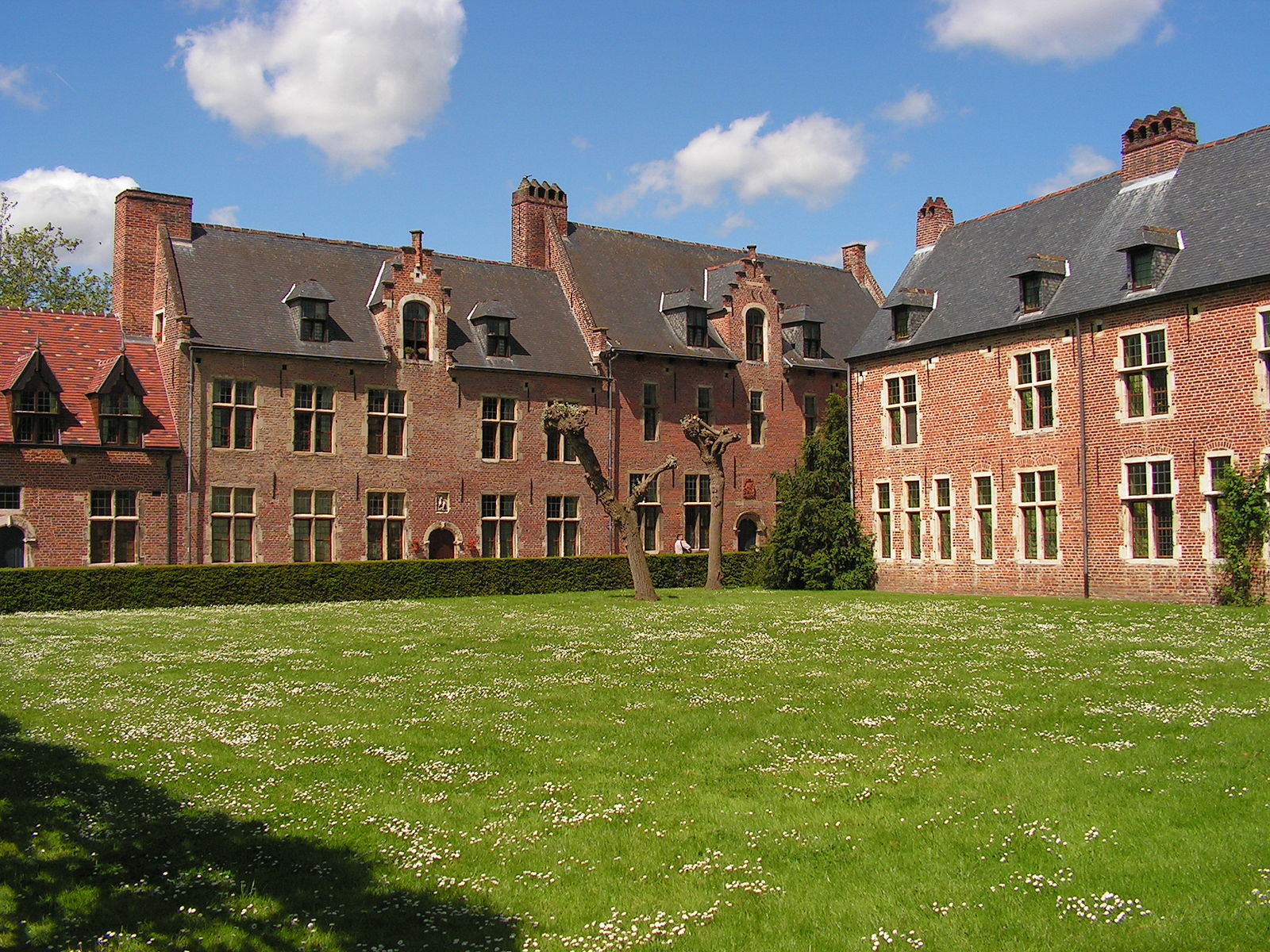
The Groot Begijnhof of Leuven was most likely established around 1232 as a community of religious women who settled outside the then city walls, on the riverbanks of the Dijle. The original little craftwork houses with clay fillings and straw roofs were gradually replaced by brick houses that can still be seen today and most of which date from the 17th century. The community had about 360 beguines in its heyday in the 17th century. With its construction beginning in 1305, the early Gothic Sint-Jan-de-Doperkerk is the oldest building in the Beguinage.
The beguinage today: Today’s Groot Begijnhof of Leuven is a well preserved beguinage and completely restored historical quarter containing a dozen streets in the south of downtown Leuven. It consists of a series of alleys, courtyards, gardens and parks with dozens of houses and convents built from traditional sandstone. It is currently inhabited by students, foreign visiting professors and staff of the oldest Catholic university in Europe. About 3 hectares (7.5 acres) in size, with some 300 apartments in almost 100 houses, it is one of the largest remaining beguinages in the Low Countries. It stretches on both sides of the river Dijle, which splits into two canals inside the beguinage, thus forming an island. Three bridges connect the parts of the beguinage.
In 1962, the University of Leuven bought the entire residential estate, with the exception of the church and a couple of houses that were only later transferred to the university. The first restoration phase took place between 1963 and 1972 under the leadership of the late professor Raymond Lemaire. In the second phase in 1990, the restoration of the houses on the Kerkstraat was completed by professor Paul Van Aerschot. The complete beguinage is now owned by the University of Leuven and used as a campus, especially for housing academics.
In 1998, UNESCO added the Grand Beguinage to the World Heritage list, together with 12 other Flemish beguinages.
1media/BoHNBackgroundf11r.jpg2020-03-14T15:36:14-07:00Physical Description Book of Hours Use of Netherlands9plain2020-10-09T11:37:06-07:00A beautifully illuminated, complete manuscript, with calendar, wide margins, more than a hundred 2-line illuminated initials, and 6 illuminated full-page miniatures, encircled by richly decorated and colored borders consisting of flowers and leaves. Inside the book cover’s back board, contemporary manuscript annotations state that the book belonged to Grietken Baeckx, who lived in “Groot Begijnhof” in Ghent. The calendar also points to Ghent, since Saints Amant (February), Amelberga (July), and Bavo (October) are emphasized in red.
The Latin is influenced by Dutch vernacular, and the large script also points to the Netherlands. The miniatures are made for the main devotions and have blank versos. They are professionally painted with life-like, long-stretched figures, engaged in different ceremonies, and often showing part of a landscape in the background (sometimes through a window, demonstrating early signs of perspective.
This page references:
1media/1600px-Leuven-Groot-Begijnhof_thumb.jpg2020-10-09T09:51:12-07:00Groot Begijnhof1Image from Wikimediamedia/1600px-Leuven-Groot-Begijnhof.jpgplain2020-10-09T09:51:12-07:00