Thanks for your patience during our recent outage at scalar.usc.edu. While Scalar content is loading normally now, saving is still slow, and Scalar's 'additional metadata' features have been disabled, which may interfere with features like timelines and maps that depend on metadata. This also means that saving a page or media item will remove its additional metadata. If this occurs, you can use the 'All versions' link at the bottom of the page to restore the earlier version. We are continuing to troubleshoot, and will provide further updates as needed. Note that this only affects Scalar projects at scalar.usc.edu, and not those hosted elsewhere.
The Brownsville AffairMain MenuThe 25th Infantry RegimentBrownsville, TexasAugust 1906Roosevelt's ResponsePunishment and its AftermathThe Legacy of the Brownsville AffairMedia coverageImage Gallerythe Historical Museum at Fort Missoula2ed0a4c76b15fe2d208dedaebb1fcaaa8b4d9c38
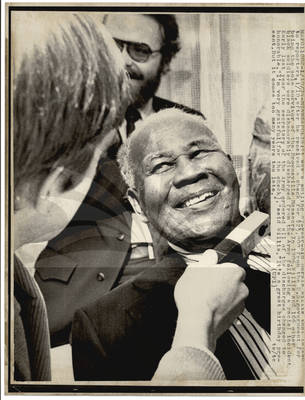
Dorsie Willis, 1974
1media/willis_thumb.jpg2020-07-04T11:12:16-07:00the Historical Museum at Fort Missoula2ed0a4c76b15fe2d208dedaebb1fcaaa8b4d9c38376435Minneapolis: It was a smiling 87-year-old Dorsie Willis that talked to reporters, 1/10, after he received a check for $25,000 from the U.S. Government for being the sole survivor of the Brownsville Massacre. In 1906, Willis and 166 other black soldiers were dishonorably discharged from the Army following a racial incident. Early last year the secretary of the Army ordered all of the discharges changed to honorable. 'I'm very grateful (for the check),' said Willis. 'It's a great birthday present. But it comes too many years too late.'plain2020-08-08T10:35:00-07:00the Historical Museum at Fort Missoula2ed0a4c76b15fe2d208dedaebb1fcaaa8b4d9c38
This page has annotations:
12020-08-08T10:37:09-07:00the Historical Museum at Fort Missoula2ed0a4c76b15fe2d208dedaebb1fcaaa8b4d9c38Dorsie Willis, 1974 (image description)the Historical Museum at Fort Missoula2plain2020-08-08T10:37:52-07:00the Historical Museum at Fort Missoula2ed0a4c76b15fe2d208dedaebb1fcaaa8b4d9c38
This page has tags:
1media/ft snelling.png2020-07-04T12:06:54-07:00the Historical Museum at Fort Missoula2ed0a4c76b15fe2d208dedaebb1fcaaa8b4d9c38Image Gallerythe Historical Museum at Fort Missoula14structured_gallery2020-12-02T10:00:04-08:00the Historical Museum at Fort Missoula2ed0a4c76b15fe2d208dedaebb1fcaaa8b4d9c38
The 25th Infantry Regiment, one of four regiments of Black soldiers established after the Civil War, had an exemplary service record. However, to many, the soldiers were Black men first and United States soldiers second, and the regiment endured being sent to the least desirable postings, being issued equipment already rejected by white regiments, and the racist attitudes of civilians in the towns they served. In 1906, in Brownsville, Texas, a shooting attributed to the soldiers of the 25th Infantry culminated in one of the most egregious examples of racism against Black soldiers in United States Army history.
1media/weaver.jpg2020-07-04T11:37:47-07:00The Legacy of the Brownsville Affair4image_header2020-12-02T09:59:04-08:00Ultimately, Roosevelt’s handling of the Brownsville affair did not cost his party the support of the Black community in the 1908 election. Roosevelt’s Secretary of War, William Taft, won the presidency, although by a much slimmer margin than previous elections. Although Taft had been instrumental in upholding the Brownsville verdict, his opponent in the race was Democrat William Jennings Bryan, whose progressive platform was marred by virulent anti Black racism. Caught between the naked racism of the Democrats and the breadcrumbs offered by the Republicans, many Black voters felt that they had no choice but to support Taft.
The affair was largely forgotten after 1908, and the Brownsville citizens’ narrative became written into history books as fact. Not until 1970 did anyone seriously re examine the case. Published in a much different political climate, John Weaver’s detailed account of the event and subsequent investigations pulled no punches in exposing the holes in the accepted narrative. Weaver’s book, titled simply The Brownsville Raid , prompted a new federal investigation, and in 1972 President Richard Nixon officially pardoned the soldiers and updated their records to show honorable discharge. Only one of the 167 men was still alive to witness the apology, Private Dorsie Willis. In an official ceremony, Willis received an apology and a pension of $25,000. He died in 1977, and was buried with full honors at the U.S. Military Cemetery at Fort Snelling, MN.