Interdisciplinarity and the BCL
The atmosphere and the Biological Computer Lab was an atmosphere of trust. It helped create a network of friends that made the individual people so very productive and happy, whether it was the leading minds like Ross Ashby and Gordon Pask, or the students that fell into this net, who felt incredibly well, and suddenly saw that their so-called professors were their friends.
Heinz von Foerster/Monika Silvia Broecker, Part of the World: Fractals of Ethics - A Drama in Three Acts, ed. Jamie Hutchinson, trans. Barbara Anger-Diaz.
One of the products of the Centennial events, including Paul Schroeder's stirring speech, was an open course listing - LAS 199 - that would allow for more interdisciplinary seminar designs based on student interests. It was a course listing that Heinz von Foerster would use to set up unique and creative courses that set up the work of student-produced publications. von Foerster ran four of these courses in total; the first, the Heuristics seminar, would set the tone and produce perhaps the most well-known publication of the four in 1969: The Whole University Catalog.
von Foerster recognized that heuristics had a double meaning it could relate both to mathematics as well as a student-centered education system. When a student approached him initially to teach a course on heuristics, von Foerster suspects that the student was unaware of the double meaning, and as he asked which the student intended to focus on through the course, replied "Both!" von Foerster then asked if Herbert Brun would teach the course with him, who responded that he prioritized any student requests for courses and would accept von Foerster's offer.
The students for the Heuristics courses ended up making for quite an interdisciplinary corps. According to von Foerster's course directory, which lists students' names, contact information, majors, and interests, the most popular disciplinary backgrounds include LAS (the most popular with 10 students), Chemistry, Economics, Psychology, English, Philosophy, Political Science, Mechanical Engineering, and Electrical Engineering. But other listed disciplines include Graphic and Industrial Design, Music, Pre-med, Biophysics, Spanish, Home Economics, History, Rhetoric, Psycholinguistics, Pre-Dental, and Commerce. One discipline listing that particularly stands out is the one provided by Richard Howe, who simply writes “long-time undergrad.”
The course itself was first taught in the Fall ‘68 semester at the behest of an eager, interdisciplinary group of students interested in the philosophies and cognitive processes behind problem-solving. von Foerster conveys that the syllabus that resulted from this request aimed not only to expose students to the “heuristic procedures” of problem solving, but also to put them to practice and test their efficacy in class and through assigned exercises. After finding a suitably sized classroom given its popularity, the course structure soon became one that fluctuated between a typical classroom experience and a more experimental one predicated on improvisation as a mode of learning. The students insisted the course continue into the following semester, so it did; the same happened that semester, and so it was offered again in the Fall ‘69 semester.
Course assignments were unique to say the least. For at least the first iteration of the course, students came together to decide on the logistics of the class and when they should meet weekly, after which von Foerster provided the first assignment: to list their desires in order of how they need to be met to fulfill them all. While the initial expectation was for the assignment to take them a week, it became the center of the next six weeks of discussion. The papers were eventually used by the class to help define their shared desires as a student group. Given this, it is not surprising that The Whole University Catalog, the text the students would collaborate on in which each student was given a page to highlight whatever they saw fit to include, reflects many of the countercultural, anti-way, and education reform sentiments of the time.
Needless to say, The Whole University Catalog emerged as a highly controversial text, one that von Foerster would have to testify in Springfield over amid a swarm of hearings about campus protest in Illinois universities. Though Brian Clardy's The Management of Dissent: Responses to the Post Kent State Protests at Seven Public Universities in Illinois includes a chapter on the Horseley Committee (also known as the Joint House and Senate Committee on Campus Unrest), he only briefly touches on the Springfield hearings in September 1970. The Committee overall focused on getting to the bottom of how university policies and faculty may have contributed to the surge of campus activism and how to quell it moving forward. Clardy brings up the testimony of a “Hans Van Forrester” (which impressively gets all of von Foerster’s name wrong) on the publication of the Whole University Catalog:
Hans Van Forrester . . . testified that one of his former students had published a seditious manual that was circulated widely among the student body. Within its contents, the manual gave students instructions on how to start a riot and defraud both the local phone company and their landlords. The manual gave meticulous instructions on how to find “pot” within the county; other drug-related information pertained to instructions about how to inject narcotics like heroin and cocaine. And others pertained to how to put drugs into the campus food supply and “how to cheat parking meters.”
Brian K. Clardy, The Management of Dissent: Responses to the Post Kent State Protests at Seven Public Universities in Illinois (University Press of America: Lanham, 2002)
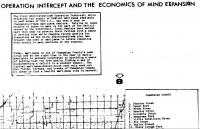
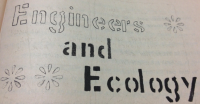
While The Whole University Catalogue gained more attention in part due to these controversies, it was not the only student-produced publication out of the BCL, as mentioned previously. The Ecological Source Book, published a year later, proves a far more conventional text in comparison. The topics the book covers include abortion, air and water pollution, water conservation, reusing and recycling, oil slick, noise pollution (even getting into the biology of the ear to explain its ramifications), the rise in world population (which it treats in a similar fashion as von Foerster’s Doomsday paper), war/nuclear accident effects, and wilderness preservation. But more broadly, the book has a keen interest in the need to think more ecologically toward engineering, particularly considering the context of industrialization at the time, and how to effect environmental change through activist work.
Analysis . . .
This page has paths:
- The Biological Computer Laboratory Ned Prutzer