Thanks for your patience during our recent outage at scalar.usc.edu. While Scalar content is loading normally now, saving is still slow, and Scalar's 'additional metadata' features have been disabled, which may interfere with features like timelines and maps that depend on metadata. This also means that saving a page or media item will remove its additional metadata. If this occurs, you can use the 'All versions' link at the bottom of the page to restore the earlier version. We are continuing to troubleshoot, and will provide further updates as needed. Note that this only affects Scalar projects at scalar.usc.edu, and not those hosted elsewhere.
Textual Analysis of the English Translation of Selected Verdi Operas
Main Menu
Chelsea Hoover
43ce27d45c313c0eacd59f771db3bbe1247ca9fb
Macbeth
1 2015-12-09T15:22:32-08:00 Chelsea Hoover 43ce27d45c313c0eacd59f771db3bbe1247ca9fb 7211 1 plain 2015-12-09T15:22:32-08:00 Chelsea Hoover 43ce27d45c313c0eacd59f771db3bbe1247ca9fbThis page is referenced by:
-
1
media/downloadCollectionPicture.jpg
2015-12-08T19:15:49-08:00
Act III: An Analysis of Verdi's Macbeth and How It Compares to A Masked Ball and The Force of Destiny
41
plain
2015-12-16T20:50:50-08:00
Scene 1: An Analysis of Verdi's Macbeth
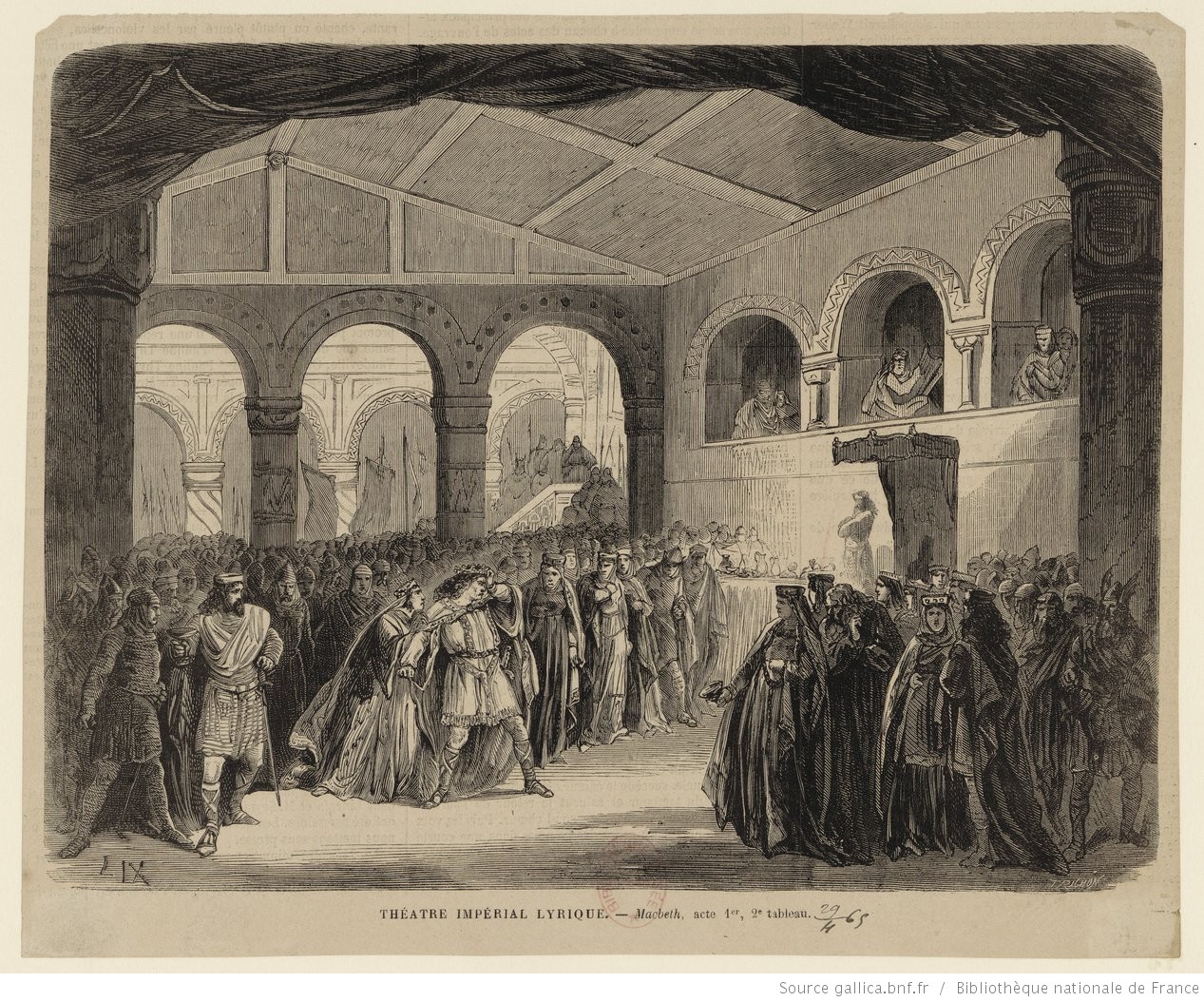
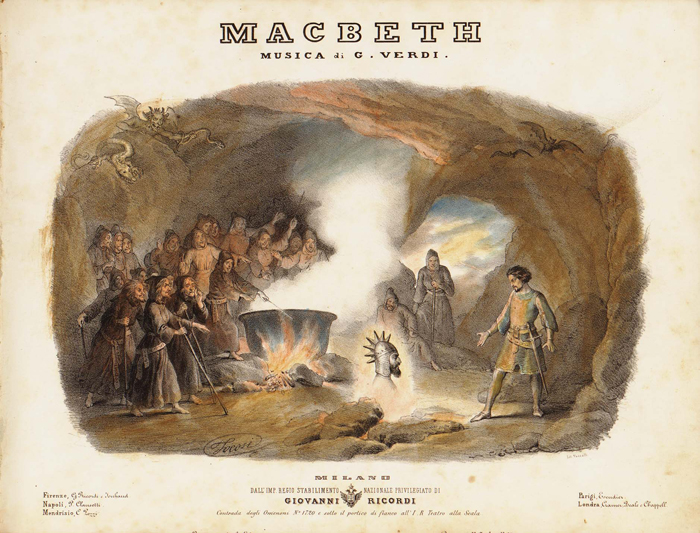
Synopsis: The opera opens with a group of witches who are gathered in a wood beside a battlefield exchanging stories of evils they have performed. Generals Macbeth and Banco approach the witches and are hailed by them. Macbeth is hailed as Thane of Glamis (a title he already holds), Thane of Cawdor, and king “thereafter”, while Banco is hailed as the ancestor of a future line of kings. The witches vanish and messengers from the king announce that Macbeth is now Thane of Cawdor, as the former Thane has been executed for treason. Macbeth and Banco marvel in a duet together about how the witches’ prophecies are becoming true. Macbeth wonders how close he is to becoming king and ponders whether fate will grant him the position without taking action while also dreaming of killing the king. Meanwhile Banco, who has been mistrustful of the witches, wonders whether the demons of Hell will reveal an honest truth in order to lead one to damnation. Macbeth tells his wife Lady Macbeth about the witches’ prophecies, and she is determined to see that Macbeth becomes king, whether that happens through fate or treacherous play. In the next scene, Lady Macbeth learns that King Duncan will be staying the night at his castle, and she is determined to have Duncan killed. She tells Macbeth of the news and urges him to kill Duncan, but Macbeth, who is initially compelled to carry out the act, backs out. Lady Macbeth carries out the act instead and frames Duncan's sleeping guards for the deed by smearing Duncan’s blood on them and planting Macbeth’s dagger in their hands. Macduff, who is the Thane of Fife, visits the castle for an appointment with King Duncan but discovers that Duncan has been murdered. Macduff arouses the castle. Macbeth is now promoted to king, as King Duncan’s son Malcom has fled the country to avoid suspicion. Macbeth is still disturbed by the witches’ prophecy that Banquo (and not he) will found a royal line and tells Lady Macbeth of his plans to have Banquo and his son murdered when they come to the banquet. Banquo is murdered by a band of assassins outside the castle before the banquet, but his son Fleanzio escapes.; Macbeth receives the news of Banquo’s assassination privately at the banquet, but when he returns to the table he sees the ghost of Banquo sitting in his place. Macbeth marvels at the ghost, and the guests believe Macbeth has gone mad. Lady Macbeth attempts to make light of the situation by calling for a toast to the absent Banquo, whose death has not yet become public knowledge. But the ghost reappears and drives Macbeth to insanity. Macduff resolves to leave the country, asserting that it is cursed and only the wicked remain. The guests are terrified by Macbeth’s talk of ghosts, phantoms, and witches and frantically depart from the banquet. Macbeth meets the witches in their cave, and they conjure up three apparitions for him. One of the apparitions warns Macbeth to beware of Macduff. Macbeth is then shown the ghost of Banquo and his descendants, who are the eight future kings of Scotland, which confirms the witches' prophecy. Macbeth collapses but regains consciousness later in the castle. Macbeth then tells his wife about his encounter with the witches, and they resolve to track down and kill Banquo’s son, as well as Macduff and his family.
In the final act, Macduff is determined to avenge the deaths of his wife and children, who have been killed by Macbeth’s army. Macduff joins forces with Malcom (King Duncan’s son) and the English army to liberate Scotland from Macbeth’s tyrannical rule. Meanwhile, a doctor and servant observe Queen Macbeth walking in her sleep in a fit of madness as she raves about the deaths of Duncan and Banquo, as well as Macduff’s family, and how she cannot cleanse her conscience from these acts. The doctor and servant are horrified but do not repeat what they have just witnessed. Macbeth learns of a rebel Scottish army led by Macduff that has come to do battle against him. Macbeth encounters Macduff and is mortally wounded. After Macbeth is killed, Macduff returns to his army announcing the news. Malcom is proclaimed king, while Macduff is proclaimed hero. The two swear to restore greatness to Scotland.
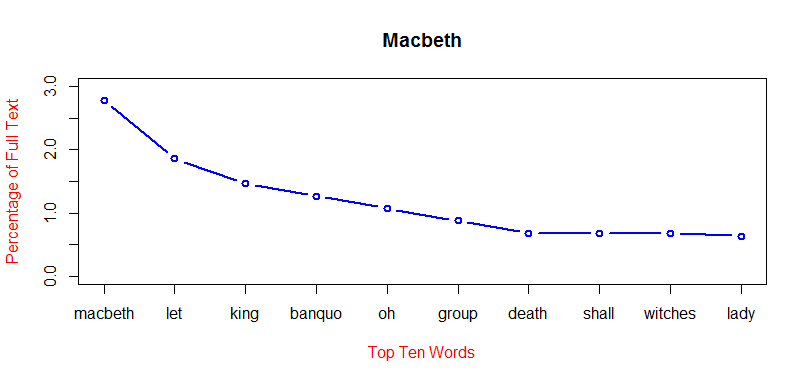
Top Ten Words in Macbeth:
**This chart contains the top ten most frequently occurring words in Macbeth. Please scroll to the bottom of the page for a more in depth analysis.
Word Cloud for Macbeth:
**This word cloud contains the most frequently occurring words in Macbeth. Please scroll to the bottom of the page for a more in depth analysis.
Scene 2: A Comparison of Verdi's Macbeth with A Masked Ball and The Force of Destiny
Thematic similarities in A Masked Ball, The Force of Destiny, and Macbeth:- all three involve noble men/women as main characters
- characters are told their fortunes
- at least one character intends to murder another character
- someone gets stabbed to death
As you can see in the top ten words charts, the main words that all three operas frequently employ include the words "shall" and "let." As I did in the previous page, I will compare the context in which Macbeth employs the word "shall", since this word has multiple connotations. As was the case in A Masked Ball and The Force of Destiny, Macbeth employs the word "shall" primarily in situations in which characters express determination. In Macbeth, the characters who mainly use "shall" in this context are Macbeth and Lady Macbeth. Macbeth uses the word in the context of determination after Banquo has been assassinated, and Macbeth is expressing his eagerness to sit in Banquo's place. Lady Macbeth uses the word in this context after she has found out about Macbeth's prophecy and wants to insure that Macbeth becomes king. She specifically uses the phrase "I shall give you courage" in Act One, scene two, when she wants Macbeth to kill Duncan when Macbeth is presented the opportunity.
You can also see that both A Masked Ball and Macbeth frequently use the word "death." Because this word only has one connotation and death is a major part of both operas (although more so in Macbeth), this trend is self-explanatory.
Similar Word Cloud Words:
As you can see in all three word clouds, a common topic all three clouds share is death. Common words in all three operas that pertain to death include some form of the word dead, such as "dies" and "assassins" in The Force of Destiny, "dead", "parricide", "murderer", and "slaughter" in Macbeth, and "dying", "blood", and "death" in A Masked Ball. This trend is appropriate for all three operas, as death plays a central role in the development of each operatic plot. As in A Masked Ball, Macbeth also contains words that pertain to royalty (including "queen", "lady", "king", and "reign") and night (including "night", "lamp", and "shadows"). These topics are appropriate because the scenes in the opera mainly occur at night, and the main characters are of royal status. Macbeth also contains words that pertain to demonic spirits, and these include words such as "witches" and "ghost". This topic is appropriate and very central in the development of the plot because Macbeth consults witches in order to learn his prophecy, and he is driven to the brink of insanity after he has had Banquo murdered and sees Banquo's ghost.