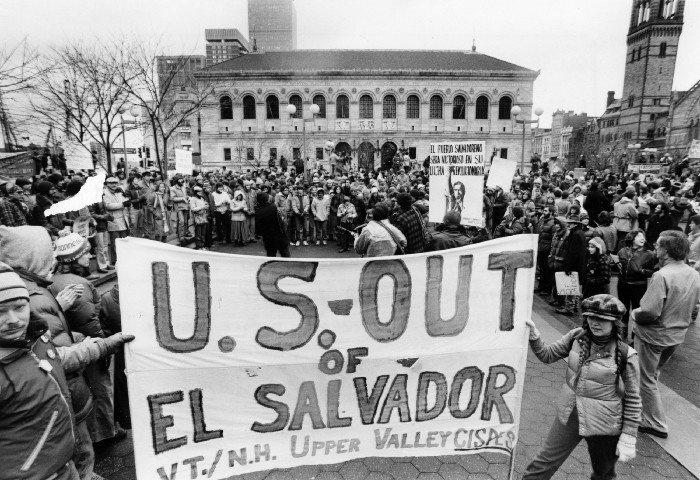
protest
This page is referenced by:
-
Virginia History Textbooks and the Cold War in Latin America
While in high school, my Cold War education began and ended at the idea that the United States and the Soviet Union fought (without actually fighting) over ideologies of communism and capitalism. The Soviet Union lost, the Berlin Wall fell, and the United States emerged as the sole global superpower. This narrative seemed true; I mean, I read about it in my History textbooks and my teachers taught according to the textbook. Why would this not be what the Cold War was about?
What this narrative forgot, however, was the ways in which the Cold War gravely impacted other regions on a global scale. While the Korean and Vietnam Wars remain sore subjects in United States history today, the relationship between the United States and Latin America are rarely considered in the larger repercussions of the Cold War. The United States actively interfered with, intervened, and injected itself into Latin American political, economic, social, and cultural spheres and played a significant role in the thousands of human rights violations that struck Latin American countries throughout the Cold War. How are public school state textbooks able to balance the narrative of US exceptionalism following a 'victory' in the Cold War with the 'other side of the story' that implicates the United States with hundreds of thousands of disappeared, kidnapped, and murdered victims at the hand of communist fears?What is the goal of this project?
This project investigates eight Virginia state-approved History textbooks for middle and high school students to analyze how these sources implicate the United States in the Cold War in Latin America. Through understanding to what extent textbooks acknowledge the United States' role in Latin America, either as a periphery actor or one directly intervening, we can begin to question the history promoted by these sources as well as the narratives of United States exceptionalism embedded within.
This project is particularly envisioned for teachers who are teaching these textbooks, illustrating the problematic, undeveloped, unorganized, and incomplete history of the Cold War in Latin America presented by these sources. It also provides supplemental information to learn more about this past. Some tools within this project demonstrate how these textbooks present partial, privileged, and selective information, while others allow teachers and their students to interact with this history and think about how a different presentation of this information might elicit different questions and concerns. While primarily a pedagogical tool explaining how to complicate the narrative of 'truth' determined by textbooks, this project also speaks to challenging the United States exceptionalism persistent and dominant in our public school education.
We must grapple with the ways in which the United States caused pain and suffering in Latin America in order to present a more realistic historical narrative of this country. This textbook analysis is the latest attempt to deconstruct the myth of centralized United States nationalism and instead complicate this narrative through interrogating the actions and behaviors of United States leaders.
I thank you for visiting this site and encourage you to use this pedagogical tool to explore the different ways to challenge our assumptions and our memory of the past.
What did the United States even do during the Cold War in Latin America?
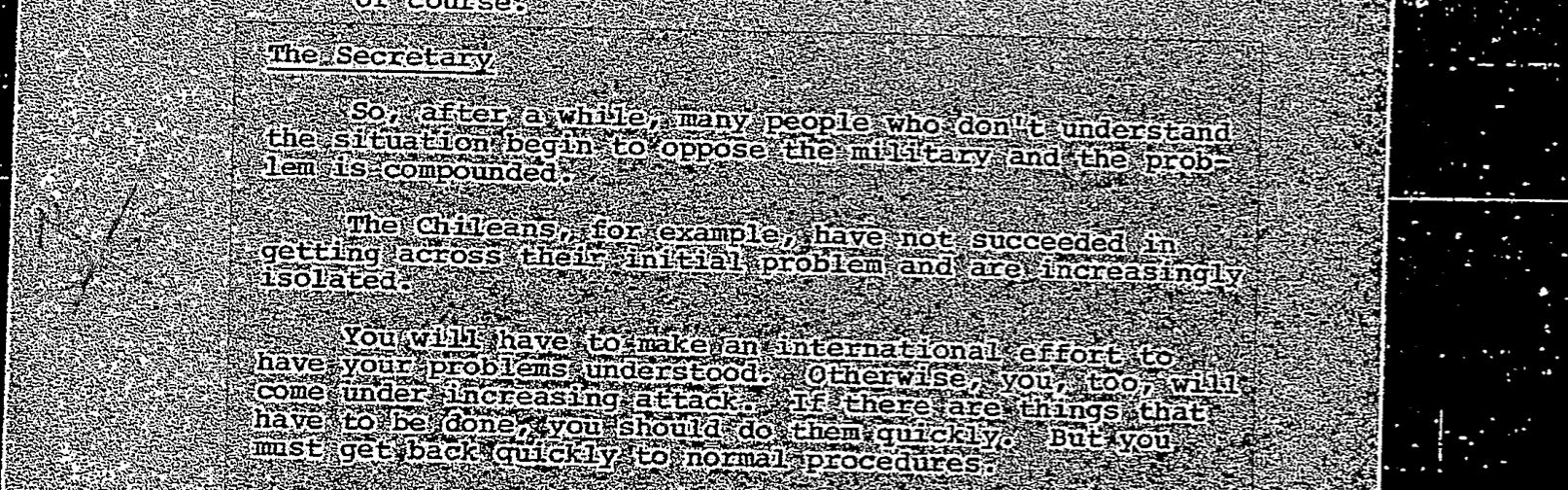
This transcript, taken from a meeting between Argentine Foreign Minister Admiral Cesar Augusto Guzzetti and Secretary of State Henry Kissinger on June 10, 1976, shows Kissinger telling this Argentine diplomat that in order to counteract terrorism, "if there are things that have to be done, you should do them quickly." Through this 'green light,' the United States became implicated in the eight year Argentine military junta that kidnapped, tortured, and disappeared up to 30,000 people during the Cold War.
How can we reconcile this truth with the ways in which middle and high school textbooks teach the Cold War in Latin America? What can documents like this one do to nuance our understanding of the past? How does introducing this document make us question the coverage of the United States in these textbooks?
Explore more here:
“Memorandum of Conversation,” June 10, 1976. The National Security Archive. https://nsarchive2.gwu.edu/NSAEBB/NSAEBB133/19760610%20Memorandum%20of%20Conversation%20clean.pdf.