Scalar's 'additional metadata' features have been disabled on this install. Learn more.
Virginia Textbooks and the Cold War in Latin AmericaMain MenuVirginia History Textbooks and the Cold War in Latin Americahome-page; basic descriptionTextbook IntroductionTimeline of the Cold War in Latin AmericaThis is where the Timeline JS will be placed.Visualizations of Textbook TitlesThis is where my super pretty interconnected web will come into play.Primary SourcesHere is where my bibliography will be with a bunch of different archives/primary sourcesSecondary SourcesAdditional ResourcesAbout the AuthorTyler Goldbergerc5a2faadde3ab62833b350dce242f448ba972625
Heat Map Feature
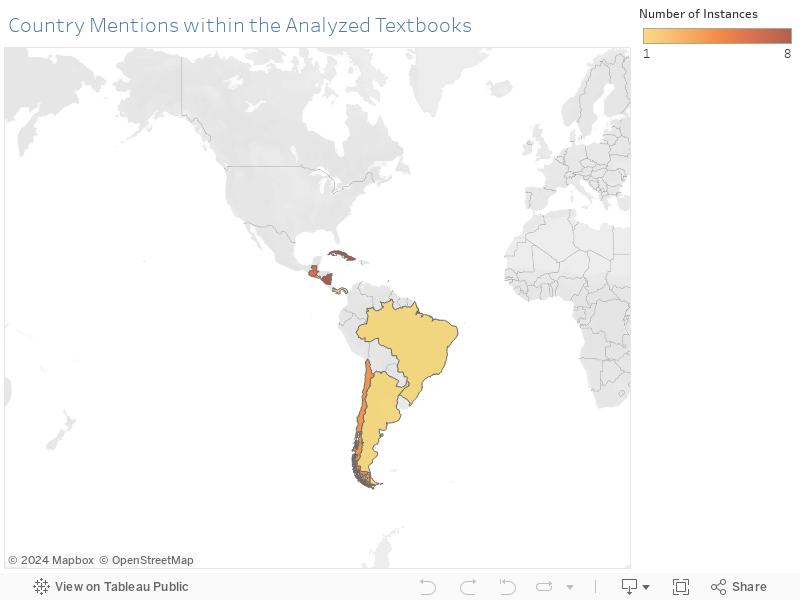
12020-09-26T06:55:32-07:00Tyler Goldbergerc5a2faadde3ab62833b350dce242f448ba9726253809322This is how frequently each country is mentioned in text in these different textbooksplain2020-10-15T14:29:12-07:00Tyler Goldbergerc5a2faadde3ab62833b350dce242f448ba972625
The first tool of analysis to think about how different middle and high school textbooks portray events from the Cold War in Latin America takes the shape of a heat map. This tool requires direct interaction to understand how frequently different Latin American countries are discussed. It helps to orient ourselves to Latin America as a region, both in its relationship to the United States as well as its individual countries. Feel free to play around, hover your mouse over each shaded country, and explore this quantitative approach to this project’s research question.
While it is apparent visually, looking at how some regions are closer to red than others, the quantitative count that can be obtained by hovering the mouse over each shaded country demonstrates the disparity at which different countries are acknowledged within this Virginia textbooks. Cuba and Nicaragua are mentioned in every textbook analyzed and arguably for quite obvious reasons. Cuba played a huge role in United States policy during the Cold War due to its close proximity to the United States and its willingness to partner with the Soviet Union. The Cuban Revolution sparked immediate and persistent fear and frustration that Cuba would become a fully communist country which made the United States orchestrate a failed invasion attempt. Therefore, the United States had to act to contain and ultimately extinguish communism. Cuba also participated in the Cuban Missile Crisis that brought the Cold War to the brink of nuclear War. Many of these events are associated with President Kennedy and the rollercoaster of successes and failures he had during his presidency.
Nicaragua is mentioned frequently in these textbooks because of the Iran-Contra Affair/Iran-Contra Scandal that transpired during President Reagan’s second term. Despite the prior Congressional law that had banned the funding of the Nicaraguan Contras, the right-wing rebel group that opposed leftism, President Reagan’s administration facilitated a complicated selling of arms to Iran whose profit directly supported the Contras. While still unknown whether President Reagan himself was directly implicated in this illegal trade, it tarnished the record of his administration and once against highlights the severe actions the United States was willing to take in order to prevent the spread of communism.
Other major events that the United States spearheaded during the Cold War, motivated by the constant and pervasive fear of communism, are not unanimously mentioned in these textbooks. The CIA-supported coup d’état in Guatemala that uprooted the Ten Years of Spring that Guatemalans experienced is only referenced in six out of the eight textbooks, the active role that the United States government played in installing General Augusto Pinochet for a seventeen-year dictatorship is only regarded in half of the textbooks, and the human rights violations that plagued Argentina and Brazil during the Cold War are only mentioned in a total of one textbook. This gap begs the questions: How does United States history remember and justify its actions of the past? How does the United States choose to remember the violation of human rights during the Cold War? Why do Cuba and Nicaragua dominate the Cold War in Latin America coverage when other nations were equally shaped by United States direct intervention and control?
The utility of this map equally showcases the countries completely erased from the Cold War narrative. The Dominican Republic spent a large portion of the Cold War trying to stabilize after the death of United States-supported dictator Rafael Trujillo. Countries like Honduras and Paraguay faced many human rights violations that disappeared, kidnapped, and tortured thousands of victims, yet these countries are not given a space in the historical record. If these textbooks do not include other Latin American nations, when will students learn about the direct consequences of United States action on Latin American soil? This silence is a theme that persists throughout this project and throughout the textbooks examined that are being used as references to teaching students about the Cold War.