Scalar's 'additional metadata' features have been disabled on this install. Learn more.
Spatializing Paintings: Analizing Frida Kahlo
Main Menu
Alaka K
08bf7dd3497bddbb37556a53542708d52de79083
The Broken Column 1944
1 2016-09-25T21:17:57-07:00 Alaka K 08bf7dd3497bddbb37556a53542708d52de79083 11603 1 Work 1 plain 2016-09-25T21:17:57-07:00 Alaka K 08bf7dd3497bddbb37556a53542708d52de79083This page is referenced by:
-
1
2016-09-25T21:12:39-07:00
Frida Kahlo and 5 portraits
3
The works taken for analizing
plain
2016-10-04T22:35:20-07:00
The Broken Column was painted shortly after Kahlo underwent spinal surgery. She depicts herself bound and constrained by a cage-like body brace. A cavern of missing flesh violates the integrity of her body, exposing a broken column in place of her spine. The column appears to be on the verge of collapsing into rubble. Metal nails pierce Kahlo’s face, breasts, arms, and torso, as well as her upper thigh, hidden behind a swath of cloth. Tears stream down her face. Set in an open landscape, the artist-sitter is exposed in more ways than one. The terrain on which she stands appears barren and cleaved. The emotional intensity and imaginative scope of pictures like this one has led many, including her contemporaries, to label Kahlo a Surrealist. Although she accepted this membership for practical and professional reasons, Kahlo distinguished her work from that of other Surrealists, noting that it dealt not with dreams worlds, but rather with her own lived reality.
In this self-portrait, Memory, the Heart 1937, Frida Kahlo expressed her misery and resent over the affair happened two years ago between Diego Rivera and Cristina. In this painting, her face has no expression but with all tears. She cropped her hair and was wearing the European-style clothes, which style was her favorite when she was separated from Diego Rivera. And as always, she use the physical wounds to imply her psychic injuries.
In the background was her schoolgirl outfit and her Tehuana costume and each set of clothes has one arm, with Frida Kahlo standing there without arms and seems helpless. She stands there with one food on the ground and the other in the sea. The foot put over the sea wears an apparatus and suggested the recent food surgery she was undergoing.
Memory, the Heart delivered a direct and simple meaasge: she was heart broken. Her huge heart lies on the ground at her feet and was pumping rivers of blood in the the background landscape. Her body was pierced bu a steel rod with seesawing cupids on either end, which created an accurate visualization of the sensation of pain.
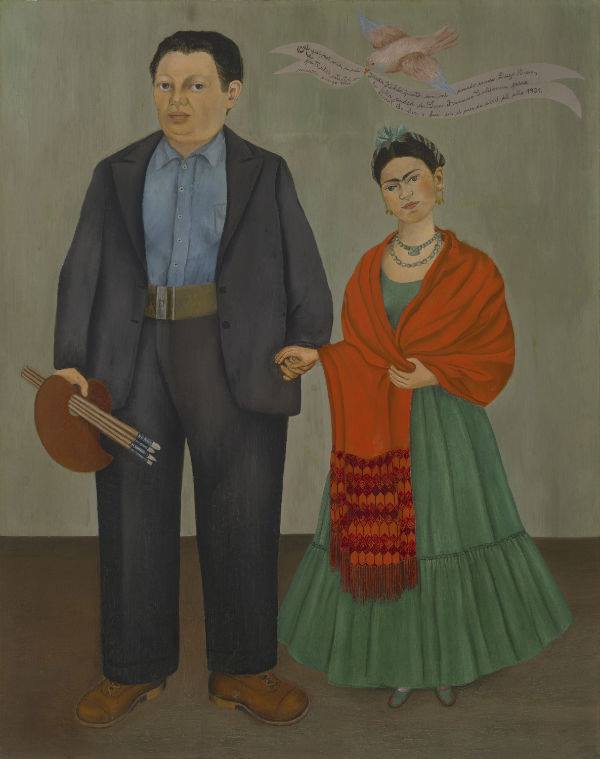
In Frida's painting of her and Diego, she recorded the up and downs of her marriage. She draw this painting, Frida and Diego Rivera, 1931, as a wedding portrait. This was completed after two years of their conjugal life. In this painting Frida adopted the stiff pose which is an influence of naive nineteenth-century painters such as Jose Maria Estrada, whose work influenced Diego Rivera also. An enlightening engraving on a strip in the snout of a pigeon (a gadget both Frida and Diego obtained from such craftsmen as Estrada and from well known craftsmanship) is as straightforward in tone as the painting is folkloric in style: "Here you see us, me Frieda Kahlo, with my dearest husband Diego Rivera. I painted these pictures in the delightful city of San Francisco California for our companion Mr. Albert Bender, and it was in the month of April of the year 1931." (Bender, a Rivera supporter, had secured consent for Rivera to enter the United States after he was declined a visa due to his well-known Communism.) The painting indications at what the Riveras' marriage would get to be. As solidly planted as an oak, Rivera looks colossal beside his wife. Dismissing from her, he shakes his palette and brushes - he is the extraordinary maestro. Frida, whose little feet scarcely brush the ground, cocks her make a beeline for her great mate. This painting shows her favorite image: the genius's adoring wife. She was holding his hand with the lightest possible clasp. Frida understood that Diego belongs to nobody. Even while she was painting this portrait, Rivera was in affair with tennis champion Helen Wills. He painted her nude image on the ceiling of the Luncheon Club of the Pacific Stock Exchange in San Francisco. Later Frida was to remark: "Being the wife of Diego is the most marvelous thing in the world ... I let him play matrimony with other women. Diego is not anybody's husband and never will be, but he is a great comrade." Nevertheless, she wanted to be his favorite comrade: in the exact center of her wedding portrait are the couple's hold hands holding together. The truning point of Frida's life was the marriage bond.
Paradise Monkeys 1943
In the 1943 painting, there are four monkeys. Two of them hug Frida. Two more behind her are half buried by the leaves of a bird of paradise plant featuring a brilliant orange and blue flower.
On Kahlo’s white cotton blouse or huipil (itself part of the carefully chosen peasant and indigenous costuming that Frida adopted in everyday life), two of the monkeys point to a red and orange Aztec glyph (or sign) for earthquake or movement (ollin), enclosed in a rectangle.
The glyph is identical with an image in the Florentine codex, a document with which Frida and Diego were familiar.
Many of Frida’s self portraits were commissioned. One of her first monkey paintings, for example, was bought in 1938 by the industrialist, philanthropist and first president of the Museum of Modern Art in New York City, Anson Conger Goodyear.
Goodyear was one of a group of wealthy figures, from business, publishing and Hollywood, as well as from the private sector and diplomatic circles in Mexico, whose commissions enabled Frida and Diego (both of whom were Communist revolutionaries) to pay for Diego’s lavish collecting and Frida’s onerous medical bills.
One of these patrons was Jacques Gelman, a Jewish exile from European fascism, who made a successful career in Mexico as film producer and early promoter of the actor Cantinflas. Together with his wife Natasha, Gelman assembled a spectacular collection of Mexican and European art. Some of their Frida and Diego paintings are now on show at the Art Gallery of New South Wales.
Frida Kahlo painted Self-Portrait with Cropped Hair shortly after she divorced her unfaithful husband, the artist Diego Rivera. As a painter of many self- portraits, she had often shown herself wearing a Mexican woman's traditional dresses and flowing hair; now, in renunciation of Rivera, she painted herself short haired and in a man's shirt, shoes, and oversized suit (presumably her former husband's).
Kahlo knew adventurous European and American art, and her own work was embraced by the Surrealists, whose leader, André Breton, described it as "a ribbon around a bomb." But her stylistic inspirations were chiefly Mexican, especially nineteenth-century religious painting, and she would say, "I do not know if my paintings are Surrealist or not, but I do know that they are the most frank expression of myself." The queasily animate locks of fresh-cut hair in this painting must also be linked to her feelings of estrangement from Rivera (whom she remarried the following year), and they also have the dreamlike quality of Surrealism. For, into the work she has written the lyric of a Mexican song: "Look, if I loved you it was because of your hair. Now that you are without hair, I don't love you anymore."