No individual solution to our problems
In “Librarians of the World Unite!” a cartoon published in The Nib during the coronavirus pandemic, we get a glimpse of how weak we are when we can't communicate with one another and how much change we can achieve if we organize ourselves to understand our common circumstances better.
It's essential to organize to accomplish anything for a whole profession of people. In Cory Doctorow's (2010) For the Win the paid gamer protagonists build a grassroots movement that challenges the status quo and along the way readers find out just how hard fought and hard won are their gains. Those of us in the profession of librarianship, just like the mercenary gamers in For the Win, have reasons to seek change. In Emily Drabinski's (2019) “Collective Responsibility: Seeking Equity for Contingent Labor in Libraries, Archives, and Museums" we come face to face with voices that must be heard.
In “Black Study, Black Struggle" Robin Kelley (2016) reminds us of how "the university possesses a unique teleology: it is supposed to be an enlightened space free of bias and prejudice, but the pursuit of this promise is hindered by structural racism and patriarchy." Kelley has a lot to teach us about the universities we work in, and the ways they are perceived by the students who study at them and the professors who work at them. He talks about both "modest and more radical critics of universities" and how "both demand that universities change in ways that we cannot expect them to change." He argues that universities are not up the task of modest or radical change and leaves us with the notion that while "universities can and will become more diverse and marginally more welcoming for black students" that "as institutions they will never be engines of social transformation."
Why? We must ask this question, for as academic librarians our jobs and our libraries are situated inside these very same universities. There's not one university for the students and another for the library. Kelley (2016) reminds us that the university won't be the engine for transformation because "such a task is ultimately the work of political education and activism. By definition it takes place outside the university." Perhaps some of what we seek for and from libraries has to be similarly situated, and informed by the hard-won knowledge Robin Kelley shares; perhaps the change we seek has to happen wholly or partly outside the library because it can't happen through it?
For us, as librarians, there is no single solution or snake oil to repair all our profession's problems. Studious librarian Barbara Gordon aka Batgirl lobbied for equal pay back in 1974 but the most recent AAUP Faculty Compensation Survey and the CAUT Almanac of Post-Secondary Education in Canada demonstrate that universities haven't quite caught up.
Taking up Doctorow's message acknowledges how we will come up with better solutions if more of our voices are heard. We must hear not just the superheroes' voice but also the voices of the disadvantaged and the most pained among us. Flaherty (2016) describes how the "privilege of the able bodied leads to people with disabilities being pushed out of our movements and our society" (20). He calls attention to how Disability Justice says "we all must move forward together or it's not really justice" (20).
A character in Doctorow's 2017 novel Walkaway reflects on his own previously aggressive and hyper-competitive mindset. He'd once ruthlessly critiqued the groups who went without leaderboards and shamed those who couldn't keep up. He later observes that such community members were not the problem:
“It twists my head that I only started disbelieving in useful and useless people when I proved to be useless. Then I had this revelation that the scale I’d judged people on—the scale that I was failing on—was irrelevant" (208).
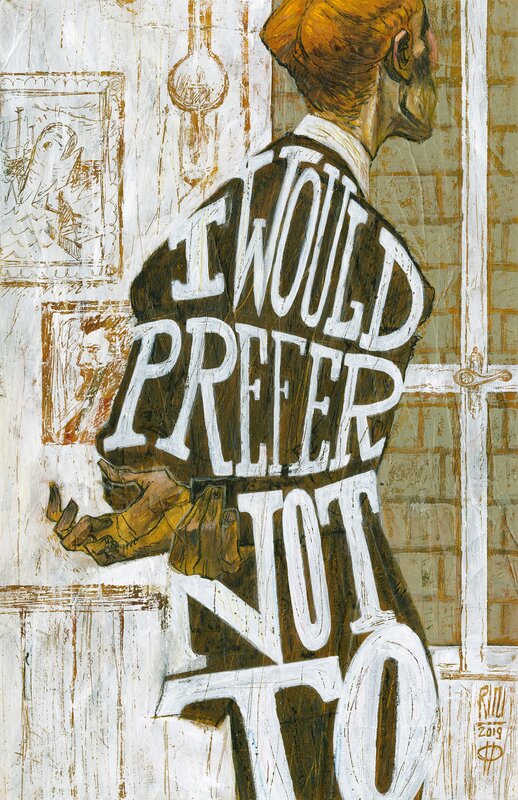
This brings us right back to Bartleby and his boss's frustration at how to consider and treat his refusing employee once Bartleby wasn't fit for work. Was Bartleby a mere managerial challenge? A puzzle to fix? Or an embarrassment, an eyesore, a problem to be gotten rid of? He was much more than that, which is why Melville makes Bartleby's situation so impossible to "look away from."
There is no single "Superhero" individual who can resurrect librarianship's "once glorious kingdom" to its real or imagined former prestige. Individually, not even those among us who have organizational or professional power/prestige, can bring our entire profession to a state of equity or equilibrium. But through communal consciousness raising, whether it happens on Twitter, on librarian blogs, in journals just like CJAL, or in any of the communities where we share ideas, we can begin conversations that help us mount collective concerted efforts that build firmer ground upon which to resolve our issues and move forward together.Our organizational weaknesses show. There's more than one reason we don't always refuse or debunk constructed scarcity when we could or should. Our weaknesses were hard felt during the COVID-19 pandemic situation. We recognize that'll it'll take more than one person, more than one action to situate ourselves better and that it will require collective as well as individual action. This does not mean we shouldn't have optimism to tackle the barriers that prevent us from occupying our profession more fully—we may be living in a cyberpunk dystopia, but there are avenues that allow us to design our way out of the situations we've inherited.
This page has paths:
- Table of Contents Mikala Narlock