Scalar's 'additional metadata' features have been disabled on this install. Learn more.
Reflecting Medieval Manuscripts: RTI at Spencer Research Library
Main Menu
About the Project
Acknowledgements
Browse Manuscripts
Glossary of Terms
Resources
Contact
Elizabeth Palomino
97f5cc41f822c98012020ee3f1612be0c7950d52
Neume
1 2022-10-20T22:24:36-07:00 Elizabeth Palomino 97f5cc41f822c98012020ee3f1612be0c7950d52 40636 1 plain 2022-10-20T22:24:36-07:00 Elizabeth Palomino 97f5cc41f822c98012020ee3f1612be0c7950d52This page is referenced by:
-
1
media/MS_C189_front_cover_010.jpg
2022-10-20T14:00:59-07:00
MS C189
36
plain
1252061
2022-12-10T12:54:48-08:00
Genre/Form Heading- Neumes
- Sermons
- Antiphonaries (Service books)
- Breviaries
- Chants
- Vellum bindings (Binding)
- Contemporary bindings (Binding)
- Manuscript waste (Binding)
Binding
Country: France?
Language: Latin
Assigned Date: s. XI
Searchable Date Range: 1050 - 1099
Script: Caroline minuscule
Number of texts: 1
Description:- Parchment - 325 x 213 mm - 2 columns of at around 35-38 lines; ruled in drypoint
- Religious text
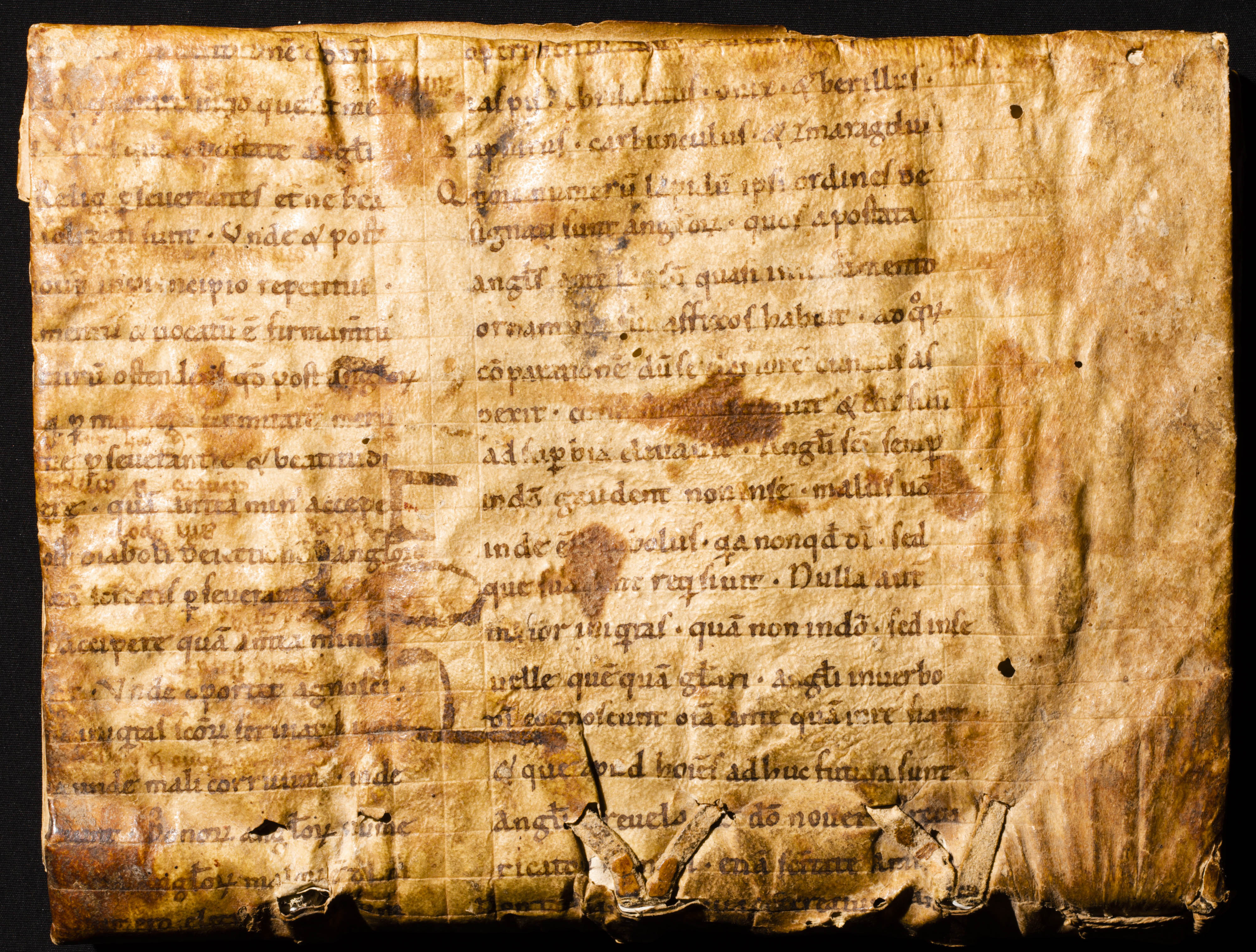
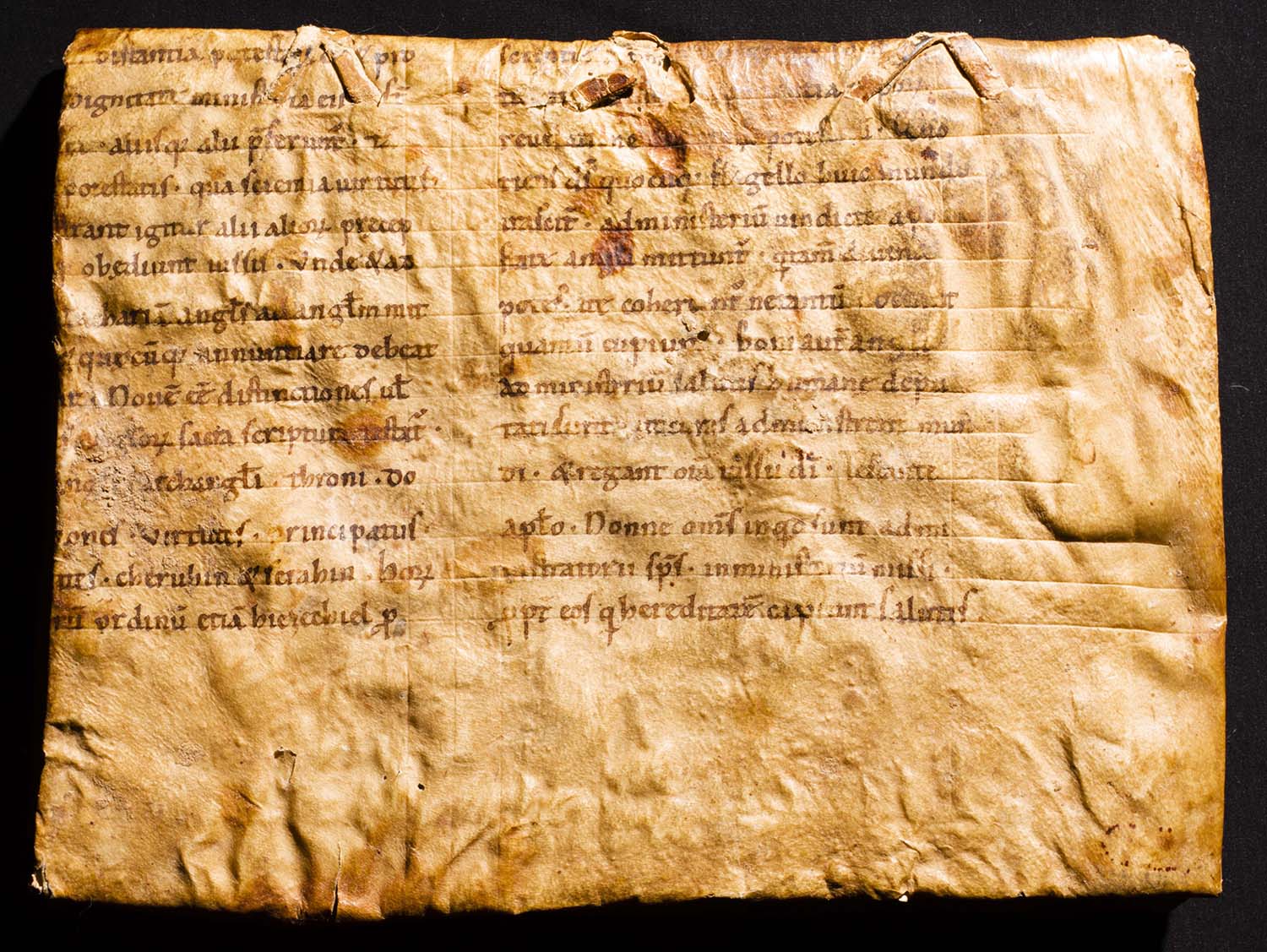
The upper margin of the bifolium (now the fore-edge turn-in of the front cover) is trimmed with no loss of text, the edges of the cover are large enough to allow for turn-ins.
Contains text from Isidore of Seville’s Sententiae, Book 10.11 "De angelis" and a sermon titled "De misericordia" attributed to John Chrysostom, also known by its opening words: "Tria sunt quae in misericordiae opera."
Link to KU catalog entry.
Link to Digital Scriptorium entry.
-
1
2022-10-20T15:53:43-07:00
MS C189 Front Flyleaf
18
plain
2022-12-10T13:10:29-08:00
Front Flyleaf
Text: John 6:1-14
Country: Italy?
Language: Latin
Assigned Date: s. XII
Date: c. 1150
Searchable Date Range: 1100-1150
Script: Late Caroline miniscule, Praegothica
Music: Neumes on a red, 1-line staff
Other Decoration:- Section titles in red
- Red initials
- Red staff lines
- Part of a large strapwork initial in brown ink, decorated in red
Description:- Parchment - 300 x 210 mm - 2 columns from 32-34 lines, ruled in drypoint; 1 line of text accompanying each line of music
- Breviary, noted
- Antiphonary
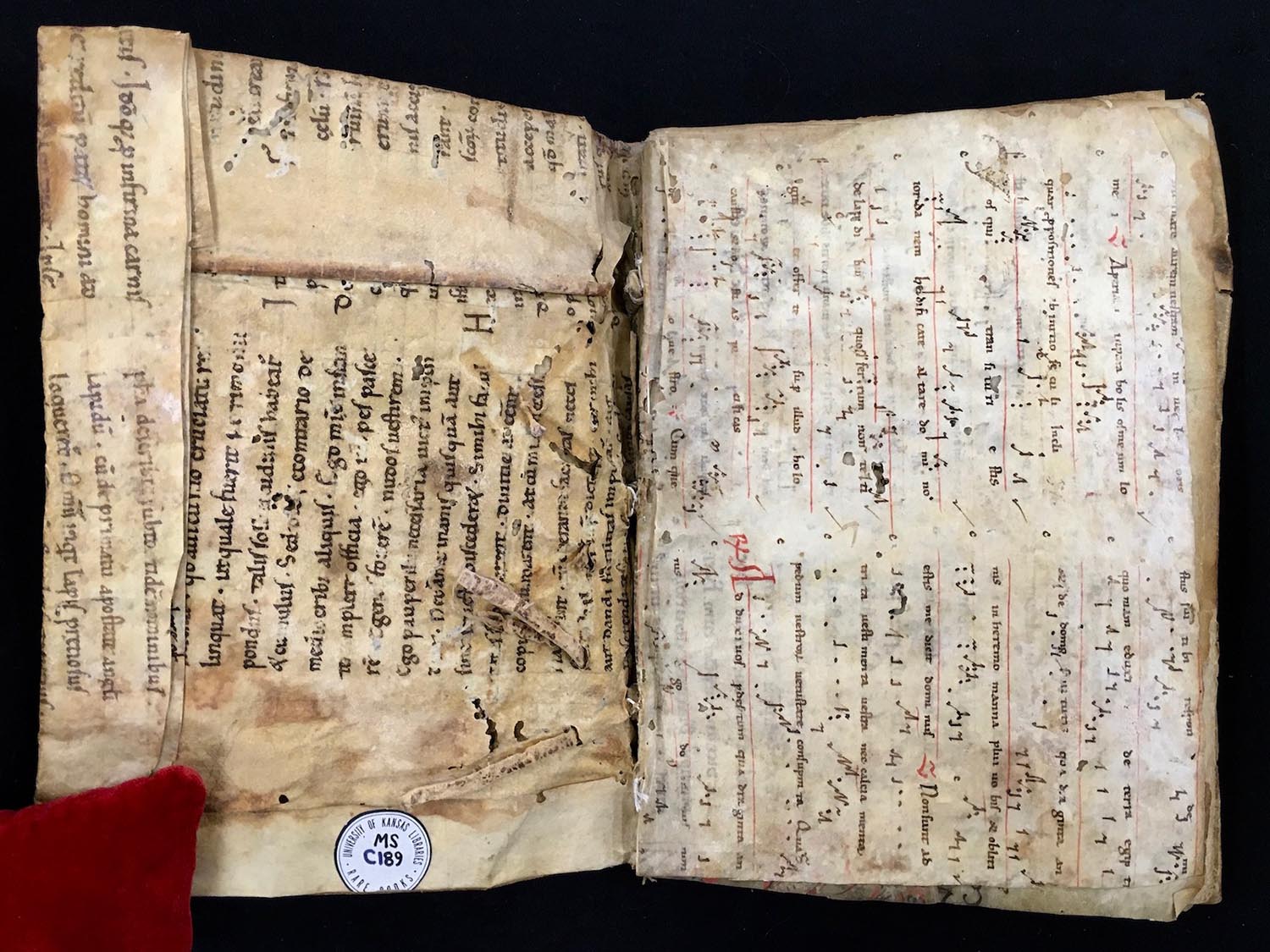
The parchment folio used for the front flyleaves likely comes from a repurposed antiphonary, dated to the first half of the twelfth century.Condition:- The upper margin of the leaf (now the outer edge of the first front flyleaf) is trimmed, with at least two lines of text lost.
- Outer and inner margins of the leaf are trimmed, with some text lost on the outer margin (now the tail-edge).
"Tunc acceptabis sacrificium justitiae si averteris faciem tuam" [Cantus ID: 005236]; "Aperiam in parabolis os meum loquar propositiones" [Cantus ID: g01030b]; "Adduxi vos per desertum quadraginta annos" [Cantus ID: 006030]; "Adduxit eos dominus in fortitudine magna cibavit" [Cantus ID: 006032].
John 6:1-14 Douay-Rheims Bible (DRB) translation:[1] After these things Jesus went over the sea of Galilee, which is that of Tiberias. [2] And a great multitude followed him, because they saw the miracles which he did on them that were diseased. [3] Jesus therefore went up into a mountain, and there he sat with his disciples. [4] Now the pasch, the festival day of the Jews, was near at hand. [5] When Jesus therefore had lifted up his eyes, and seen that a very great multitude cometh to him, he said to Philip: Whence shall we buy bread, that these may eat?
[6] And this he said to try him; for he himself knew what he would do. [7] Philip answered him: Two hundred pennyworth of bread is not sufficient for them, that every one may take a little. [8] One of his disciples, Andrew, the brother of Simon Peter, saith to him: [9] There is a boy here that hath five barley loaves, and two fishes; but what are these among so many? [10] Then Jesus said: Make the men sit down. Now there was much grass in the place. The men therefore sat down, in number about five thousand.
[11] And Jesus took the loaves: and when he had given thanks, he distributed to them that were set down. In like manner also of the fishes, as much as they would. [12] And when they were filled, he said to his disciples: Gather up the fragments that remain, lest they be lost. [13] They gathered up therefore, and filled twelve baskets with the fragments of the five barley loaves, which remained over and above to them that had eaten. [14] Now those men, when they had seen what a miracle Jesus had done, said: This is of a truth the prophet, that is to come into the world. -
1
2022-10-20T15:56:16-07:00
MS C189 Textblock
12
plain
2022-12-10T13:17:22-08:00
Beyond the cover
Textblock
Language: Latin
Country: Italy?
Century: 14th?
Date: c. 1301 and 1400
Script: Gothic rotunda
Scribe:- Written by a Robertus: “Robertus nomine scripsit” -- colophon, folio 34r.
Figurative Decoration:- Drawings of fish and birds in lower margins on folios 9r, 10v, 11r, 20v
- 6- line initial C in blue and red on folio 1r
- 2- and 3-line initials in two shades of red, some of which are embellished with pen decorations in blue or brown
- Paragraph marks in blue and red or just red
- Title "p[er] germinias" in red capital letters on upper margin of folios 19v-21r
- Spaces left for 2-, 3- and 5-line initials on folios 5r, 5v, 6r, 6v, 7r, 8r, 11v, 16v, 17r, 18r, 18v, 19r, 19v, 20r, 22v, 25r, 27r, 27v, 28v, 29r, 29v, 30v, 31v, 32r, 32v, 33r
- Guide letters visible on most folios in the upper left corner of the page
Description:- Collection of works by Aristotle and commentaries on Aristotle's works
- 34 leaves : parchment, illuminations ; 211 x 153 (127 x 77) mm; bound: 215 x 160 mm
- ff. 1- 34v - Contemporary binding made from reused parchment bifolium
- Unfoliated, quarto manuscript
- 31 long lines ruled in lead.
- Front flyleaves
- Neumatic notation.
- Minor imperfections and signs of early repairs on the manuscript leaves.
- Ink is abraded, with some text illegible.
- Tears and holes with loss of text on several folios.
- Corrections, overwriting and annotations, including the use of trigons by at least two contemporary hands, one of which is probably the scribe.
- Later annotations, especially on folios 19r-33r, by at least two hands.
- Some of the annotations on the upper margins are lost due to damage to the parchment.
The text block of the manuscript was produced together as a single unit. It does not look like there are any missing leaves or that there were more gatherings either in the beginning or at the end.
Contents:- Folios 1r-8r: Isagoge (Introduction to Categories), written by Porphyry of Tyre, translated by Boethius:
- Folios 8r-19r: Praedicamenta, also known as Categoriae, written by Aristotle, translated by Boethius
- Folios 19r-27r: Perihermenias, also known as De interpretatione written by Aristotle, translated by Boethius
- Folios 27r-34r: Liber sex principiorum
- Folio 34v: blank