Introduction: Understanding Jackson County, Florida, from 1865-1871
While the first page containing the timeline explains major events of the period, other pages in the Scalar book analyze the political activity and organized violence that make up the bulk of the timeline. Page two, “Forged from a Wilderness,” explains the historical foundations of Jackson County. Page three, “War and its Aftermath,” then explains how the Civil War and the immediate aftermath of United States military control in local government helped to transform the political, social, and economic spheres of Jackson County county during the Civil War. Pages four and five, “Gaining the Franchise” and “Political Schisms” examine the shifting political culture of Jackson County in the aftermath of the Civil War. Page six and seven, “The Regulators: Organized Violence” and “Violence and Fury Unleashed” explain how and why organized violence came about at the same time white Democrats were attempting to regain the social, economic, and political power they had so recently lost. Page eight, “Leaving for Good,” describes the end of the violence and the defanging of the powerful Republican party of Jackson County.
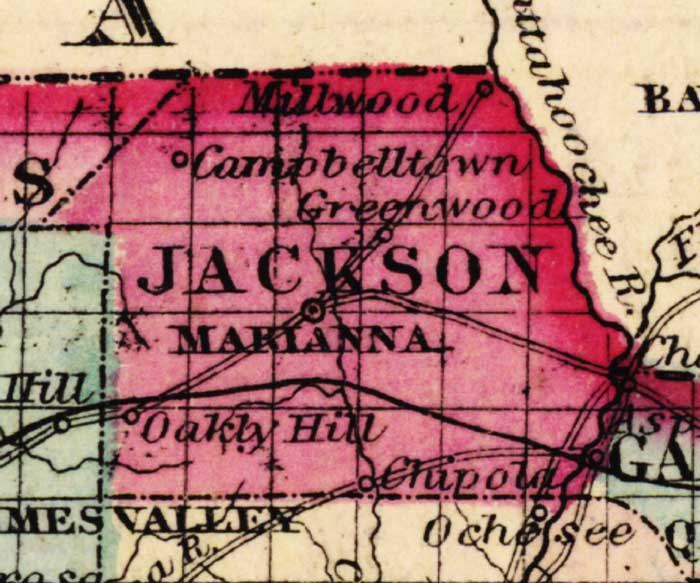
The second section of the Scalar book also offers a few digital tools to give further context and analysis to the investigation. A map was added to help individuals locate Jackson County in Florida. A photo slider presents large portraits of some of the important Republican political figures that emerged during the Reconstruction era. I acknowledge that the photos, maps, and other primary source visuals that I have chosen do not fully represent differences in race, political affiliation, or class. I am limited by photographic technology of the day and the relative difficulty of finding photographs of specific, yet relatively unknown historical actors. Poor whites and blacks in rural Jackson County probably did not have the resources for photographs, and other white Democrats were absent from the digitized state archives I used. Another digital tool that I used was a network analysis graph. This tool helped to visualize patterns of occupation that surrounded political affiliation.
This book is meant for a public audience. The index at the top of the page gives an outline of the book’s sections. Readers should follow the linear structure of the book. First, read the timeline to familiarize yourself with the chronological narrative of political action and violence in Reconstruction Era Jackson County. Then, continue to the second section to read analysis of the events. This section will provide readers with further content and the thematic breakdown of chronological events. It is the author’s hope that this born-digital book opens up a discussion about race, class, politics, and the formation of organized violence in Florida. Click the button below to begin a journey through a tumultuous and defining moment in the history of Jackson County, the state of Florida, and the American South.