Posthumanism
posthuMANism
a world without men where fish ride bicycles..?“A woman without a man is like a fish without a bicycle.”
- Irina Dunn 1970
"A woman needs a man like a fish needs a bicycle." I really hate this expression. I bet fish would totally want bicycles.
- Meg Cabot, Princess on the Brink
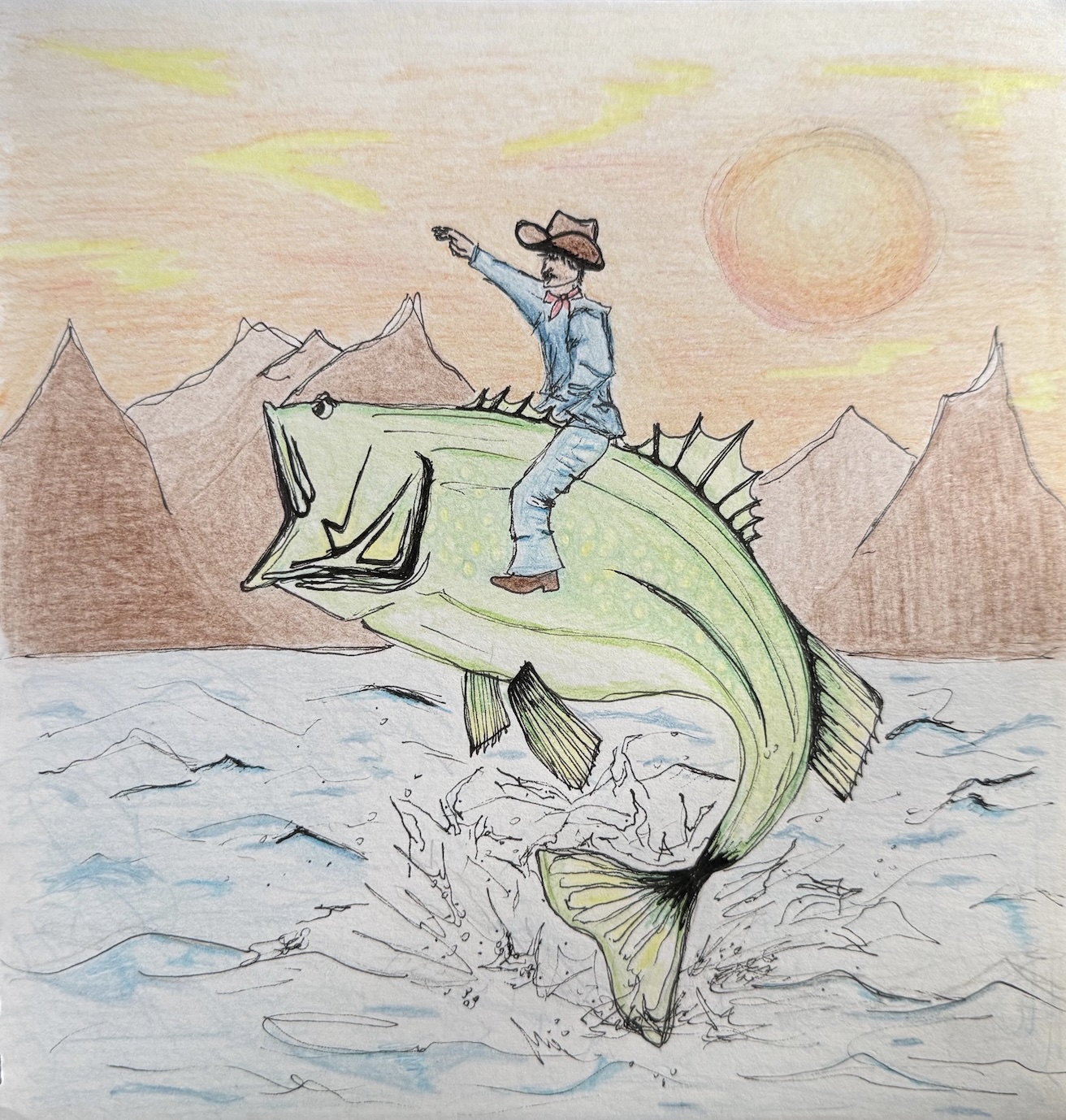
A man without a fish is like a woman without a bicycle?
At the end of the day (or the world?) everyone just wants to ride a bicycle :)
- Tess Ertel 2026
Ode To Bicycles
Pablo Neruda
I was walking down a sizzling road:
the sun popped like a field of blazing maize,
The earth was hot,
an infinite circle
with an empty
blue sky overhead.
A few bicycles passed me by,
the only insects in that dry
moment of summer,
silent,
swift,
translucent;
They barely stirred the air.
Workers and girls
were riding to their factories,
Giving their eyes to summer,
their heads to the sky,
sitting on the hard beetle backs
of the whirling bicycles
that whirred as they rode by
bridges, rosebushes, brambles
and midday.
I thought about evening
When the boys wash up,
sing, eat, raise a cup of wine
in honor of love
and life,
and waiting at the door,
the bicycle,
stilled,
Because only moving
does it have a soul,
and fallen there
it isn’t a translucent insect
Humming through summer
But a cold skeleton
that will return to life
Only when it’s needed,
when it’s light,
that is,
With the resurrection of each day.
In Pablo Neruda’s poems, bicycles without riders resemble skeletons: hollow forms waiting for movement, seemingly lifeless without human intervention. In this sense, the bicycle appears deeply anthropocentric.
But what happens when we imagine a world without humans?
This section is not meant to offer a literal or practical vision, but rather to play with the limits of imagination. If both cars and bikes rely on humans to function as intended, how might they exist—if at all—in a posthuman world? A car, complex and resource-intensive, would likely decay into a toxic artifact: metal, plastic, and chemicals slowly reintegrating into the Earth in uneven and harmful ways. A bike, by contrast, might rust quietly into the landscape, its frame overtaken by vines, its wheels slowly stilled by time. Then maybe a bird might perch on its handlebars, or fish might swim through its sunken frame...
In this imagined world, bikes are no longer vehicles but habitats—objects that have been absorbed into ecosystems rather than imposed upon them.
Of course, the image of a fish riding a bicycle is absurd. That is precisely the point. This absurdity draws attention to how deeply human-centered our technologies are. Even something as seemingly simple and sustainable as a bike is designed for a specific body.
At the same time, bikes gesture toward a different kind of relationship between movement and energy. Unlike cars, which extract and externalize power, bikes operate through the direct input of a living body. In this way, they echo older forms of movement—where the wheel once worked alongside animals like horses or oxen, rather than replacing them entirely.