Thanks for your patience during our recent outage at scalar.usc.edu. While Scalar content is loading normally now, saving is still slow, and Scalar's 'additional metadata' features have been disabled, which may interfere with features like timelines and maps that depend on metadata. This also means that saving a page or media item will remove its additional metadata. If this occurs, you can use the 'All versions' link at the bottom of the page to restore the earlier version. We are continuing to troubleshoot, and will provide further updates as needed. Note that this only affects Scalar projects at scalar.usc.edu, and not those hosted elsewhere.
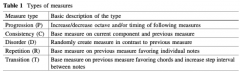
12019-04-17T14:13:22-07:00Nikita Guedj26e5e59f5c86b075d03e3719dbc6b89b70271c8f335208plain2019-04-17T20:39:05-07:00Nikita Guedj26e5e59f5c86b075d03e3719dbc6b89b70271c8fI read a fascinating article, “A Hybrid Approach to Automated Music Composition,” that discusses MAGE, the first attempt at hybrid music composition, which allows some planning. MAGE combines the best aspects of stochastic processing, genetic algorithms and routine design, and creates a composition “that is listenable both in terms of music that flows together and is not incoherently random” (Fox and al. 2016, 216). As they explain, "utilizing planning as a component in music composition can provide a bridge between the strictly predictable rule-based approach and the strictly random stochastic and GA [genetic algorithms] approaches.” (213) The user input, as in Max, specifies degrees of repetitiveness, variability, and dissonance wanted in the song. The user controls these by specifying the number of each of five available measure types. (Fox and al. 2016, 216).