Thanks for your patience during our recent outage at scalar.usc.edu. While Scalar content is loading normally now, saving is still slow, and Scalar's 'additional metadata' features have been disabled, which may interfere with features like timelines and maps that depend on metadata. This also means that saving a page or media item will remove its additional metadata. If this occurs, you can use the 'All versions' link at the bottom of the page to restore the earlier version. We are continuing to troubleshoot, and will provide further updates as needed. Note that this only affects Scalar projects at scalar.usc.edu, and not those hosted elsewhere.
Our Rare Books, Our SMC: An Exhibit of Items Held at Saint Mary's College
Main Menu
The Rare Book Room
The History of the Collection
Women's Education: Appropriate Ways of Being a Woman Across Three Centuries
Shifting Attitudes to Children’s Culture
Establishing Boundaries, Defining Cultures
The Natural World and Our Place In It
Coda
Sarah Noonan
6616b08296cc76f25739fd6dc35367e3165a69b8
Mia Belcastro
a3a4025c9d7357637088fba0bae46eec72e451f0
Laynie Cheek
b23266d257d55250b3092e9e2f6a6146bfc84236
Emma Feller
514aaf3143bed265a87e0f54a7e509b50533257d
Theresa Hayes
c341e234aafdd2032649284bfe86863d3eedee5c
Abigail Kawalec
3e7b8228867175adb63d87267d416ffa26d26938
Marykate Miller
6d060a67db1c3324a9eb7094bcb881bcf1402fc0
Ella Novak
c489dfb165482e6fc417c52bc3f14f29768f81bf
Trudi L. Patterson
084c07dfaa449798635a2d3068a7babbf010d6c0
Rachel Rowe
816d058c7808a28c481f6d1f1bdd8291f24cefe1
Stephanie Rowe
23ab13e3084a89bf0cd3e95612bf584219aadecb
Brittney Sanders
3f6ec9a46f25f58ce399d6ba1def6c0f2ed14082
Mary Sutherland
f32e9254d8d1a19f829b99e9759f62df6e72dbb8
Amaya Vega-Fernandez
dafe909530cfa94b6202a485ff111a506ef55639
Clara Venia
a95bc980f10d4536b3a25d314166e8a1e19ff360
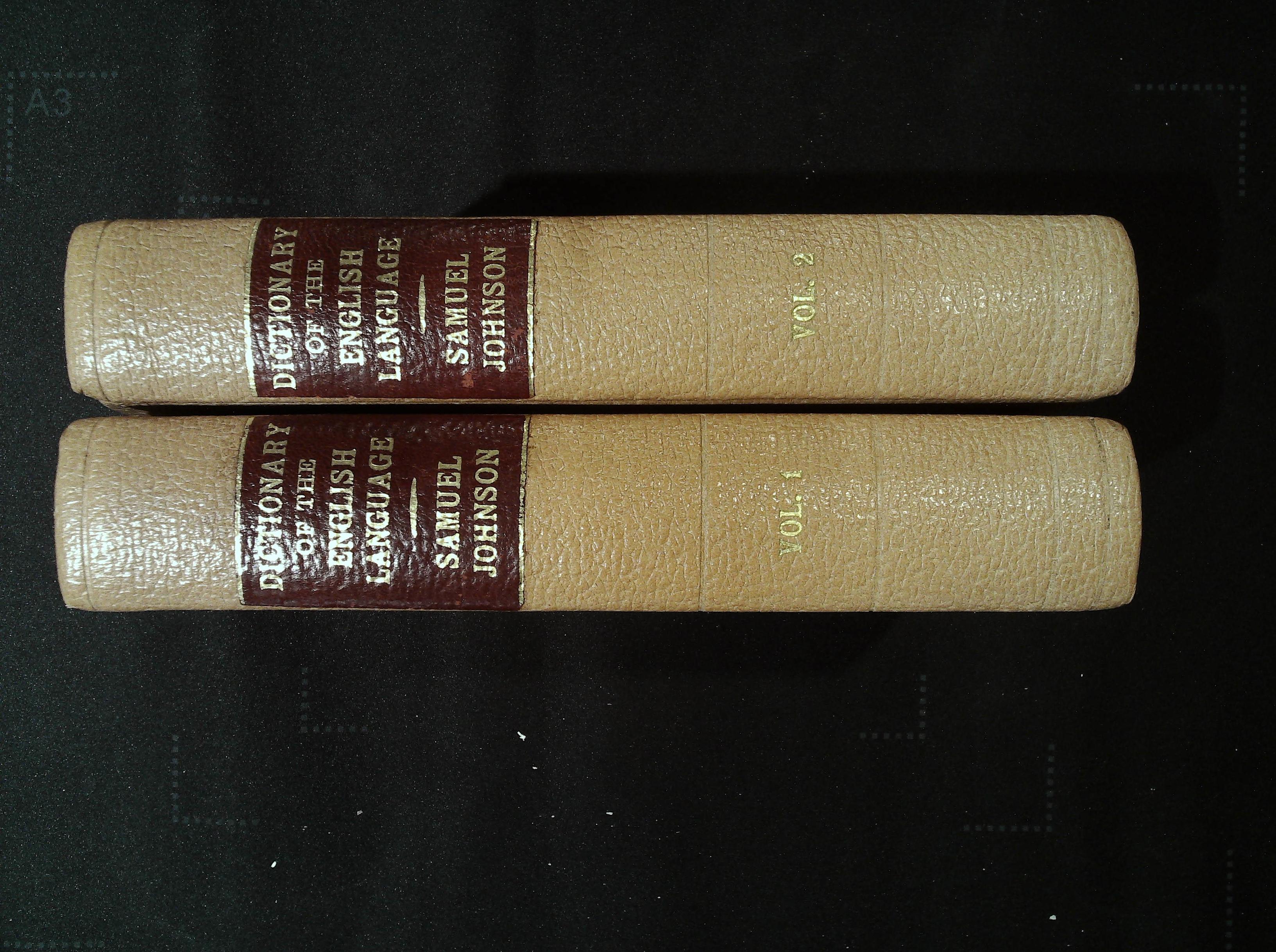
Johnson's Dictionary 7th Edition, Side Covers
1 media/Sanders_Item0174_thumb.jpg 2024-04-14T06:30:22-07:00 Brittney Sanders 3f6ec9a46f25f58ce399d6ba1def6c0f2ed14082 44797 4 Side cover from Samuel Johnson, Johnson's Dictionary 7th Edition (London, 1783). Image of the side cover of the seventh volumes of Johnson's Dictionary; note the new bindings that were put on in 1955. plain 2024-04-27T13:42:37-07:00 Brittney Sanders 3f6ec9a46f25f58ce399d6ba1def6c0f2ed14082This page is referenced by:
-
1
media/Feller_Item0238.jpg
2024-04-17T13:02:28-07:00
Three Different Editions of Johnson's Dictionary
14
plain
2024-04-30T13:33:43-07:00
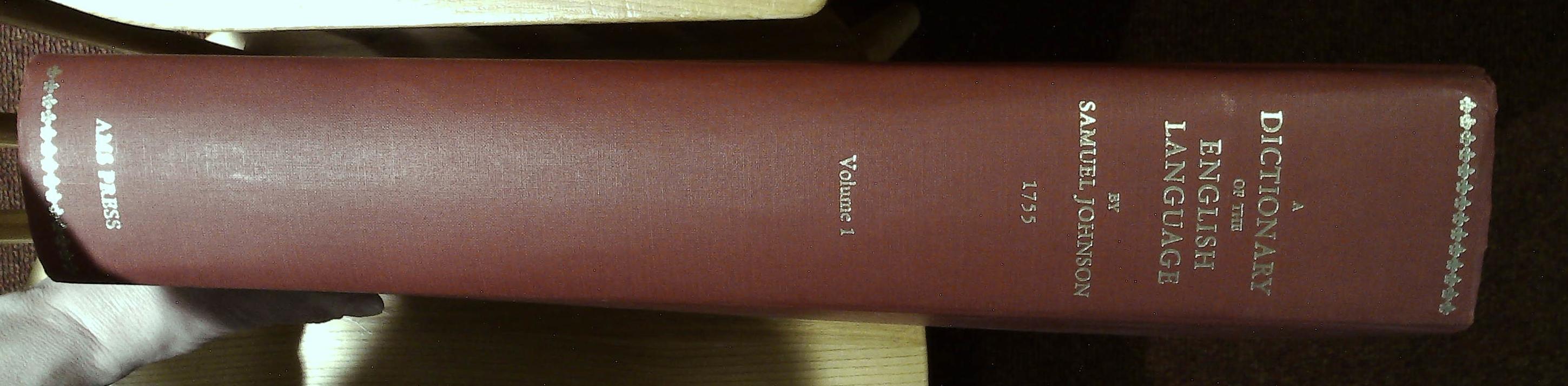
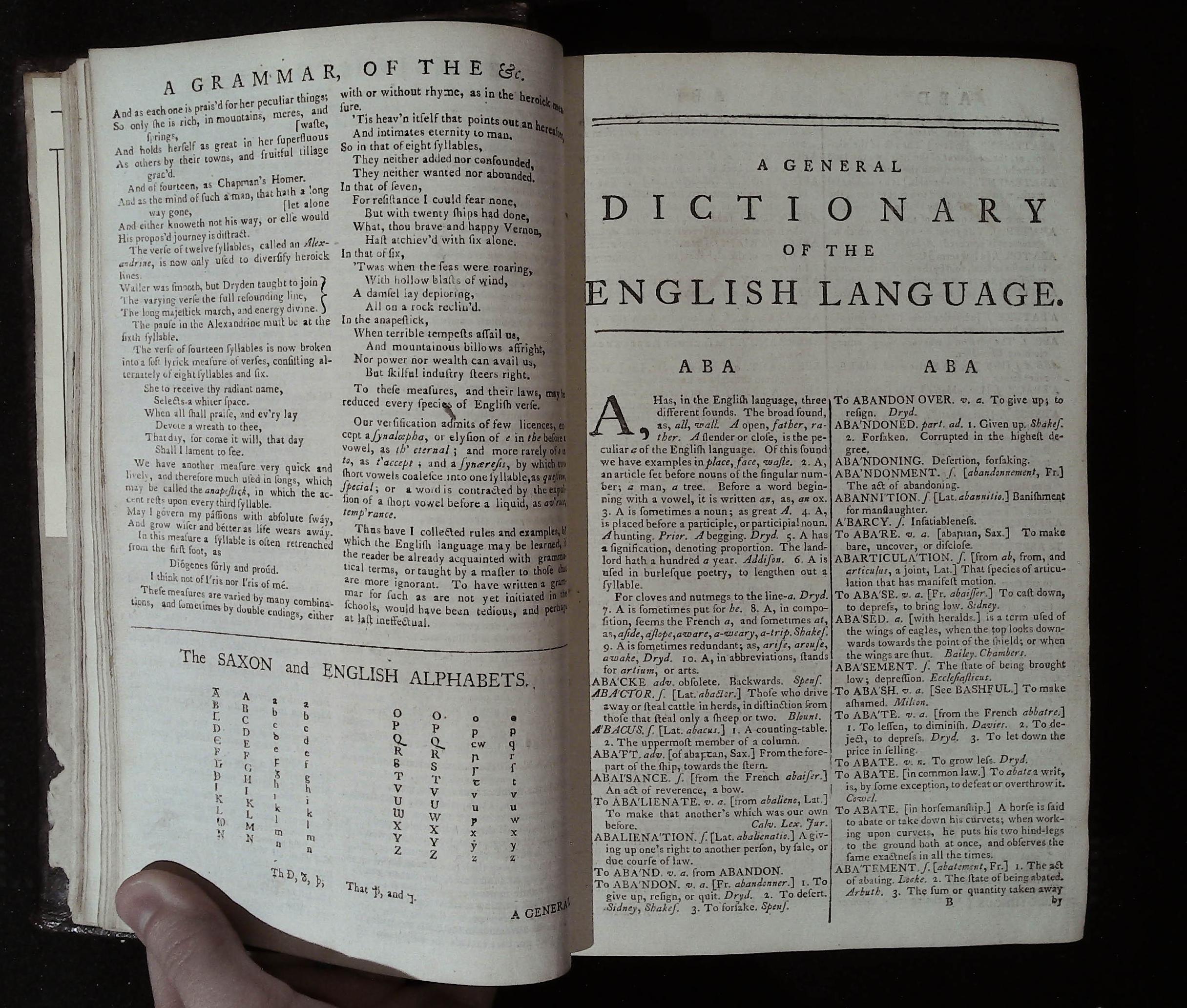
Saint Mary’s College has not one, not two, but three different editions of Samuel Johnson’s Dictionary, also known as A Dictionary of the English Language, in the Rare Book Room.
The 1st edition of his dictionary was published on April 15th, 1755. These dictionaries were important in helping increase the literacy rate in England in the mid-18th century while also encompassing the ideas that “his work, in any form, would always be unfinished” (Lerer 180). Who was Samuel Johnson, though? Johnson was an “English critic, biographer, essayist, poet, and lexicographer” (Folkenflik). He was an intelligent man who understood the ideas and workings of the English language and how it was always changing and shifting meaning, and because of this, throughout the years, Samuel Johnson would write over seven different editions of his dictionary. Johnson’s Dictionary helped literacy and the understanding of the English language for many people during his time and later on in the future.
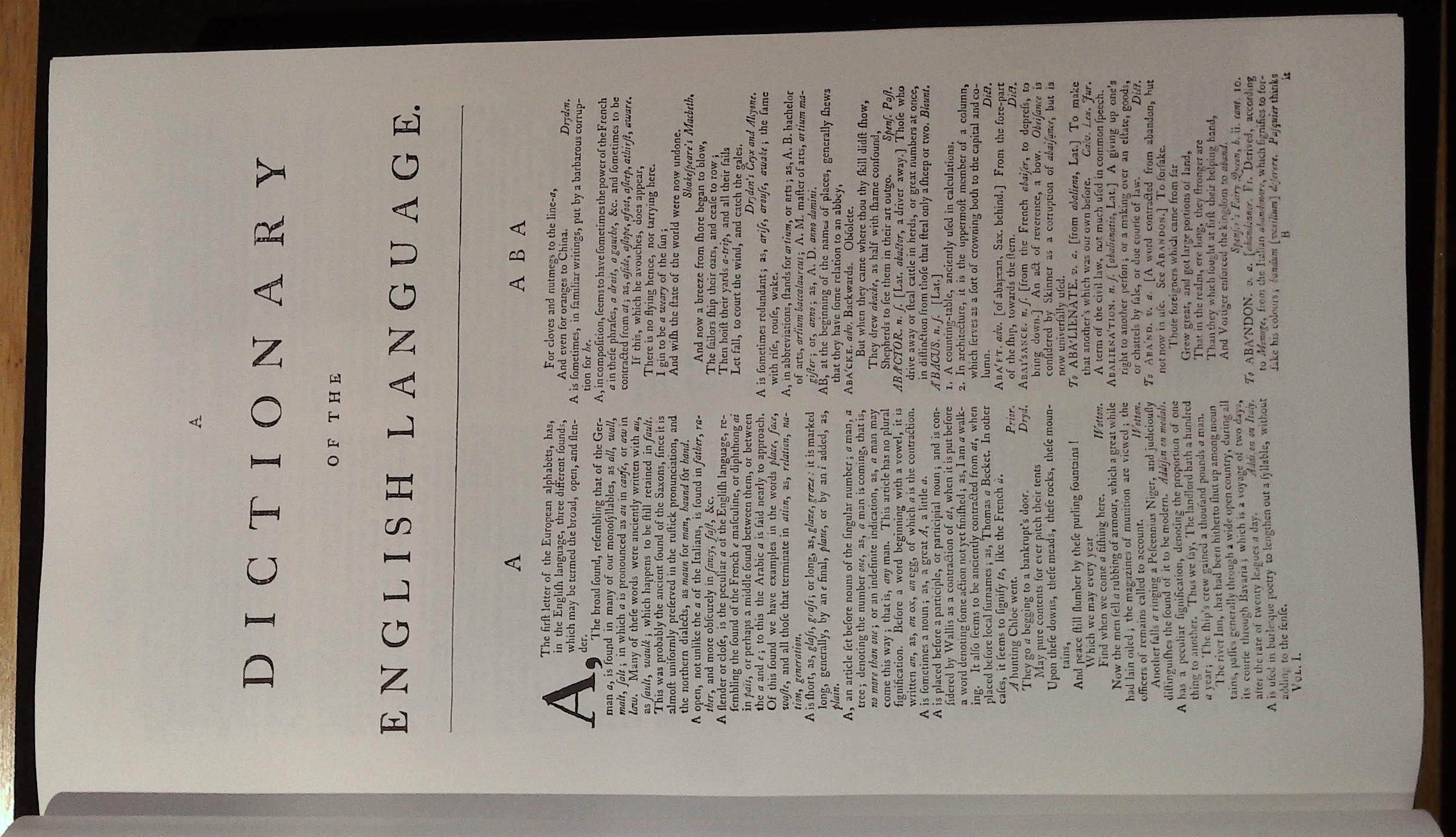
Throughout these different editions, Samuel Johnson had to compensate for additions and shifting definitions of words. For example, the definition of the letter “A” changed from the 1st to the 3rd edition. In the 1st edition, Johnson was more eloquent in explaining the context of the letter “A” and the definition of the article “a.” He described it as “resembling that of the German a” in the 1st edition yet decided to keep that out of the 3rd edition (Johnson). Perhaps he had to compensate for less room in the later editions because he had to add new definitions to old words.
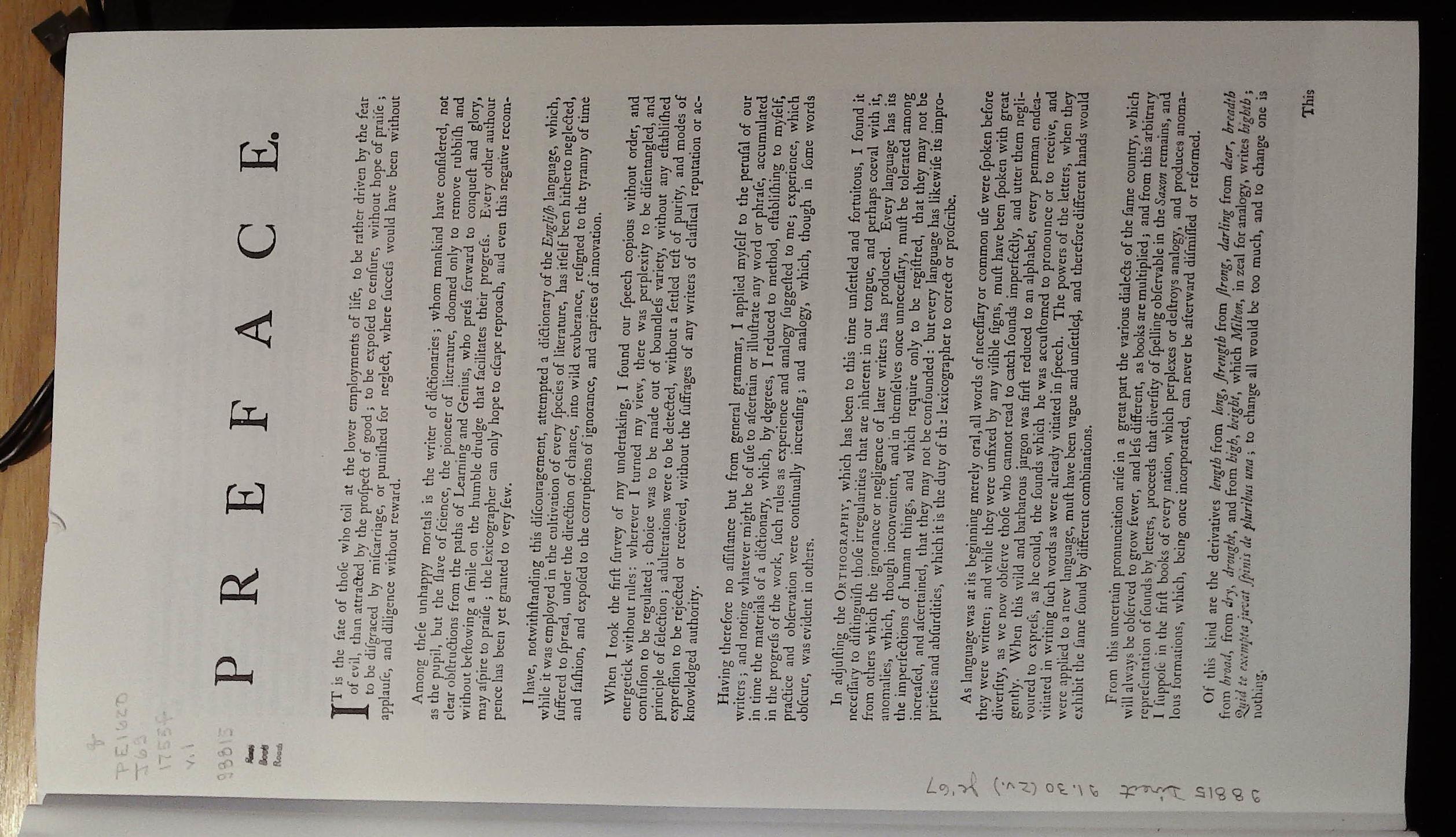
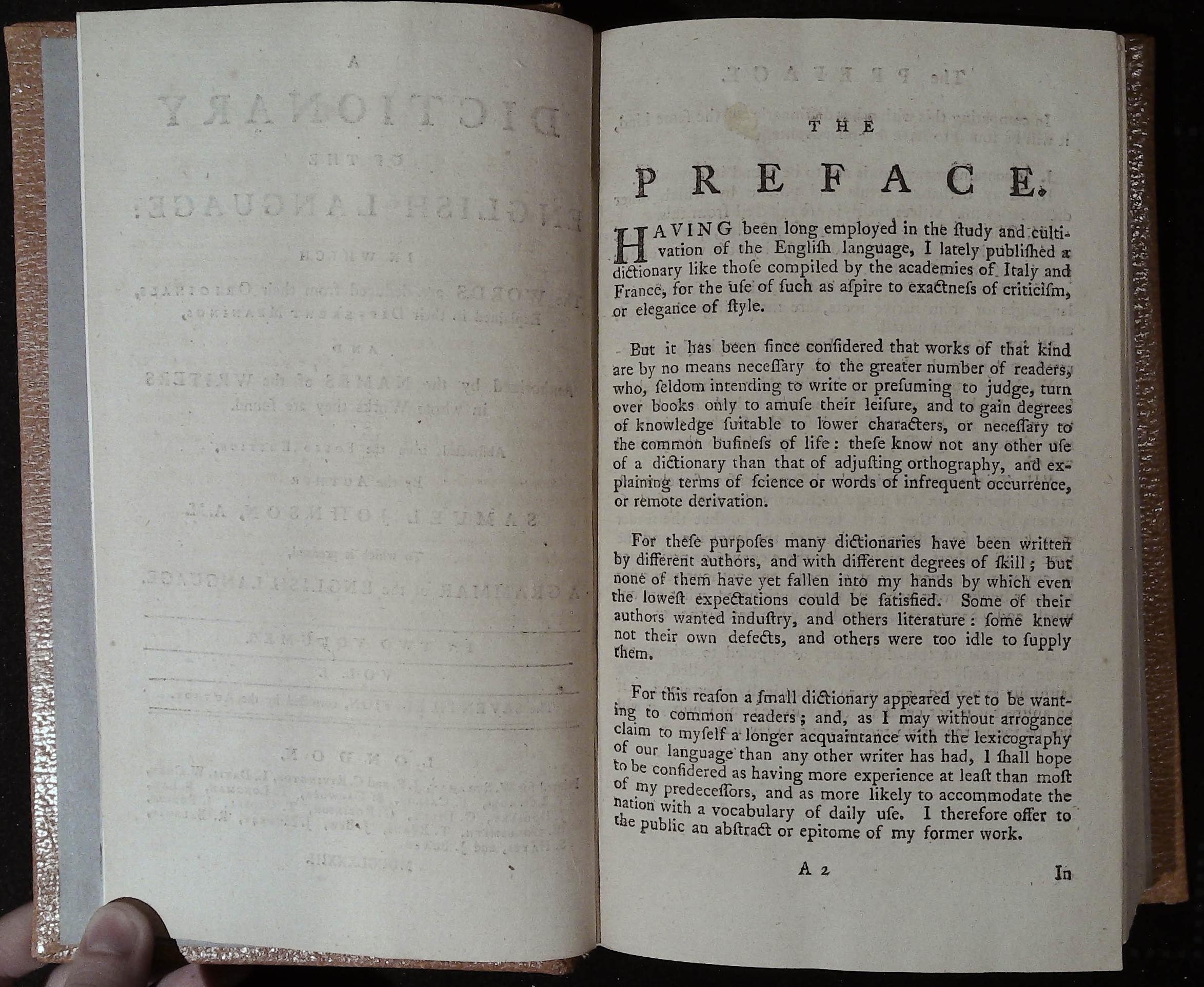
Another example of some changes Johnson made was with the preface. In our 1st edition, Johnson goes on for about 10 pages, describing his process in compiling the dictionary and how his own idea of the dictionary changed throughout the years of making it. However, in the 3rd and 7th editions we have here, the preface is about 2 pages long, describing how words had changed after he published the 1st edition. Johnson very quickly found out that the language he was trying so hard to fit into a box could never do that, that it was always meant to change.
The 1st edition facsimile of Johnson's Dictionary we have looks exactly like what the original edition looked like, but it was printed in 1967 in New York, about 200 years after Johnson began his work on it. This set of two volumes contains the full preface that Johnson used to detail his journey in creating the dictionary and the changes that came about in the 8 years it took to complete it. Johnson set out working on the next editions directly after this 1st edition was published because he realized that “this book is for the general reader” (Lerer 173). He opened up his dictionary for everyone to help establish an understanding of the English language as it was up until that point, and up to the points of each of his new editions.
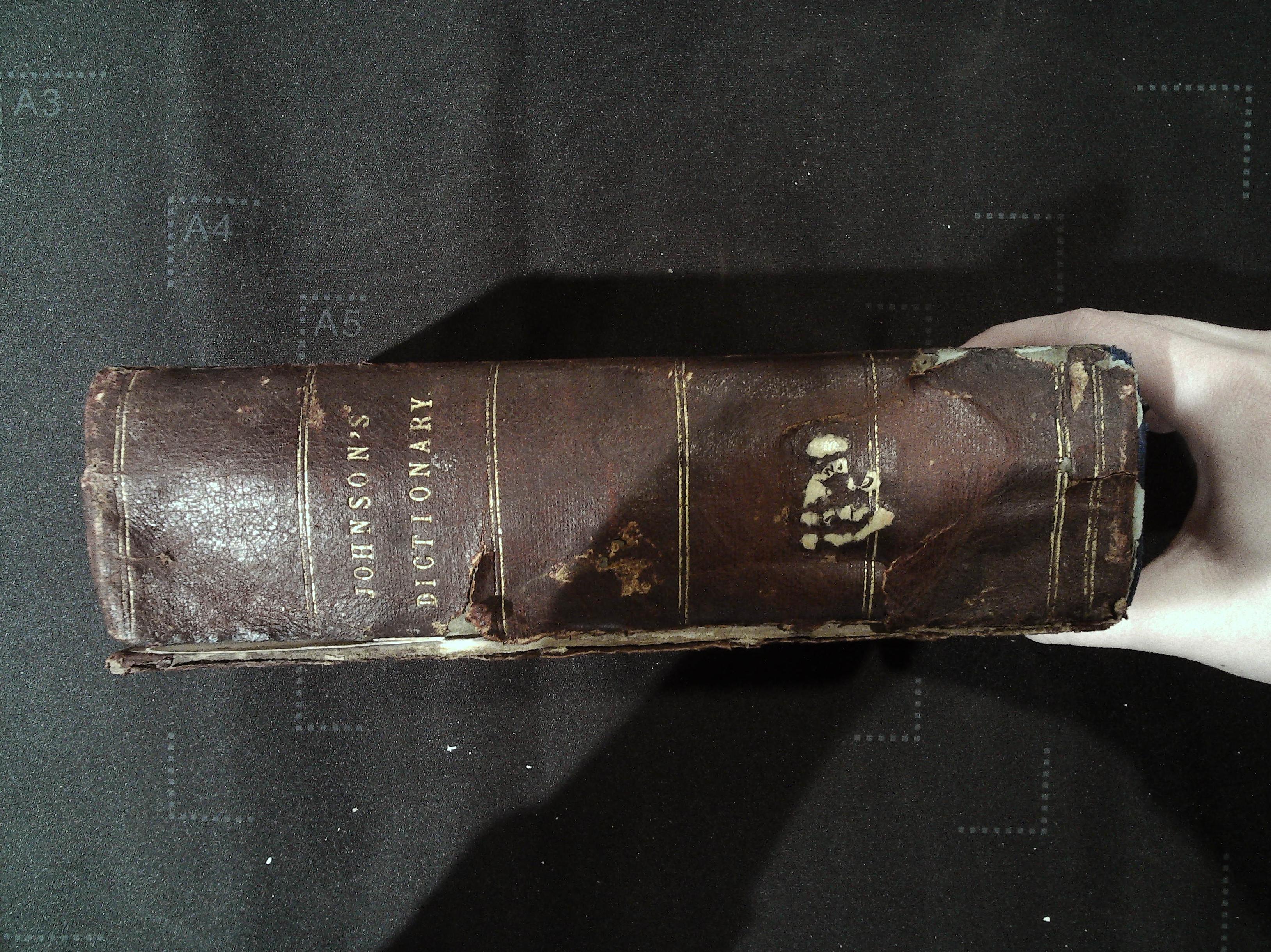
I find that the 3rd edition, published in 1768, is my favorite edition we have here because it looks like it has seen better days. The binding is falling apart, and many of the pages are dulled and discolored from use. This damage suggests that people used this particular edition to understand the English language in the past and that it provided context to this complex and complicated language. This edition contains an addition to the definition of the letter A as compared to the 1st edition. This is an interesting characteristic between these two editions because a lot of things changed in the span of two editions, showing that Johnson went through a lot to keep transforming and reevaluating the English language as something that will always shift as the years go by.
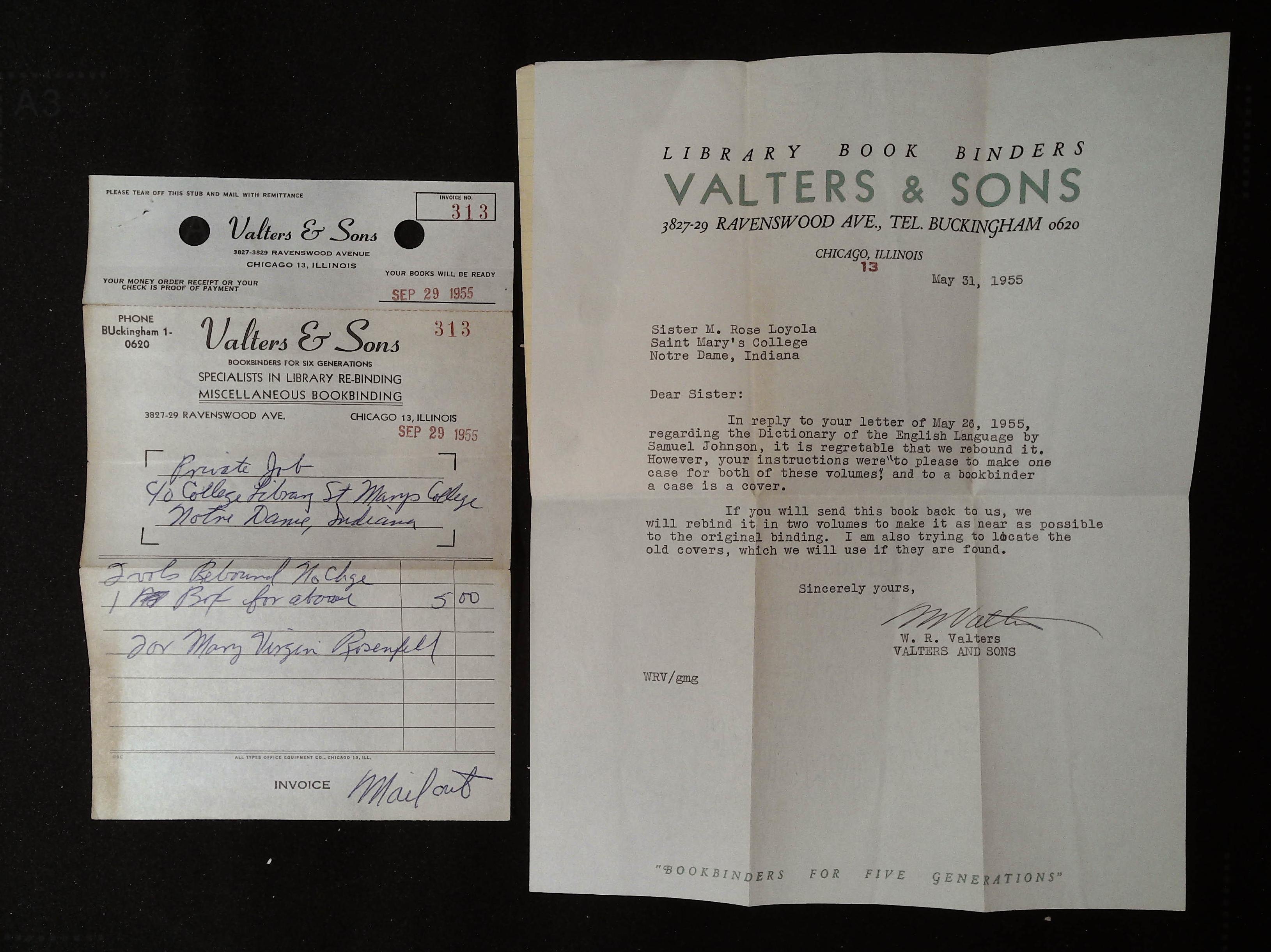
The 7th edition that we have here also contains a different preface than the 1st edition, and it goes to show how Johnson began nearly immediately in revising and adding new words to his dictionary because he knew that language adapts. However, what is so interesting about the 7th edition of Johnson’s Dictionary we have here in the Rare Book Room at Saint Mary’s College is the letter and receipt found in one of the volumes. These small pieces of papers tell a story of how the two volumes were rebound by a business in Chicago called Valters & Sons and were brought about by one Sister M. Rose Loyola in 1955. The receipt states that Valters & Sons had been “bookbinders for six generations” and were “specialists in library re-binding” and “miscellaneous bookbinding,” yet when researching about this interesting business, I could not find much of anything about them now (Indiana Library Federation). It seems like they have disappeared from the records besides a few ads they had placed in “Focus on Indiana Libraries.” These issues were published by the Indiana Library Association “in the interests of its members and its work” (Indiana Library Federation). These advertisements were published around the same time as the rebinding had happened.
Johnson’s Dictionary started out as a project to help “fix our language,” where he wanted to detail grammar rules and perfect definitions of words that lived in our world (Johnson). His dictionary was, at first, used as a way to civilize the savage tongue of those the British were colonizing, of those the British were about to colonize, and of those the British had already colonized. He wanted to “create a dictionary that would fix the English language: that would settle matters of pronunciation, spelling, usage, and etymology,” that would create a singular model of the English language for those who were not literate or those who were coming under the dome of the upcoming British Empire (Lerer 171-72). Johnson used language as a way of creating borders and boundaries between different cultures and lives. He wanted to “imagine that his dictionary can embalm his language and secure it from corruption and decay” of new ideals and cultures (Johnson).
At the end of Johnson’s process of cultivating this dictionary, he learned that “language here is not a static thing” (Lerer 173). Language will always change, and it cannot act as a colonizer. Definitions will always shift and add more and will adapt and transform. That is what is so wonderful – and incredibly powerful – about language, about words, about definitions. As students here at Saint Mary’s, we can look back at these definitions used in Johnson’s Dictionary and wonder how much has changed in the nearly 300 years it has been. This is very important because we are able to see how our language has been reconstructed. Each of these three editions can help the students here view differences from a time long ago and can help the students understand words that were important back in the 18th century. The value of these three editions to the Rare Book Room is nearly priceless because Johnson’s Dictionary paved the way to understanding and learning the English language that was used during Johnson’s time. Yet we can also look at how words and language have remained the same. Many of our words today were born from this time. We can connect with people from the past and their words that have survived. We can even connect with bookbinders who we have lost nearly every other trace of besides what we have here. That is what is so important about language: though it may change, we can always find a way to, miraculously, connect with those of the past.