Thanks for your patience during our recent outage at scalar.usc.edu. While Scalar content is loading normally now, saving is still slow, and Scalar's 'additional metadata' features have been disabled, which may interfere with features like timelines and maps that depend on metadata. This also means that saving a page or media item will remove its additional metadata. If this occurs, you can use the 'All versions' link at the bottom of the page to restore the earlier version. We are continuing to troubleshoot, and will provide further updates as needed. Note that this only affects Scalar projects at scalar.usc.edu, and not those hosted elsewhere.
Micro-Landscapes of the AnthropoceneMain MenuMarginal WorldsPlant WorldsAnimal WorldsAmy Huang, Natasha Stavreski and Rose RzepaWatery WorldsInsect WorldsBird-Atmosphere WorldsContributed by Gemma and MerahExtinctionsMarginal WorldsSam, Zach and AlexE-ConceptsAn emergent vocabulary of eco-concepts for the late AnthropoceneSigi Jöttkandt4115726eb75e75e43252a5cbfc72a780d0304d7d
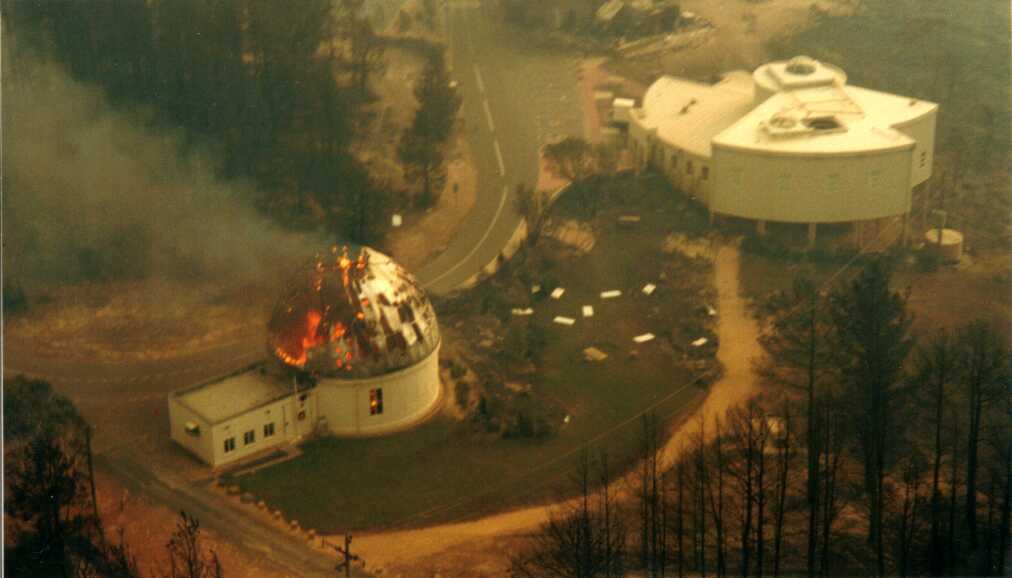
Mount Stromlo Observatory Fire
1media/StromloFire_10a_thumb.jpeg2022-09-25T07:12:46-07:00Sigi Jöttkandt4115726eb75e75e43252a5cbfc72a780d0304d7d309861Lievre, Kimberley Le. “2003 Canberra Bushfires Redefined the Future for Mount Stromlo Observatory.” The Canberra Times, 1 July 2017, www.canberratimes.com.au/story/6031387/2003-canberra-bushfires-redefined-the-future-for-mount-stromlo-observatory/. Accessed 26 Sept. 2022. plain2022-09-25T07:12:46-07:00Sigi Jöttkandt4115726eb75e75e43252a5cbfc72a780d0304d7d
This page is referenced by:
12022-09-25T08:10:38-07:00To The Stars, For The Fire4plain2022-09-26T23:20:59-07:00Let us take this burning observatory as a symbol both of human entanglement with nature and our current fascination with worlds beyond our own. Let us ask, why do we reach into space? Two thoughts come to mind for me: first, we seek life beyond our planet and, second, we seek new homes. The life we seek is, implicitly, life like us. “Intelligent,” we say, as if the life we already know isn’t really all that bright. So, we look to the brightness above to find something akin to ourselves while ignoring similarities with the fire consuming our observatories; its swift ravenous consumption may mirror our own but, clearly, its mindlessness does not. Fire engulfs, driving forward our search for other worlds for we may have grown in quantity and hunger but so too have the swift and ravenous fires. Yet, our burning observatories expose our other-worldly-want for what it truly is: a running from the maw of our extinction—and it is our extinction. As we were burning our coal, we burning our observatories. Ah, look, there it is, the smoke which called forth the smoke.