Thanks for your patience during our recent outage at scalar.usc.edu. While Scalar content is loading normally now, saving is still slow, and Scalar's 'additional metadata' features have been disabled, which may interfere with features like timelines and maps that depend on metadata. This also means that saving a page or media item will remove its additional metadata. If this occurs, you can use the 'All versions' link at the bottom of the page to restore the earlier version. We are continuing to troubleshoot, and will provide further updates as needed. Note that this only affects Scalar projects at scalar.usc.edu, and not those hosted elsewhere.
Marquee Survivals: A Multimodal Historiography of Cinema's Recycled SpacesMain MenuIntroductionMarquee Survivals: A Multimodal Historiography of Cinema's Recycled SpacesIntroduction, StartMarquee Survivals: A Multimodal Historiography of Cinema's Recycled SpacesHistories ConcealedHistories Concealed landing pageProjecting 1943Sense of PachucaBroadway as BackgroundSplash page for Broadway as Background / Background as BroadwayPhoto Essay: Marquee StoriesIntro to photo essay: Marquee StoriesPrototypesExploring project prototypesPortfolioEjected Spectators and Inactive Users: Locating Multimodal Historiography In Repurposed Media SpacesVeronica Paredesf39d262eb7e9d13906fe972f3e5494dbae1896bc
Stored on Broadway
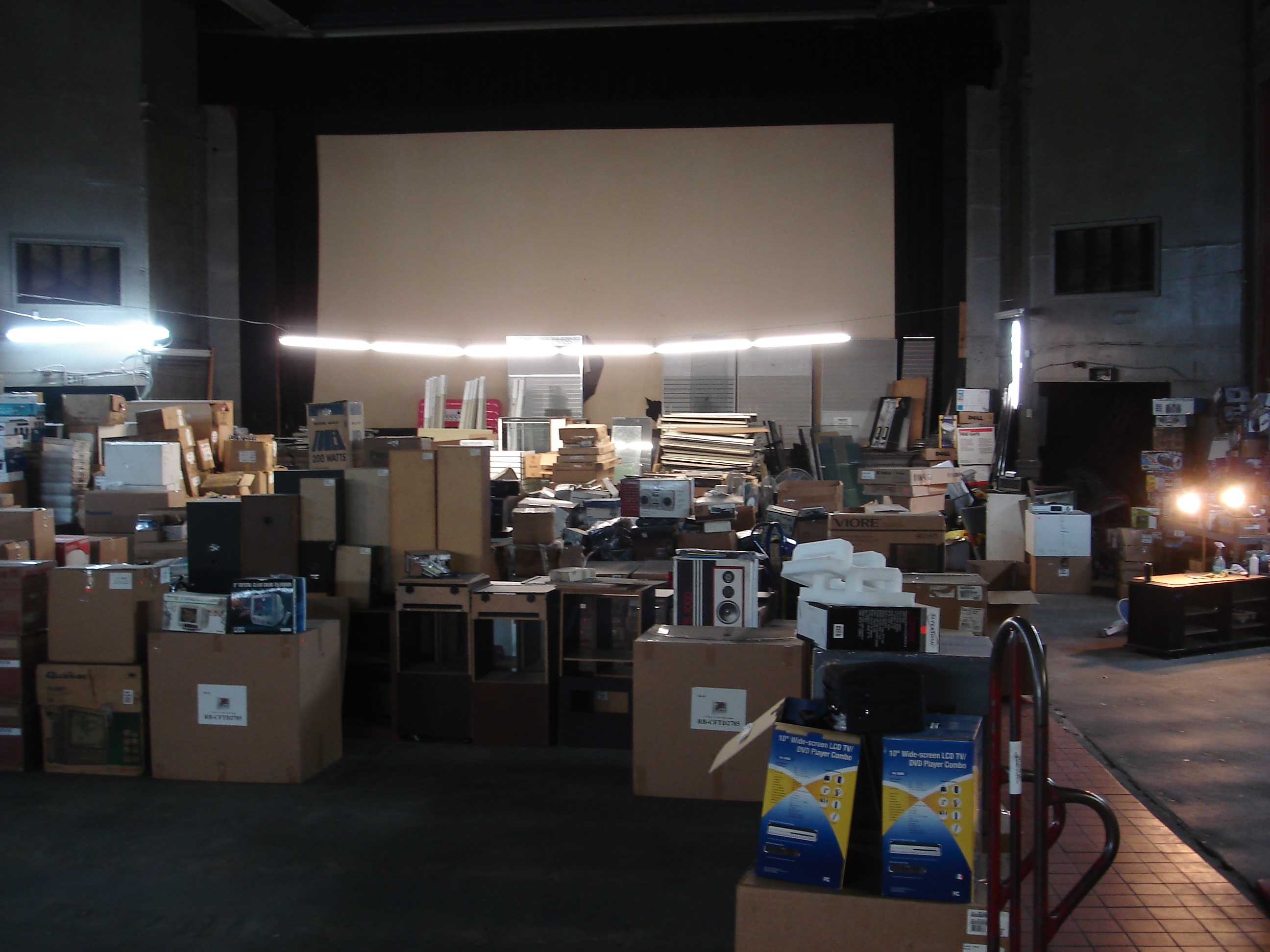
12014-10-30T22:28:27-07:00Veronica Paredesf39d262eb7e9d13906fe972f3e5494dbae1896bc34296Focuses specifically on South Broadway in Downtown Los Angelesplain2015-06-06T23:45:47-07:00Veronica Paredesf39d262eb7e9d13906fe972f3e5494dbae1896bcSeveral years ago, I traveled along South Broadway in Downtown Los Angeles as part of an Los Angeles Conservancy tour of the Theatre District. The group I walked with swooned at the Palace's newly power-washed Renaissance Revival façade. They admired renovations done to the interior of the Million Dollar Theater, the location where we met. As we reached the 500 block of the Broadway, the reactions of awe changed. On this block three former theaters—Roxie (built 1931), Cameo (formerly Clune’s Broadway, built 1910) and Arcade (formerly Pantages, built 1910)—have been converted into retail space. While Roxie sells clothing, both Cameo and Arcade specialize in consumer electronics. As the group of tourists moved through the storefronts populated by Middle Eastern, Latino and Asian electronics salesman, we retraced the steps cinema and vaudeville spectators had once followed, as they walked through theater lobbies into the downtown movie theaters. In 2007, however, there was no room for spectators in these theaters, the seats had been removed and boxes holding electronics merchandise piled high in their place.
Cameo remained one of the longest operating movie theaters in California until 1991, when it was converted into retail space. Having withstood challenges from television and resisted declines in movie theater attendance, Cameo had managed to operate as a second-run movie theater—only to become the storehouse for the very entertainment forms that had dethroned cinema. As I scanned the inventory that now filled Cameo, I noticed the handheld devices, the screens, the DVD players and the abundant supply of phones. Instead of mourning the decay of this once vibrant theater, my mind spun with the meaning of this converted space. Was cinema dead at Cameo? And if it was, was this theater its carcass, a physical signifier that implicated the electronic (or the digital) not only as a parasite, but also, therefore as physical itself?
Like the cans of film that had once made cinema projection possible inside Cameo, the boxes filled with electronics contained the physical substance of entertainment media and mediated imagination. This spectacular display in Cameo's darkened theater complicates discourses surrounding the death of cinema and its annihilation at the hands of the digital revolution, while strangely reinforcing it. It also offers an alternate to dominant understandings of convergence and its digital networks; the customers buying on Broadway are not the country's elite, rather they belong to the immigrant working-class that maintains the physical structures that make global networks possible.
Early in the twentieth century, cinema was quite alive and at home in downtown’s spaces, to this day its theaters’ marquees still light the city’s streets. Cinema’s theaters still line Broadway between Third Street and Olympic Boulevard and now comprise the city’s Historic Theater District. Beginning in 1910, Broadway became the common building ground for movie palaces, and also for a number of vaudeville playhouses. Nicknamed the Great White Way of the West, Broadway enjoyed prominence as a premier location for cinema theaters until the 1930s, when the opulent movie palaces began to choose Hollywood Boulevard instead.
In the decades following Hollywood’s relocation, many downtown theaters continued to operate. Many exhibited Spanish-language films in order to cater to Broadway’s dominant buying demographic. But, as time went on and film projectors stopped running on Broadway, the physical structures of its palaces remained. And though marquee bulbs still flicker and neon still shines on Broadway, they no longer signify newsreels, performances or even second-run late-night cinema features. The vibrant screens that once displayed projections of the American imagination now remain silent and blank (if they remain standing at all), housed in abandoned or converted real estate.