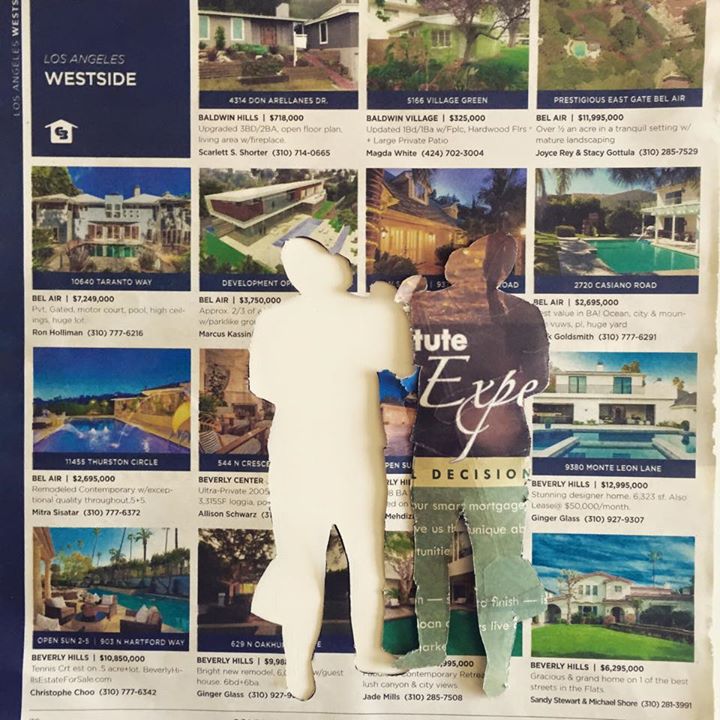
Ramiro Gomez, "Cut out" (2015)
1 2015-06-04T12:30:57-07:00 Veronica Paredes f39d262eb7e9d13906fe972f3e5494dbae1896bc 3429 2 The shape of a woman cleaning is cut out of the real estate listings of property for the Westside of Los Angeles plain 2015-06-04T12:45:17-07:00 Veronica Paredes f39d262eb7e9d13906fe972f3e5494dbae1896bcThis page is referenced by:
-
1
media/bway-as-bg.jpg
2015-05-30T09:45:56-07:00
Invisibility / Hypervisibility
31
Tag for Broadway as Background / Background as Broadway
structured_gallery
2015-06-29T02:33:05-07:00
South Broadway’s theaters are transformed into surreal, evocative settings in David Lynch’s Mulholland Drive, subtly shot to the point of becoming nearly imperceptible as their actual locations. While the potentially recognizable exterior of the Palace Theatre building and interior of the Tower Theatre are used for the Club Silencio scene, the interior of the Tower Theatre again appears as the setting for the seedy downtown hotel, Park Hotel. Geno Silva plays both the emcee at Club Silencio and the manager at Park Hotel. Given little guidance for both roles, Silva inflects a Chicano accent that will go unnoticed by most of the film’s viewers. Silva’s character warns Adam Kesher (played by Justin Theroux) that shady characters are looking for him and have emptied his bank accounts. While this encounter at Park Hotel is brief, to, the scene subtly references the Mexican American vernacular and cultures of Los Angeles (see also the Club Silencio scene analyzed in the “Mexico lindo y querido” page).
Geno Silva’s performances in films about Los Angeles intersect with many of the themes of this project. He appears in Steven Spielberg’s 1941 as a stock pachuco character named “Martinez”; he performed in the stage and film versions of Zoot Suit (1981), playing the Mexican American cop that joins the white police officers as they together beat Henry Reyna; he took the role of the villainous assassin character “The Skull” in Scarface (1983) after Edward James Olmos rejected it. and he appeared on the television show Walker, Texas Ranger (1996) as a character simply named “El Coyote.” Many of these roles could be classified as adhering to stereotypes about Mexican American or Latino identity. In Mulholland Drive, this finds expression mostly in his use of Chicano colloquialisms such as “Oye, carnal” and “Mira, ese,” and his reference to the Mexican folk tale of “La Llorona” in introducing Rebekah del Rio.
Silva’s use of language in the Mulholland Drive scenes, when considered in relation to many of his other career roles, provides a compelling example for thinking through the theme of invisibility / hypervisibility. As Cookie, he points to what it means to be heard, felt and seen on South Broadway, as the street’s significance in Los Angeles’ history is reconfigured by a hegemonic, white spatial imaginary. It may be imperceptible to most audiences, and willfully or ignorantly ignored, while it can also be portrayed so broadly as to become caricature.
Negotiations between invisibility, assimilation (or even neglect) and hypervisibility or grotesque caricature are found in the following clips from predominantly genre films. In the romance melodramas – whether they be Hollywood (City of Angels) or indie (In Search of a Midnight Kiss and (500) Days of Summer) – South Broadway is used as a socially aesthetic backdrop for romantic awakening. By emphasizing the abstract and philosophical qualities of the street’s “ruins” in these courting conversations on quirky dates, romance films are able to conveniently ignore the social realities experienced by other people sharing the sidewalks of South Broadway. The directive here is to “look up” and be impressed by the arcane knowledge of Los Angeles’ architecture, or the philosophical musings, and sensuous descriptions shared between a doctor and her angel.
Another genre featured in these clips is the action film. Here South Broadway becomes the space where white male protagonists either assert their masculinity by violently subduing criminals (Kindergarten Cop), or by assuming the role of criminal (Virtuosity). In discussing works of genre revisionism, George Lipsitz has pointed out how “action/ adventure films often rely on racial imagery…[using] racial differences to signal zones of danger and refuge” (186). The clips featured below use South Broadway in just these ways, depicting the street as a den of criminality, drug use and amorality, in which characters either enforce or elude violence and law. . These scenes repeat the racist spatial logic used in typical portrayals of the U.S.-Mexico border in Hollywood Westerns.
Camilla Fojas observes, Los Angeles can be considered a border city, where “the border emerges…as a symbolic boundary and a complex of operations, especially in the technologies of surveillance that reach northward and link up to the policing agencies within the city” (145). The clips analyzed below highlight how this symbolic boundary and its linked segregation of the city can lead to grotesque portrayals that fixate on cultural difference, and spatialize difference in order to create an exotic environment in which to connect with a romantic partner. Or the representations may completely elide cultural difference in order to retreat to a more familiar cultural imagining of the city's stifled past.
Video annotations:
In KINDERGARTEN COP:- Low lives, street toughs, and punk tramps;
- ¿A dónde vas?;
- Terminator saves compassion for Oregon
- Drugs at Broadway Arcade
SID's Spring-Broadway Arcade strut in VIRTUOSITY
Describe it, like Hemingway & Pears at Grand Central Market in CITY OF ANGELS
South Broadway as backdrop for quirky romance in IN SEARCH OF A MIDNIGHT KISS
Walking Tour & Perspective from Angels Knoll in (500) DAYS OF SUMMER