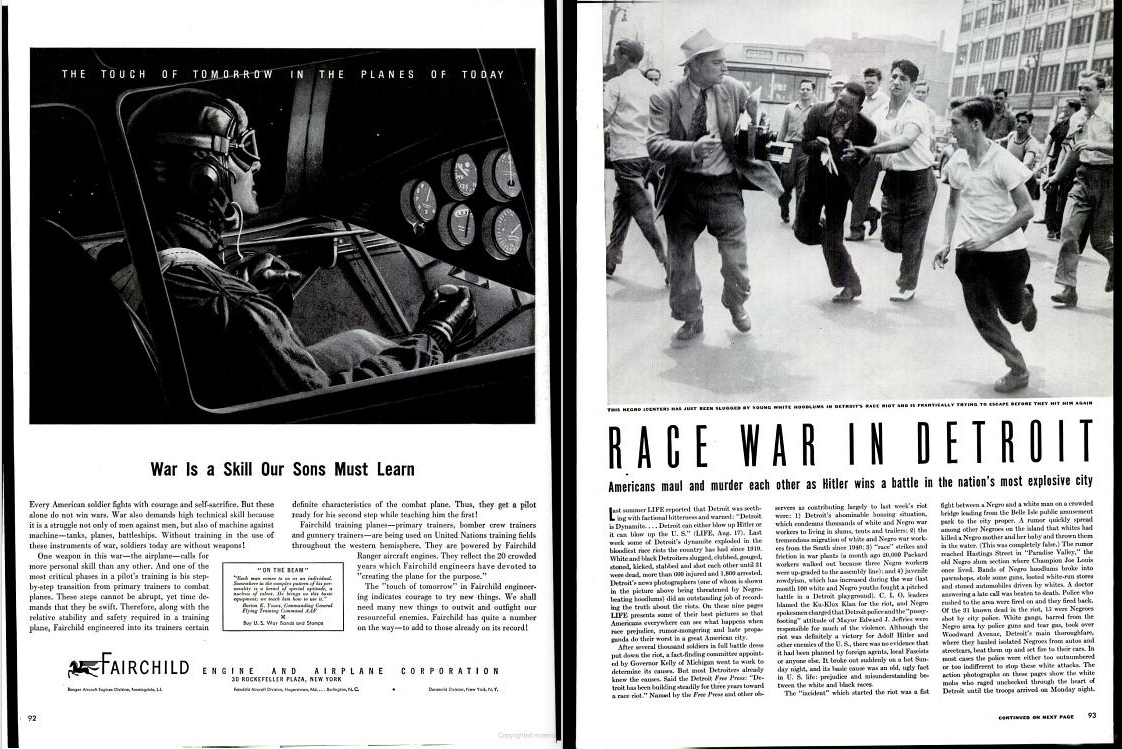
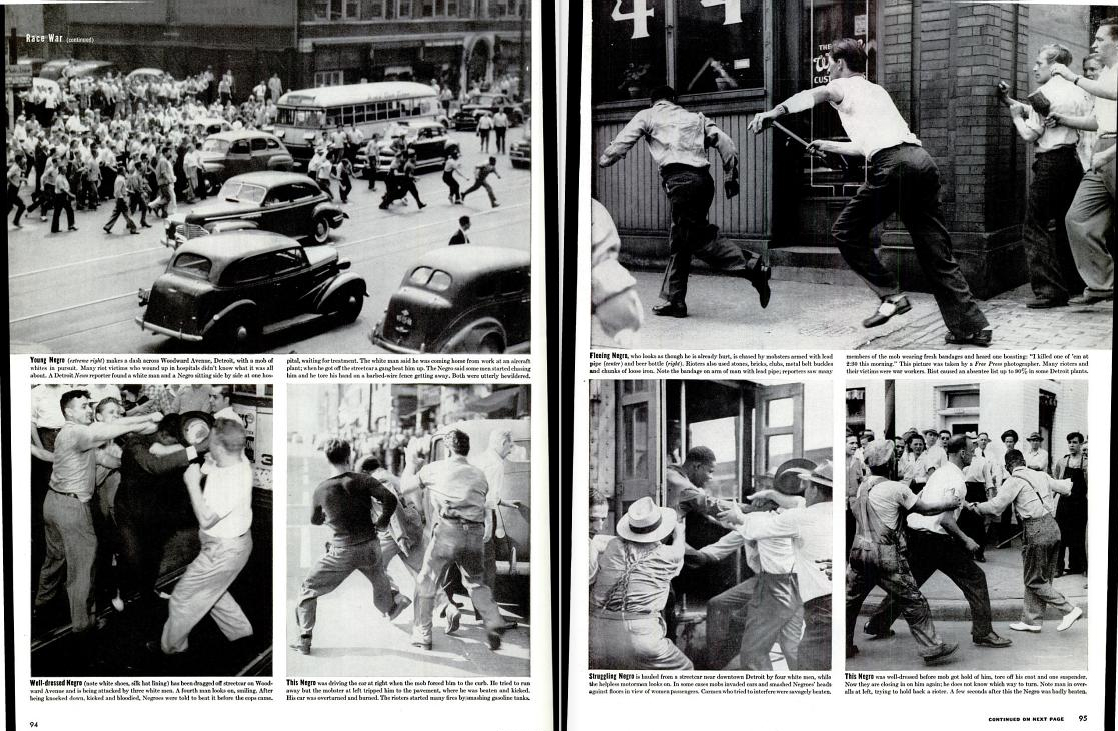
Life Magazine, 5 July 1943, pp 98-99
1 2015-05-28T22:02:09-07:00 Veronica Paredes f39d262eb7e9d13906fe972f3e5494dbae1896bc 3429 2 Life Magazine, "Race War in Detroit," (5 July 1943): 98-99 plain 2015-05-28T22:02:45-07:00 Veronica Paredes f39d262eb7e9d13906fe972f3e5494dbae1896bcThis page has annotations:
- 1 media/map-of-progress_navigation-test-lowres.jpg media/map-of-progress_navigation-test-lowres.jpg 2015-05-28T18:20:21-07:00 Veronica Paredes f39d262eb7e9d13906fe972f3e5494dbae1896bc Historical Background & Other Riots Veronica Paredes 9 image_header 2015-05-28T22:28:28-07:00 Veronica Paredes f39d262eb7e9d13906fe972f3e5494dbae1896bc
This page is referenced by:
-
1
media/map-of-progress_navigation-test-lowres.jpg
media/map-of-progress_navigation-test-lowres.jpg
2015-05-28T18:20:21-07:00
Historical Background & Other Riots
14
plain
2015-05-28T22:54:31-07:00
In 1943, riots were reported in several cities across the United States, from Los Angeles to Beaumont and Mobile to Detroit and Harlem, to name the largest.[i] The Los Angeles riot is unique amongst these in that it is still remembered as the “Zoot Suit Riots,”[ii] named after the clothing that allegedly incited the riot. Unsurprisingly, this evasive name has been contested, at times called the “so-called pachuco riots,” “sailor riots” and by Chester Himes at the time of the event, race riots.[iii] “Race riots” was commonly used to describe events that took place in other cities across the U.S. in 1943, but not as frequently in regards to Los Angeles.[iv] This desire to avoid discussing race and ethnicity with the Zoot Suit Riots emerged at the time from multiple causes: potential legal claims Mexican Americans have had to whiteness has historically confused clear racial identification; wartime sensitivities to an alliance between the United States and Mexico affected how Mexican Americans could be identified in the press without offending the support provided to the American war effort by Mexican nationals and Mexican American soldiers.[v] In part, this influenced why contemporaneous news coverage event conjured the “zoot suit” and “pachucos” in its reports rather than focusing on the Mexican and Black Americans beaten that were not wearing the fashion, influencing even now how the riots are remembered.[vi] Memory flattens many of the same socio-economic issues that influenced the riots in Detroit and Harlem, labor disputes in factories, resentment resulting from discrimination against Black soldiers home from warfare.
Similar to the Zoot Suit Riots, movie theaters, trolleys and other public spaces appear in materials that document the Detroit riots. For example, in describing the rioters from June 1943 in Detroit, Dominic Capeci and Martha Wilkerson relate how in the early morning of June 21 white “adolescents and young men…assaulted black patrons exiting from the all-night cinemas” after having “gathered about the Roxy and Colonial theaters”(9).[vii] The consequences of the Detroit riot were much more severe than the Los Angeles riot: 34 deaths, 676 injured victims, and $2 million estimated property damage[EP2] (87). In contrast, the Los Angeles riot yielded no deaths, injuries were minimal, and there was no severe property damage.[viii]
Later in the summer, the Harlem riot was precipitated by an incident in the lobby of the Braddock Hotel. Rumors spread after a white police officer (James Collins) shot a black soldier (Robert Bandy) after the soldier protested the officer’s perceived mistreatment of a black female hotel customer (Marjorie Polite[EP3] ).[ix] Unlike in Detroit and Los Angeles, the Harlem riot was contained to only two days, August 1-2, and resulted in much fewer deaths than Detroit, still more than Los Angeles’ count of zero: six black persons dead and several hundred injured. [x] Additionally, accounts of the Harlem riot are distinctly different from Detroit and Los Angeles, in that black Harlem residents were reported as the primary rioters, in contrast to the other cities’ white rioters attacking black and Latino targets (in the case of Los Angeles), or at least equal measure of white and non-white rioters (for Detroit).[xi] The Harlem riot also involved looting resulting in property damage on a larger scale, some estimates placing damage as high as $5 million.
While the very naming of the Zoot Suit Riots as a “riot” is frequently challenged in literature about American race riots, historian of the Harlem and Detroit riots, Dominic Capeci has stated “it was the Harlem upheavals of 1935 .. and 1943 that ushered in Watts, Newark, and the second Detroit.” [xii] According to Luis Alvarez, in contrast to white New Yorkers’ interpretation after the riot that black rioters acted in anger toward white Americans, “Black New Yorkers involved in the rioting…saw their behavior as targeting property rather than persons” (229). Alienated by poverty, rising rents and increased living costs, combined with unfair and unequal treatment by white business owners, financial institutions, legal structures and the police force, Harlem erupted in rebellion. Replacing the images from Los Angeles and Detroit of Mexican American and black people being dragged out of streetcars and movie theaters, reports show that the riot in Harlem marked a shift, with accounts of white patrons harassed and beaten in the public spaces of the movie house and trolley car.[xiii] However, this aspect of the rioting was rare. Newspaper images from the riot focus on rioters’ looting of luxury clothing and goods, as well as the destruction of white-owned businesses.[xiv]
In The Power of the Zoot, Luis Alvarez situates the Zoot Suit Riots in the context of this violence across the country in 1943, “rather than viewing [them] as isolated incidents” (200). Alvarez’s argument that the “the bloody confrontations…reflected the ongoing struggle for dignity by nonwhites in the wartime United States” (199) connects to his overall interpretation of the zoot style as an expression used by racialized youths to reclaim dignity in this period of discrimination. Finding this emphasis on dignity and respect important for understanding the Harlem rebellion and the smaller scale expressions of adopting a zoot style, this project is interested in how racial issues were coded in coverage of the riots in ways that influenced cultural narratives formed around the events. Race was evaded in the case of the Zoot Suit Riots through the use of “zoot suiter” and “pachuco” to avoid identifying youths involved and attacked as Mexican or Mexican American. This resonates with how racial injustice was minimized as an influence in the Harlem riots in contemporaneous coverage,[xv] framed instead as “potent expressions of racial antagonism.”[xvi]
[i] Though different sources identify riots as taking place in other locations in the United States, these are the primary locations explored in Walter C. Rucker and James N. Upton’s Encyclopedia of American Race Riots (Greenwood Publishing Group, 2007): Beaumont 30; Detroit 160-64; Zoot Suit riot 372; Mobile 422-23; Harlem 476-78.
In The Power of the Zoot: Youth Culture and Resistance During World War II, Luis Alvarez covers the Detroit, Harlem and Gulf Coast Riots of 1943 in an excellent chapter titled “Race Riots across the United States.” While Alvarez is focused on the struggle for “dignity and national belonging during World War II” the thoroughness of his coverage of primary and secondary sources on this summer of riots is tremendously helpful (200-201).[ii] Although I will use “Zoot Suit Riots” throughout this project to describe this event, it is important to note that it is a contested label. While Acuña represents one form of challenging this name, in much of the scholarship about the Los Angeles 1943 riot “Zoot Suit Riots” is referred to in the singular form (“Zoot Suit Riot”) instead of the more popular pluralized designation.[iii] “So-called Pachuco Riots” and “sailor riots” are both used by Rodolfo Acuña in Occupied America (1972). Chester Himes’ “Zoot Riots Are Race Riots [1943]” is included in Black on Black: Baby Sister and Selected Writings (New York: Doubleday, 1973): 220–225.[iv] This observation is not meant to simplify the complicated ways race functioned in those riots as well. For instance, the label “race riot” was also denied in contemporaneous newspaper accounts about the Harlem riot of 1943. See “Race Bias Denied as Rioting Factor.” New York Times 3 Aug. 1943: 11.[v] In his study of the pachuco, Antonio Madrid-Barela writes about the end of the riot: “Only the restriction of all military personnel to their bases and pressure on the press and local government from Washington officials worried by the negative effects the riots were having on America’s Good Neighbor Policy with Latin America (and therefore on the war effort) ended the large scale attacks on the Mexican populace in California.” (32) About Mexican Americans’ legal claims and unfulfilled benefits of whiteness see George A. Martinez, “Legal Construction of Race: Mexican-Americans and Whiteness.” Harvard Latino Law Review 2 (1997): 321–348. Martinez explains that while “the courts and federal government constructed the race of Mexican-Americans as white,” this ultimately did not reflect privileged legal status. (336)
Madrid-Barela[vi] See “Cherry Poppin’ Daddies - “Zoot Suit Riot” (original Video).” Dir. Isaac Camner. YouTube Video. This reason for naming the riot the Zoot Suit Riots is also mentioned in Luis Valdez’s play Zoot Suit as the character of Pachuco, famously played by Edward James Olmos on stage and in the film adaptation tells a character playing PRESS: “The Press distorted the very meaning of the word “zoot suit.”/ All it is for you guys is another way to say Mexican” (80).[vii] Capeci, Dominic J. Jr., and Martha Wilkerson. Layered Violence: The Detroit Rioters of 1943. University Press of Mississippi, 1991: 9.[viii] Mazón, Mauricio. The Zoot-Suit Riots: The Psychology of Symbolic Annihilation. Austin: University of Texas Press, 1984: 1.[ix] Langston Hughes’ poem immortalized Marjorie Polite in “The Ballad of Margie Polite”:
If Margie Polite
Had of been white
She might not’ve cussed
Out the cop that night…
She started the riots!
Harlemites say
August 1st is
MARGIE’S DAY.
The full poem can be found in The Collected Poems of Langston Hughes (New York: Knopf Doubleday Publishing Company, 1994): 282-283.[x] According to Nat Brandt, “nearly seven hundred persons injured, including forty policemen” (207). However, Dominic Capeci estimates ----?[xi] Alvarez 218[xii] On the topic of challenging Zoot Suit Riots as a riot, consider Janet L. Abu-Lughod states in Race, Space, and Riots in Chicago, New York, and Los Angeles that “the Los Angeles case was deviant indeed, and I question whether the 1943 outbreak of conflict between white sailors and Mexican youths should be included in any list of urban race riots” (20). Capeci quote is from Abu-Lughod 152.[xiii] However, the appearance of these events should not be overstated, as they may have been isolated events, not nearly as frequent in reports from the riot as the ejections explored throughout this chapter. Nat Brandt writes, “rioters were focusing their hostility on white-owned property and police. Two young British seamen were beaten as they left a 125th Street movie house, and a white patron at the Apollo was knocked down as he emerged from that theater. A sixty-one-year-old passenger on a trolley car was hit in his right eye when three black men reached through an open window and struck him” (190).[xiv] The Autobiography of Malcolm X provides a brief account of the black civil rights leader’s experience of the riot, and includes an interesting story related to race and business ownership:
“…we laughed about the scared little Chinese whose restaurant didn't have a hand laid on it, because the rioters just about convulsed laughing when they saw the sign the Chinese had hastily stuck on his front door: ‘Me Colored Too’” (117). A story of using coalitional politics cynically in pursuit of economic benefit, while its derisive tone might alert the reader to a possible dismissal of this coalitional possibility, the sign is still portrayed as effective.[xv] “Race Bias Denied as Rioting Factor.” New York Times 3 Aug. 1943: 11.[xvi] Report No. D-3, August 21, 1943, Research Division, Bureau of Special Services, Office of War Information, Harlem Riots of 1943 Report, collection MG 93, Schomburg Center for Research in Black Culture, New York.