Thanks for your patience during our recent outage at scalar.usc.edu. While Scalar content is loading normally now, saving is still slow, and Scalar's 'additional metadata' features have been disabled, which may interfere with features like timelines and maps that depend on metadata. This also means that saving a page or media item will remove its additional metadata. If this occurs, you can use the 'All versions' link at the bottom of the page to restore the earlier version. We are continuing to troubleshoot, and will provide further updates as needed. Note that this only affects Scalar projects at scalar.usc.edu, and not those hosted elsewhere.
Marquee Survivals: A Multimodal Historiography of Cinema's Recycled Spaces
Main Menu
Introduction
Marquee Survivals: A Multimodal Historiography of Cinema's Recycled Spaces
Introduction, Start
Marquee Survivals: A Multimodal Historiography of Cinema's Recycled Spaces
Histories Concealed
Histories Concealed landing page
Projecting 1943
Sense of Pachuca
Broadway as Background
Splash page for Broadway as Background / Background as Broadway
Photo Essay: Marquee Stories
Intro to photo essay: Marquee Stories
Prototypes
Exploring project prototypes
Portfolio
Ejected Spectators and Inactive Users: Locating Multimodal Historiography In Repurposed Media Spaces
Veronica Paredes
f39d262eb7e9d13906fe972f3e5494dbae1896bc
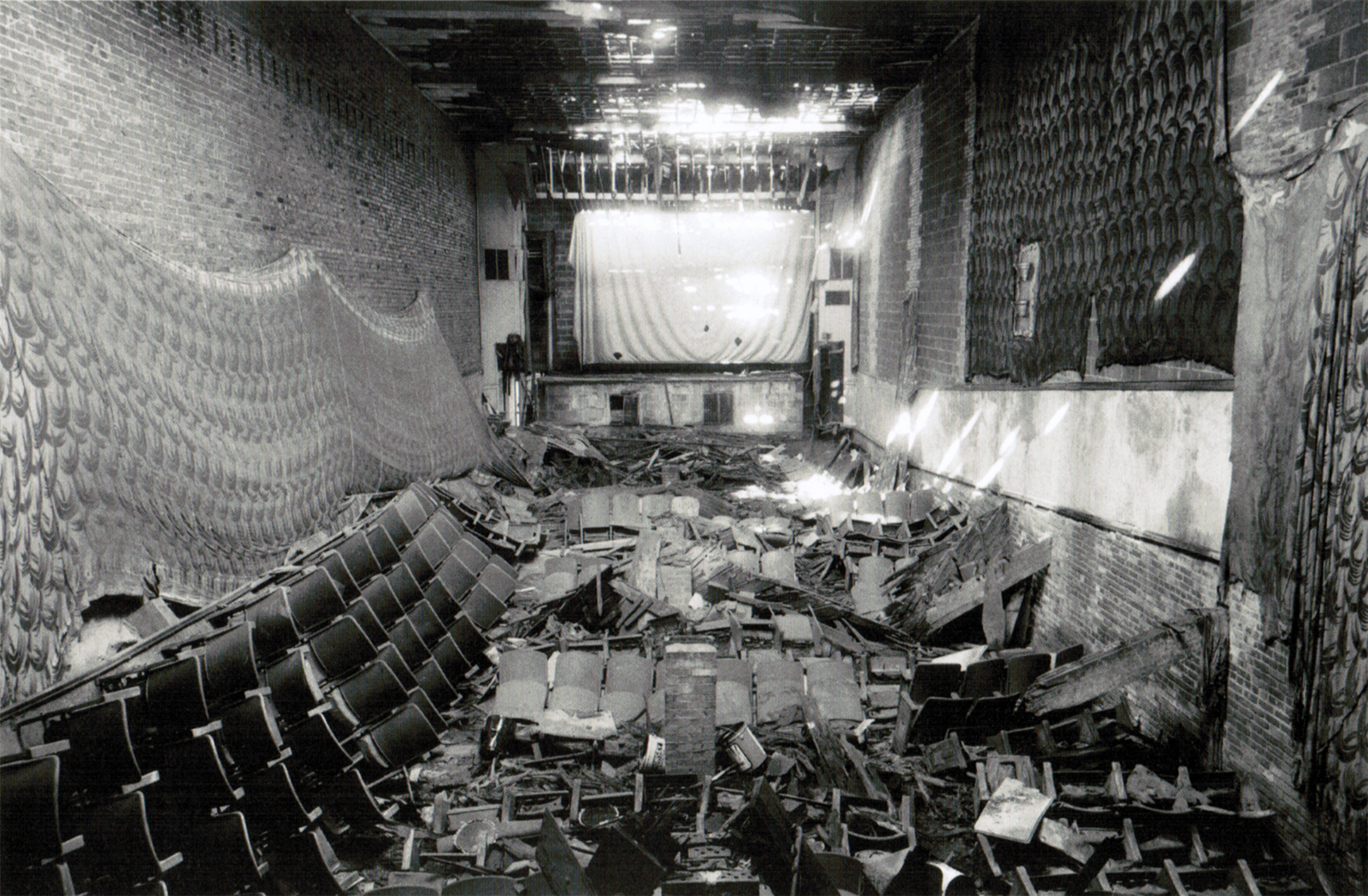
Earle, Big Stone Gap, Virginia, 1985
1 2015-06-17T14:13:12-07:00 Veronica Paredes f39d262eb7e9d13906fe972f3e5494dbae1896bc 3429 1 Silent Screens, p 44 plain 2015-06-17T14:13:12-07:00 Veronica Paredes f39d262eb7e9d13906fe972f3e5494dbae1896bcThis page is referenced by:
-
1
2015-06-16T09:19:51-07:00
Introduction: Nostalgia II
9
Introduction: Nostalgia II
plain
2015-06-26T09:47:36-07:00
However, movie palaces also resonate with the public on a symbolic level. Numerous photography books document the trajectory of movie theaters through various states of use, abandonment, restoration and demolition. Early on, the literature was represented by books like Ben M. Hall’s The Best Remaining Seats (1961) and David Naylor’s American Picture Palaces (1981) and Movie Palaces (1988), which focused on the beauty of still-functioning movie palaces, invoking a pre-white flight, golden age of moviegoing. According to the dominant narrative, this was before white residents began retreating to the suburbs, where every house is equipped with a television set. Published more recently, Silent Screens (2000) self-consciously chronicles theaters after this moment, presenting them in ruins or configured for unexpected new uses. In his introduction to the book, photographer Michael Putnam describes dilapidated movie theaters as “embodiments of the death of the American town” (96). Conflating the movie theater with the character and vitality of the mid-twentieth century American city, Putnam emphasizes cinema’s symbolic level as he anthropomorphizes its material structure. These images connect theaters to one another, creating a network that is not based on the contemporary circulation of media, but rather on symbolic circuits of a bygone era. Putnam situates movie theaters within a national narrative of media change, but in so doing, sacrifices the theaters’ specific local context and history. Still, the vision is compelling and many photographers and writers share Putnam’s fascination with the melancholic implications of the fallen movie theater. For example, Matt Lambros frequently updates his website After the Final Curtain with “photographic obituaries” from around the country. A complementary impulse characterizes projects that profile restorations, inspiring reverence at the handiwork of the craftsmanship of earlier eras, while concealing the hard work put in by preservationists to create an illusion that makes the present imperceptible.
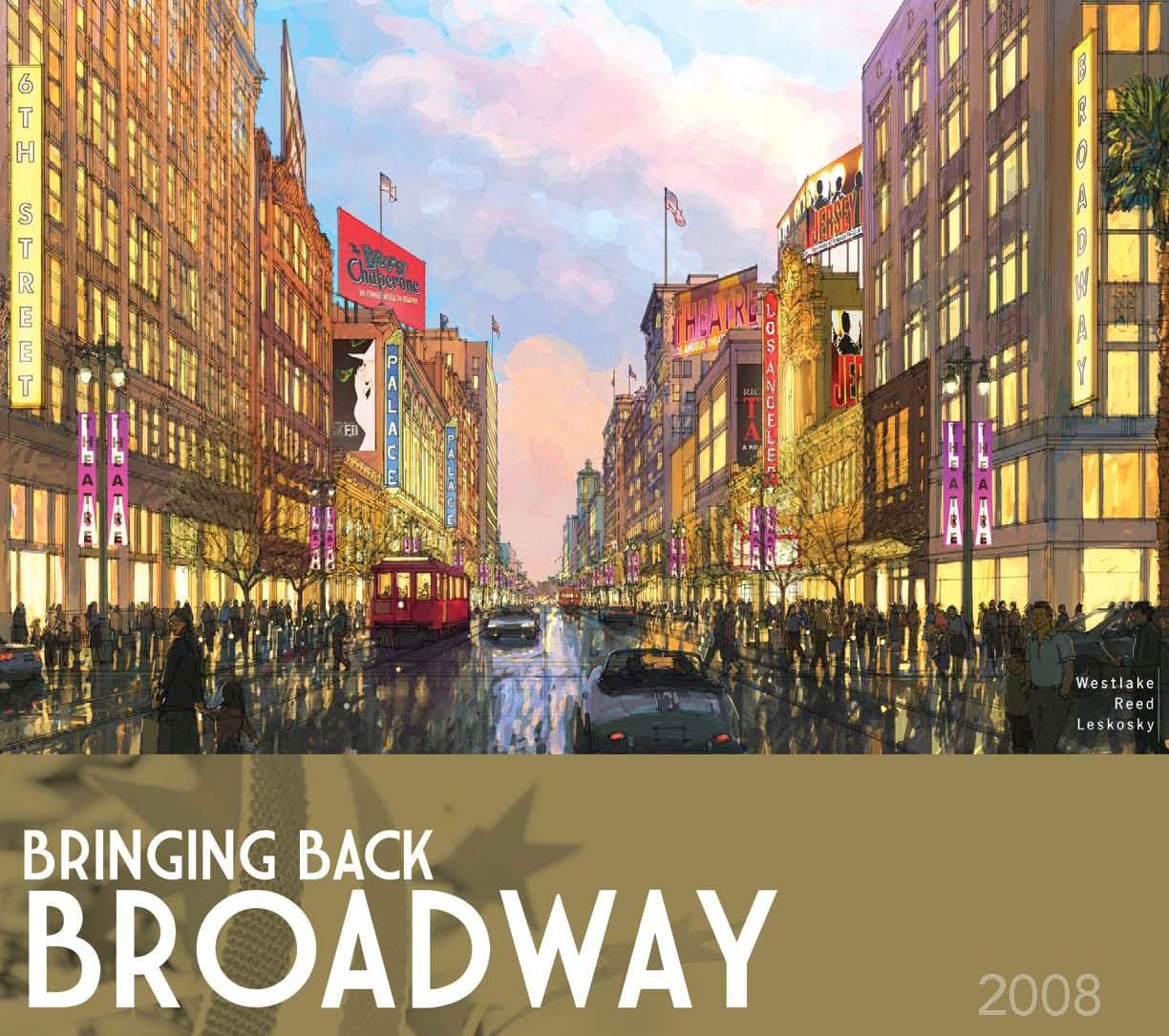
The nostalgic impulses of the carefully curated portraits of movie palace decadence and decay that individual book projects or artist websites provide are also found in the efforts of city organizers and officials. City councilmember Jose Huizar launched Bringing Back Broadway, a “ten year vision,” in January 2008. The initiative promised to “revitalize the corridor, activate the theaters” and usher in a streetcar system. Restorative nostalgia characterizes the visual rhetoric that the initiative’s campaign used to convince the voting residents of Downtown Los Angeles of what the street could (or did) look like. This is in great contrast to what it looks like now, and has looked like for the past forty years or so. What sense of place is Bringing Back Broadway attempting to preserve? Its projections of the American dream of a “real downtown” are meant to replace the vernacular streetscapes and economies that once thrived in Downtown Los Angeles, and in so doing preserved the city’s structures from the beginning of the twentieth century to the present.
In The Future of Nostalgia, Svetlana Boym conceives of reflective nostalgia as an antidote to the zealousness that pervades restorative nostalgia’s yearning for “truth and tradition.” “Instead of recreation of the lost home, reflective nostalgia can foster a creative self... Nostalgia can be both a social disease and a creative emotion, a poison and a cure.” The dreams of imagined homelands cannot and should not come to life. Instead of squeezing diverse memories into a single plot, this variation on the sentiment “dwells on the ambivalences of human longing and belonging.” Boym describes reflective nostalgia as open to the contradictions of modernity, including how “it loves details, not symbols.” The Saturday morning conservancy tour members introduced earlier also delight in the minutiae of Broadway’s history, but their concept of the past’s true image is seldom threatened by what is discovered. A narrative of rise, fall and decline remains intact, along with a preference for a classical era and a persistent need to return to it from the present. Rather than containing details into a predetermined narrative or destination, a critical nostalgia can uncover the potential latent in overlooked details of neglected infrastructures, forgotten places or minor networks.