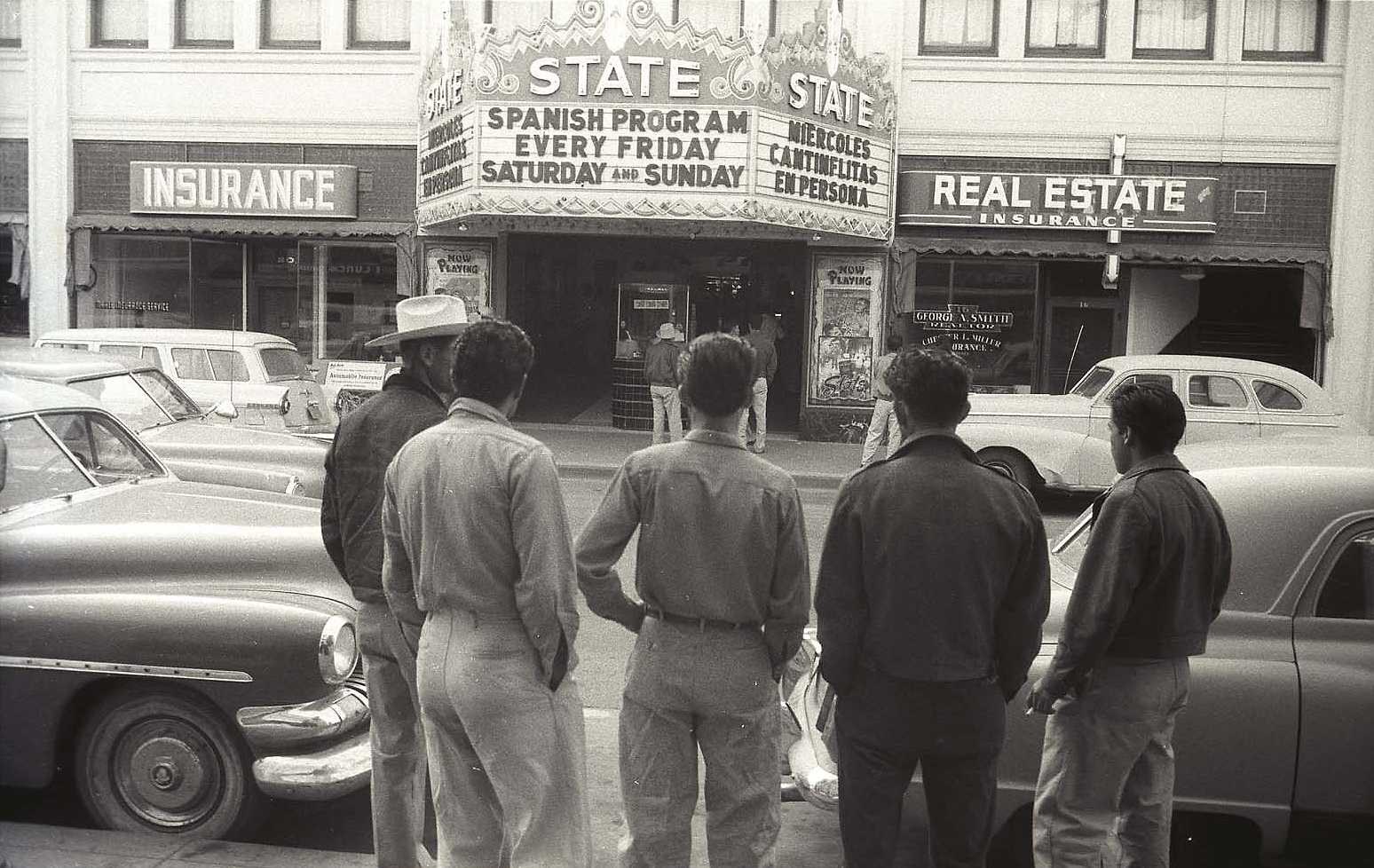
Braceros in front of State Theater in Watsonville, CA
1 2015-05-29T12:31:58-07:00 Veronica Paredes f39d262eb7e9d13906fe972f3e5494dbae1896bc 3429 2 Photograph: Braceros stand across the street from a movie theater in the town of Watsonville, California. plain 2015-05-29T12:32:46-07:00 Veronica Paredes f39d262eb7e9d13906fe972f3e5494dbae1896bcThis page is referenced by:
-
1
media/NMAH-NAD-200401382939-2.jpg
media/NMAH-NAD-200401382939-2.jpg
2015-05-28T18:48:56-07:00
Ejected Spectatorship II: Migrant Spectator
12
plain
2015-09-22T00:50:45-07:00
The significance of moviegoing publics for this topic would be taken up later by film scholars researching the history of specific regional and transnational cinema audiences and their importance for considering racial and ethnic spectatorship. Influenced by studies in new film history, these film scholars and historians assert that while race, gender and class matter in researching spectatorship, so does space, place and nation. In Migrating to the Movies, Jacqueline Najuma Stewart explores “Black spectatorship and the performance of urban modernity” in proposing how Black audiences migrating from the South of the United States to urban cities in the North negotiated the contradictions of cinema as a “contested discursive and physical space in which migrating Black public spheres were constructed and interpreted” (4). Focusing on the Great Migration in the period around World War I, Stewart documents how these contestations functioned for audiences of Black subjects who “could see and be seen in modern ways” in Chicago’s movie theaters. Stewart proposes the concept of “reconstructive spectatorship” to investigate these engagements with modernity, “draw[ing] on the notions of fluidity, negotiation, heterogeneity, and polyphony offered by” models of spectatorship, while accounting for “cinema's public dimensions" (100).In Making Cinelandia, film historian Laura Isabel Serna explores how American films were circulated, consumed and mediated in Mexico and the United States by Mexican audiences during the 1920s to forge transnationally inflected practices of modernity. While Serna, like Stewart, focuses on silent films, her descriptions of Mexican film cultures on both sides of the border, as well as her exploration of migrant / Mexican ethnic spectatorship in this period are relevant for understanding the mediated experiences of second generation Mexican Americans during World War II. Serna notes that while American films were screened and enjoyed in Spanish-language film theaters both in the U.S. and Mexico, the aggregated experience frequently combined them with Mexican films or performances and succeeded in “linking Mexican migrant audiences to audiences in Mexico" (184). The simultaneous engagement with Mexican and American film and entertainment, also contributes to a nuanced understanding of how modernity is created within these transnational circuits. This is also true for other moments of modernity and postmodernity as they continued to be experienced on South Broadway in Downtown Los Angeles late into the 20th century. This confluence of modern and postmodern modalities of experience is explored in other parts of this Scalar project.
In the last chapter of her book, subtitled “Mexican Migrants Go to the Movies,” Serna discusses the role that race played in moviegoing for many Mexican immigrants across the United States. In many American cities across the country, Mexicans and Mexican Americans learned “their place in the U.S. racial pecking order” (191). She continues:
That lesson could have been taught in two ways: through the action on the screen, or in the social space of the cinema itself. For Mexicans in the United States, race typically determined which theaters they could enter and where they could sit.
Serna notes that “at least downtown, it seems that Mexicans were welcome in theaters that catered to Anglo audiences” (204), with “movie theaters catering to Mexican migrants lin[ing] Broadway and Main Street” (202). What the Zoot Suit Riots demonstrate is that while Mexican American film audiences were welcome in these theaters, they were also vulnerable to violence and expulsion – to becoming ejected spectators. It is also no accident that the first theater attacked on June 3 was one that catered to audiences of Mexican immigrants in an ethnic neighborhood, similar to locations attacked again in the later days of the riot.