Styling an Icon
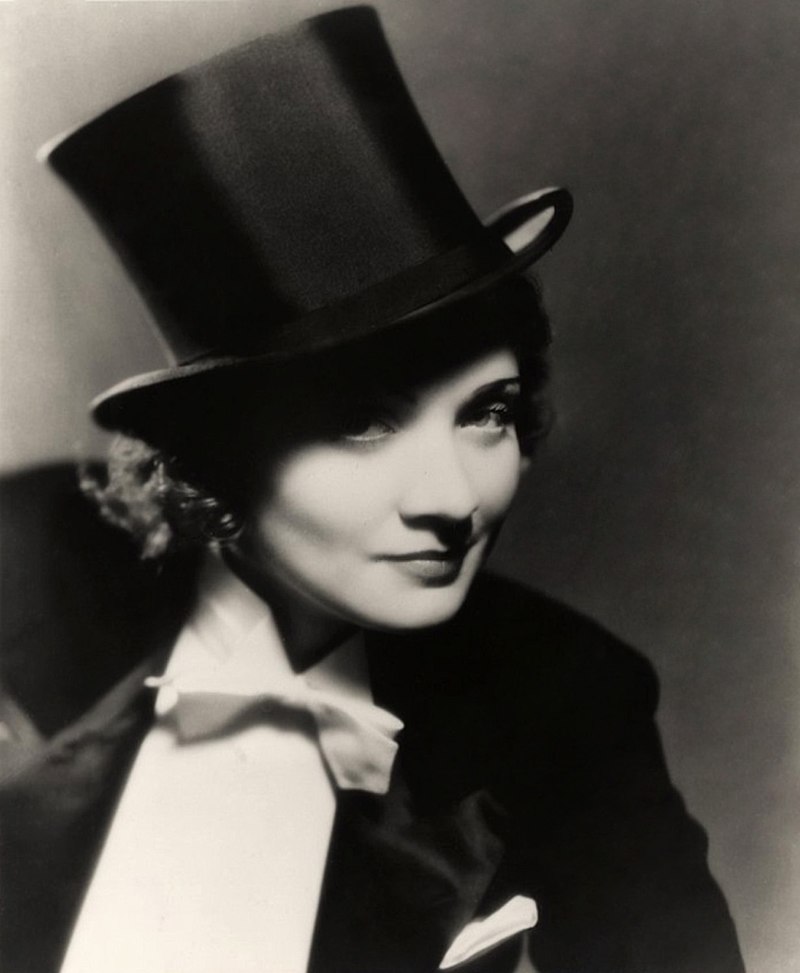
As with any Hollywood starlet, fashion was crucial for building Dietrich's personal aesthetic. Dietrich pulled from both gay and lesbian fashion symbols, yet refused to adhere to any sort of dichotomy, and therefore upset the common understanding of butch and femme aesthetics (Kennison 148). Wearing pants both on screen and in real life, many of her looks played into a persona that regularly confused gender norms. She became known for her masculine outfits and perpetual drag that led to harsh criticism from the press (Kennison 149). Her look was both “fully feminine and fully masculine” in a way that clearly elicited a sense of the unease – she remained an alluring sex symbol nonetheless. Much of what made her appearance unsettling for the time was its origins. Queer spaces in the 1920s, such as ballrooms and bars, utilized specific pieces to indicate some form of subversion, as indicated in the annotations (Kennison 150-151). In pulling inspiration from these communities in a mainstream medium, the actress' outfits reveal both anxieties and trends revolving around women's fashion.
Morocco, in particular, plays with the concept of an underground space home to illicit behavior. Dietrich’s character dons a tuxedo and a top hat while singing a song meant for a man, despite clearly being a woman (Kennison 152). She approaches a woman in the audience, removing a flower from the woman’s hair before swooping down for a brief kiss. The scene is played for laughs, and the woman is clearly embarrassed as she covers her face with a fan – yet Dietrich’s character is almost boastful as she walks through the crowd and tips her hat. This blurring of boundaries – between straight and gay, between public and private, between illegal and permissible – creates an intriguing power dynamic. On the one hand, it is a joke that gets the audience on the character’s side after they jeer at her entrance. On the other, it grants her control over the room. This moment would likely not play out the same way if not for her apparel, and “asserting her power, granted to her by her tuxedo, over an entire audience, men and women, straight and gay” solidifies her prestige (Kennison 151). She transforms into a sex symbol not because of her femininity but because of her willingness to dip into the masculine and seize that authority with brazen assurance. Cloaking herself in the protection of menswear, Dietrich is able to express desire towards a woman (Horak 180). We may then understand her role in society’s concepts of desire as one that shifts away from the cunning seductress or harsh femme fatale and towards something altogether different, though it would take some time to become fully fleshed out.
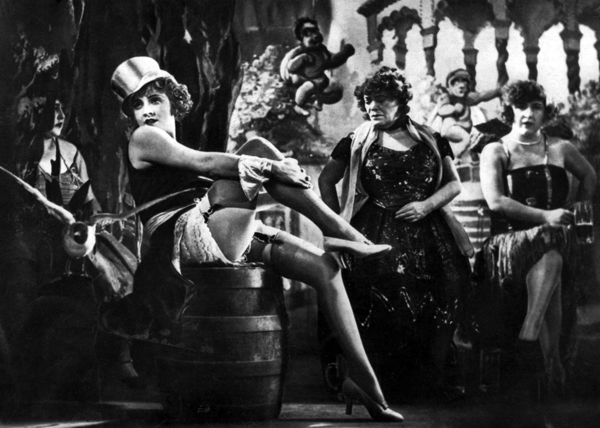
The Blue Angel released before Morocco, and her collaboration with Josef von Sternberg is evident in the aesthetic similarities. Here, we again see Dietrich don the top hat and sleek aesthetics. A hint of her underthings peaks out, and her pose highlights her sensuous figure. The top hat and more subdued look indicate hints of the masculine, but she does not fully abandon the feminine. These blurred lines may reflect Dietrich’s own sensibilities. The actress often designed her own costumes featuring her own clothes, which may indicate how she would go on to utilize clothing in her personal life (Kennison 150). The Blue Angel's success was wide-reaching, and it gained a cult following amongst Berlin's lesbian subculture (McCormick 662).
The Blue Angel features more feminine looks as well, as evidenced above. The film embodies the fact that Diedrich “neither solely butch nor only femme but constantly both” (Kennison 149). She switches between the two, inviting an alluring confusion. Despite the change, however, she “rejected any view of herself as androgynous” and complained of her fans trying to transform her “into an androgynous Madonna” – presumably meaning sexless, divine, and holy (Kennison 150). Her character in this film rejects that notion; she is a sexually charged individual who, instead of bringing redemption to the main character, brings about his downfall.
Both The Blue Angel and Morocco, as well as her 1931 film Dishonored, feature a much more problematic understanding of accessory. For all that one can argue that Dietrich herself was fetishized in her films, scholar Judith Mayne explores how she fetishized other communities. Dietrich was an “icon of sophistication and glamour” – yet she played into the harmful and underdeveloped understanding of race. She took her dolls with her everywhere, and were so much a part of her daily life that her daughter made note of them being packed away for travel in the biography she wrote on her mother (Mayne 1260). Utilizing them as accessories both in film and in daily life indicates that Dietrich was upholding “white male fantasies of female sexuality and primitivism” in a way that both commodified the figures and the space they inhabited (Mayne 1263). These dolls were as much a part of her personal aesthetic as her pants, top hat, and monocle. However, they underscore the more pernicious impacts of her attempts at subversion.

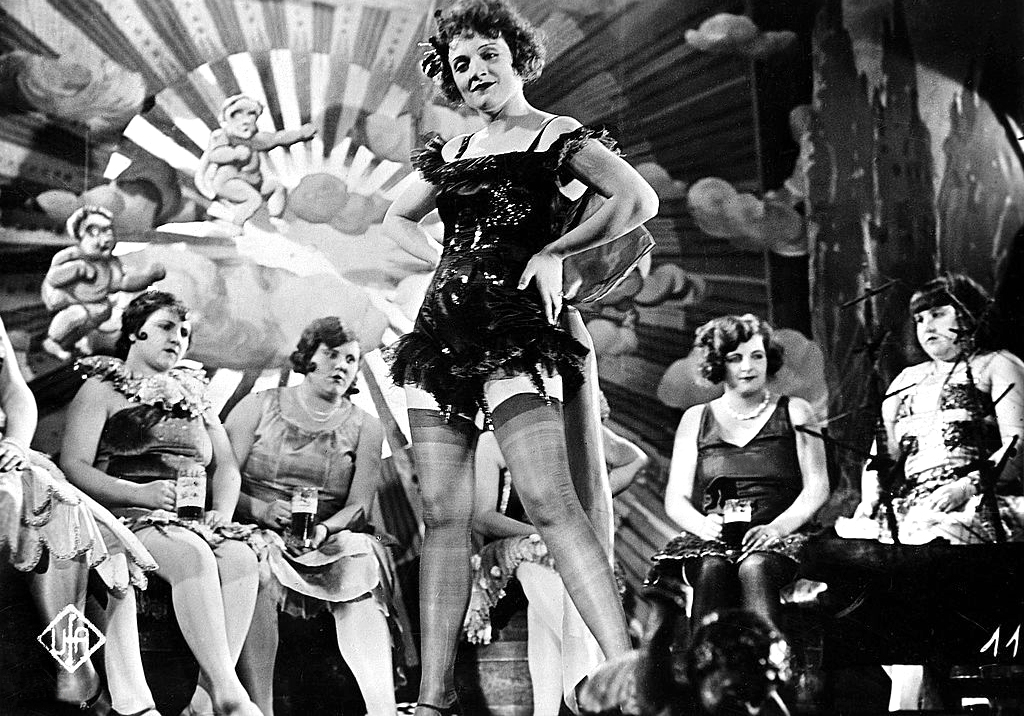

In The Blue Angel, her black doll appears in the aftermath of Dietrich’s character sleeping with the leading man. He does not look at Dietrich in this morning-after moment, instead gazing at the doll. Swapping the woman with the doll dehumanizes her but it also, according Mayne, contemplates the man’s connection to his childlike self (Mayne 1261). But swapping a white woman with a black doll has troubling implications; it “projects a stereotypical image of what a “native African” was imagined to be – childlike yet oddly sexual, and thus a reflection of stereotypes of the primitive that were popular in Europe in the 1920s” (Mayne 1261). This connection between Dietrich’s sexuality and her doll plays on tired racial tropes, highlighting Dietrich’s blonde, seductive figure in juxtaposition to the primitive black figure.
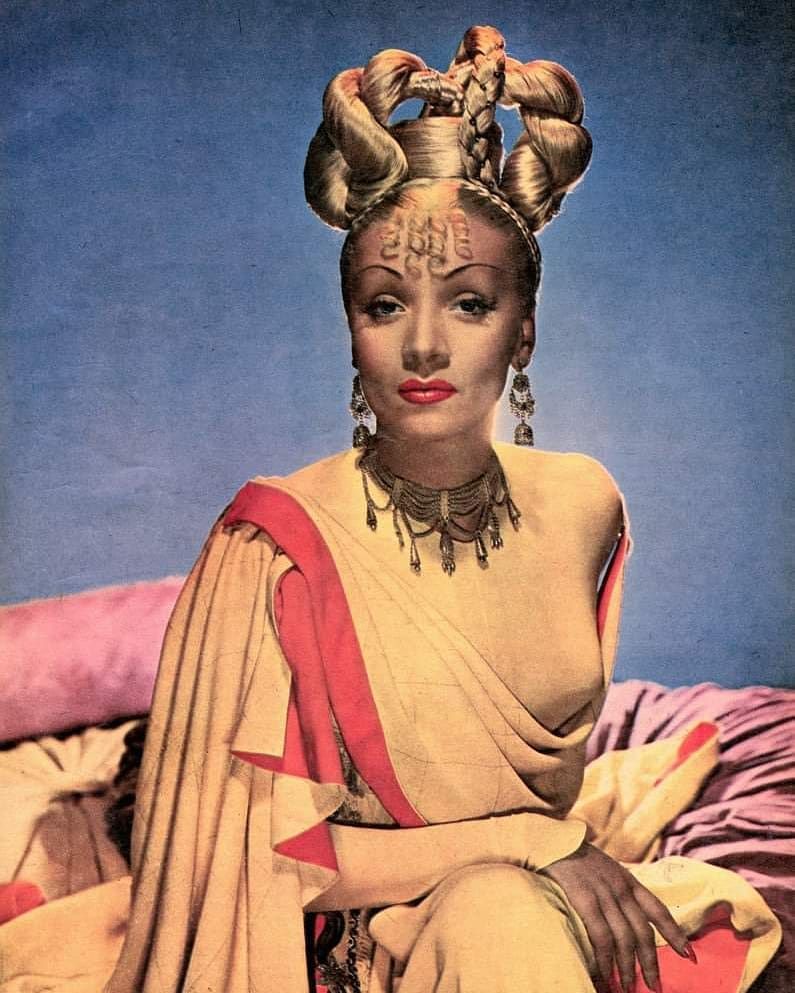
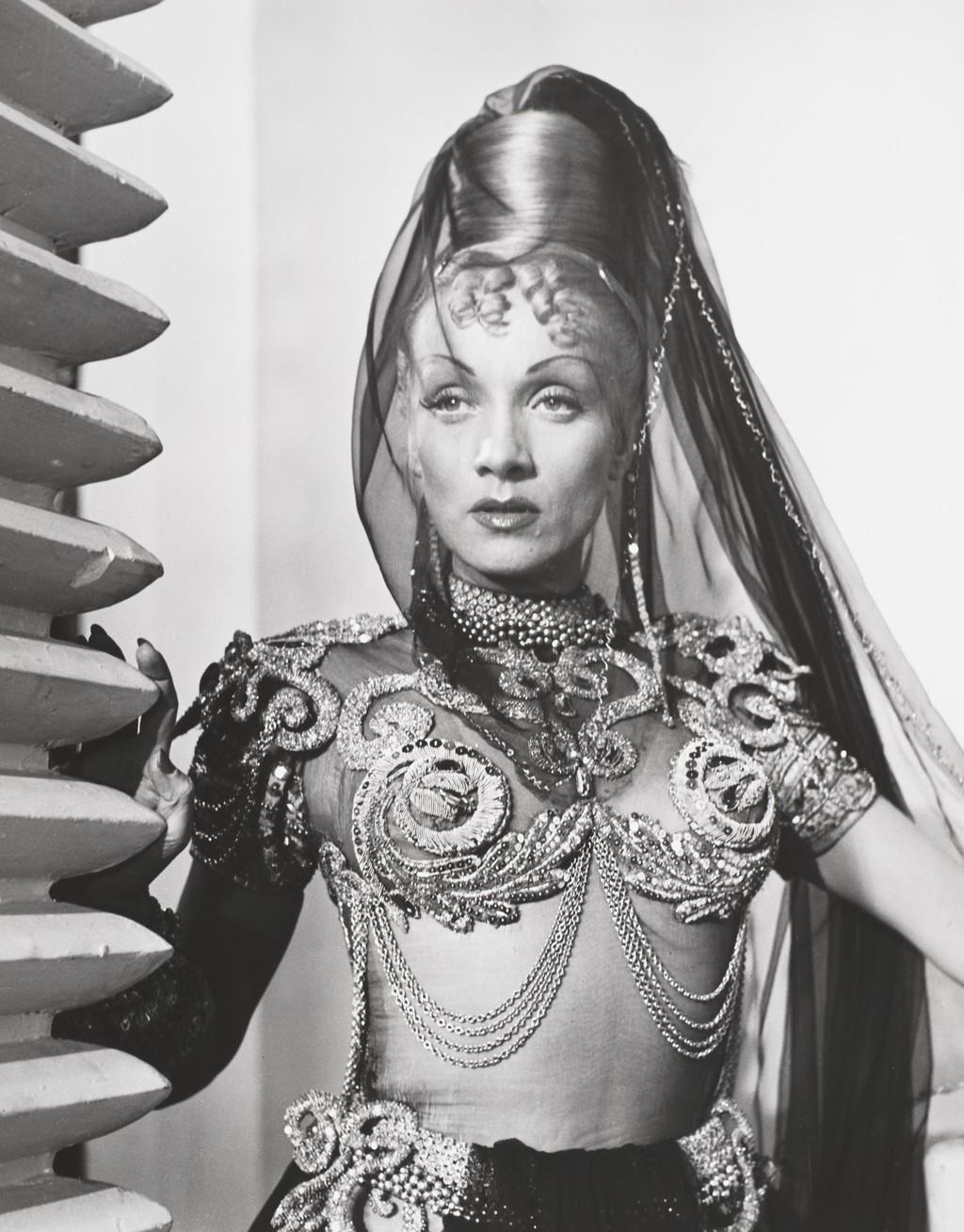
In contrast to the other films we have explored, the 1944 film Kismet draws upon the feminine mystique. The film stars Dietrich as Lady Jamilla, the Queen of the Grand Vizier's harem. Though it takes place in Baghdad and draws on Arabian Nights for inspiration, the cast is white. Once again we see Dietrich utilize race as a stepping point for fetishization. When she is portraying a white woman, she can be powerful through her masculinity. When she is portraying a woman of color, she can only be powerful through being fetishized. Here, gender presentation is tied in with race, further adding to her more harmful exploration of gender expression.
Dietrich carefully cultivated her appearance off the big screen as well. Clothing was essential to her cabaret performances. She wore “nude dresses” – form fitting and flesh-toned – while singing traditionally feminine songs. As the night progressed, traditionally “men’s songs” were accompanied by a tuxedo (Kennison 153-154). It is a highly sensual outfit, leaving little to the imagination while still technically covering almost her entire body. In this dress, Dietrich embodies the classic cabaret singer.
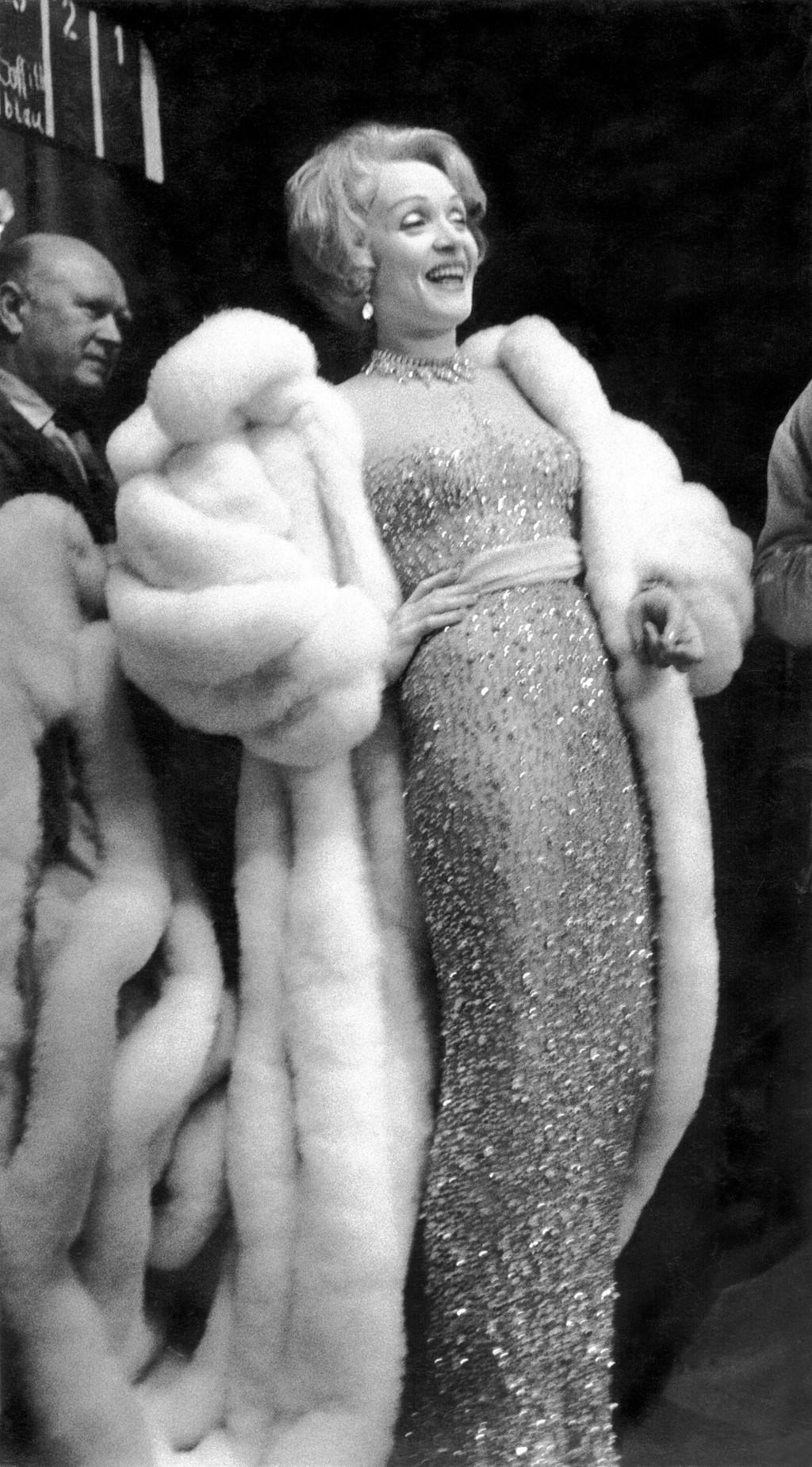
Her more masculine looks, however, took on a different meaning off-stage. As long as she was in character, it was permissible. Hollywood had long allowed women to cross-dress, with a decline in the trend occurring in 1929 because the practice had become more openly associated with queerness (Horak 171).
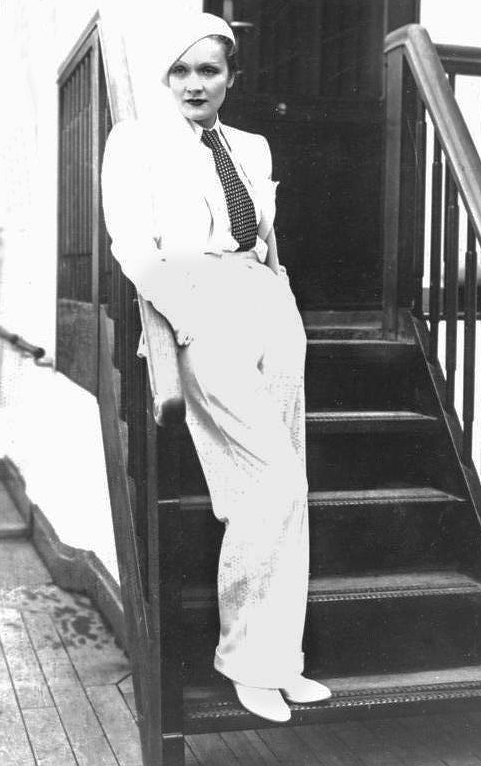
Offscreen, queer spaces were making a name for themselves. Prohibition made alcohol transgressive, and gay men and women were now able to perform in both speakeasies and nightclubs (Horak 171-172). Danger still lingered, and police raids were always a possibility; Eve Adams, who opened one of America’s first lesbian tea rooms, was arrested on obscenity charges in 1926 and deported, and she would eventually die in Auschwitz. At the same time magazines like Vogue were advocating for women to start wearing trousers, women within the queer community were still being targeted (Horak 181). Just because Hollywood was allowed to explore these more subversive expressions of gender and sexuality does not mean that grace extended to everyone.
Dietrich was not the first starlet to wear pants in public, but she was one of the most notable. 1931 marks the first time she did so, and by 1933 she was donning suits to movie premieres – breaking the previous requirement that such outfits were only meant for women to wear in casual settings (Harok 181, 194). Picturegoer magazine published a photo of Dietrich alongside a caption crediting her with starting the “trousers for women” style.
Dietrich wanted to be seen and admired. She often asking photographers to document her in a way that would “make [her] a star” and frequently wore menswear to press events and premieres (Petro 301; Horak 197). However, in February 1933 there was heightened scrutiny surrounding cross-dressing, with the vice president of Warner Brothers-First National studios Jack L. Warner labeling it “a freakish fad” (Horak 198). Hollywood found itself at the center of a moral war; critics viewed the performing women in pants – both on and off screen – as responsible for the supposed spread of homosexuality. The silver screen, apparently teeming with lesbians, posed a threat to the susceptible children of America, according to more conservative critics (Horak 200). Dietrich's clothes then become representative of Hollywood's supposedly progressive ideals not quite being actualize.
Yet women did not stop wearing pants. At the same time that wearing pants could be viewed as enough evidence of homosexuality, it was also a burgeoning fashion trend (Horak 223). Dietrich’s role in this style is evident, and she herself continued to wear pants both on stage and off. Her clothing reflects shifting trends in women's styles and cultural anxieties surrounding what those clothes can represent. The autonomy to reject normative clothing trends indicated the slowly growing social power some women had access to.
This page has paths:
- Marlene Dietrich Alyssa Wheeler, Carol Cheng, Keven Michel, Kristin Snyder, and Liz Ketcham