Blogpost 2
The practice became very popular and spread out throughout the country. But the Kremlin soon became interested in the Immortal Regiment and made it state-sponsored demonstrations in 2014. I thought Emma had a very interesting point in class about the state using over-identification as a tool and in a way co-opts the body of the dead.
In a way, Putin uses the bodies of the dead and thereby also the bodies of the living, who walk in the demonstrations, to play on a nostalgia of the great war heroes, although that was not the initial purpose for the people who started the movement. As we discussed in class, the ultimate sovereignty of a state must be when it gets to decide who lives and dies, but in a way also who gets to be immortal and whose memory will be carried on in the living world.
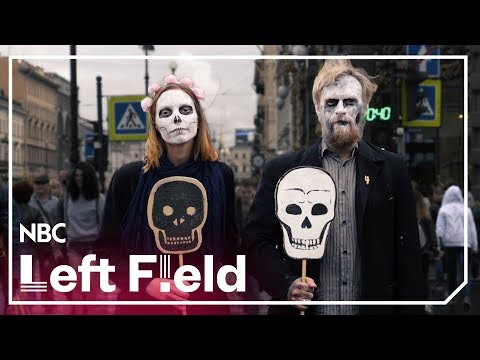
In 2017, the artist Maksim Evstropov created a critical reaction to the Immortal Regiment, when he started new street actions under the name ‘Party of The Dead’. Like the Immortal Regiment, this new movement sprung up across Russia. Instead of carrying pictures of the dead, all of them carried pictures of skulls and banners where they used government slogans, just reiterated morbidly and critically. Their banners read slogans such as ‘The Dead Don’t Make War’ and ‘Even the Dead Are Against Such Pension Funds’ (Hanukai, 2021).
The Party of The Dead criticizes that Kremlin takes the dead hostage in a political message, and their lack of representation of all the dead; also the queers, the migrant workers, and the political opponents to Putin.
In a way, I think this plays on a theme that we have discussed several times in class, which is how resistance and protest can be communicated in a way where you are not completely sure if the person is making fun or is serious, and therefore is harder to punish. They do this by using over-identification and styob. It reminds me of Mikhail Zoshchenkos's story about the Galosh because here it was mere descriptions and ridicule of the everyday life in the Soviet Union, but if you wanted to read government criticism into it you could. The balance is very difficult though, because Evstropov takes it a bit further by using slogans that are directly ridiculing political decisions such as pension funds.
Although Evstropov claims that the Party of The Dead is an artistic project it comes across as being very political to me. In Hanukai’s text, Evstropov is also quoted as saying that the Party of The Dead is merely masqueraded as an artistic project, but is more political. As it can be seen in the attached NBC News interview with Evstropov from 2018, he also comments on the political implications of his art.
I thought it was really interesting the way Hanukai ends their interpretation and analysis of the Party of The Dead with the following quote from Evstropov:
“There is no need to wait for the revolution, hope in change is no longer tied to any human action—the only thing that gives us hope is the natural and ‘inhuman’ processes of aging, decay, dispersal, and disintegration.” - Maksim Evstropov
In a way that ties a bow on the whole project about immortality and the state captivating the dead.
It also connects to the recently reported death of Putin’s biggest opponent politician Alexei Navalny. Navalny now lives in the memory, and other people must carry him in their physical bodies if he shall become immortal. I therefore wonder, if the presumable state killing of Navalny, will disadvantage Putin because he now is a martyr that will live on no matter how many he arrests.
This page has paths:
- Titel page: Remediating Protest Lisa Seidelin