Pass Guaranteed Tableau - Valid TDS-C01 Sample Questions Pdf
P.S. Free & New TDS-C01 dumps are available on Google Drive shared by Exam4Docs: https://drive.google.com/open?id=1Pc2t3B5QrkY5JuzGC0slqQhjgygrzu4C
You can use this TDS-C01 practice exam software to test and enhance your Tableau Desktop Specialist (TDS-C01) exam preparation. Your practice will be made easier by having the option to customize the TDS-C01 Exam Dumps. The fact that it runs without an active internet connection is an incredible comfort for users who don't have access to the internet all the time.
What are the Prerequisites to take the Tableau TDS-C01 Certification Exam?
There is no prerequisite for the Tableau TDS-C01 Certification Exam. However, the candidates should have basic knowledge of the Tableau Desktop. Qualification and experience are not a requirement for the Tableau TDS-C01 Certification Exam. The worksheet visualisation is the most important tool to solve the questions. But, it is not a requirement for the Tableau TDS-C01 Certification Exam.
>> TDS-C01 Sample Questions Pdf <<
Flexible TDS-C01 Learning Mode | TDS-C01 Reliable Test Answers
Once we have latest version, we will send it to your mailbox as soon as possible. our TDS-C01 exam questions just need students to spend 20 to 30 hours practicing on the platform which provides simulation problems, can let them have the confidence to pass the TDS-C01 exam, so little time great convenience for some workers. Our TDS-C01 question torrent not only have reasonable price but also can support practice perfectly, as well as in the update to facilitate instant upgrade for the users in the first place, compared with other education platform on the market, the TDS-C01 Exam Question can be said to have high quality performance. It must be your best tool to pass your exam and achieve your target.
Tableau TDS-C01 (Tableau Desktop Specialist) Certification Exam is a highly sought after exam in the field of data analytics. TDS-C01 exam is designed to test the knowledge and skills of individuals who work with Tableau Desktop software. TDS-C01 exam covers a wide range of topics including data preparation, data analysis, and data visualization. Individuals who Pass TDS-C01 Exam are considered to be highly skilled in the use of Tableau Desktop software and are highly valued by employers.
Tableau Desktop Specialist Sample Questions (Q71-Q76):
NEW QUESTION # 71
In which situation should you save a workbook as a PDF document?
- A. Your users have Tableau Desktop but not Tableau Reader.
- B. You need paper copies of the workbook.
- C. You want document users to be able to filter and sort the views.
- D. Your analysis does not require a live connection to a data source.
Answer: B
Explanation:
You should save a workbook as a PDF document if you need paper copies of the workbook. A PDF document preserves the layout and formatting of the workbook, and can be easily printed or shared. Saving a workbook as a PDF document is not necessary or useful in the other situations1
NEW QUESTION # 72
Which three statements accurately describes the capabilities of dashboard actions? (Choose three.)
- A. Can be set to run on Hover, Select, or Menu
- B. Can be set to dynamically update when a workbook opens
- C. Can be set to be triggered on a data value
- D. Can be set to Filter, Highlight, or Go to URL
- E. Can have multiple source and target sheets
Answer: A,D,E
Explanation:
Dashboard actions in Tableau have several capabilities:
- They can involve multiple source and target sheets, allowing actions to span across various views within a dashboard.
- Actions can be set to run on Hover, Select, or Menu, providing different interaction methods for triggering the action.
- Actions can perform operations like Filter, Highlight, or Go to URL, enhancing interactivity by allowing users to drill down or navigate to external content.
NEW QUESTION # 73
Which two statements accurately describe relationships in Tableau Desktop? (Choose two.)
- A. Maintains tables separately in the data source
- B. Maintains each table's level of detail (LOD) without duplicating records
- C. Used to join physical tables into a single logical table
- D. Used to establish an explicit join type
Answer: A,B
Explanation:
Relationships in Tableau:
- Maintain tables separately in the data source, allowing each table to retain its structure and only joining them when needed in the analysis.
- Maintain each table's level of detail (LOD), which helps avoid duplicating records and supports more flexible, accurate analysis without flattening the data.
Relationships do not establish an explicit join type; they are flexible connections that adjust based on fields used in the view. They are also not used to join physical tables into a single logical table; instead, they connect logical tables while preserving the original data structure.
NEW QUESTION # 74
According to Tableau's 'Order of Operations', which of the following filters is applied FIRST?
- A. Measure Filter
- B. Context Filter
- C. Dimension Filter
- D. Extract Filter
Answer: D
Explanation:
Explanation
According to Tableau's order of operations, the Extract filter is right at the top of the hierarchy. The data filtered in the Extract is then passed on to what we see in the Data Pane. See below: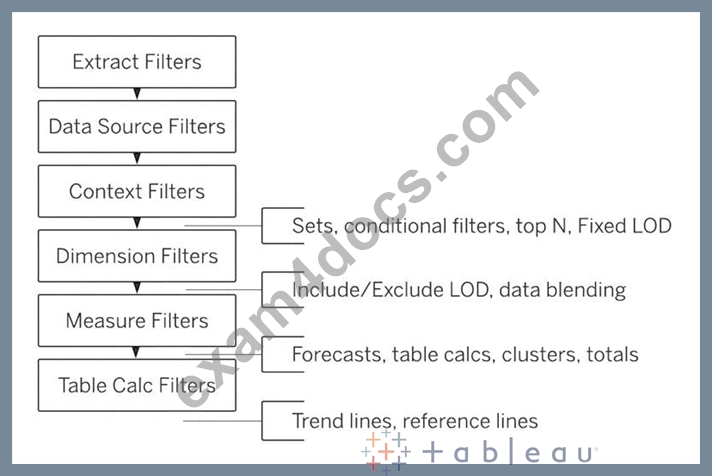
NEW QUESTION # 75
True or False: When you drag additional tables to the logical layer canvas, Tableau automatically attempts to create the relationship based on existing key constraints and matching fields to define the relationship. If it can't determine the matching fields, then relating these tables is not possible.
- A. False
- B. True
Answer: A
Explanation:
Graphical user interface, application Description automatically generated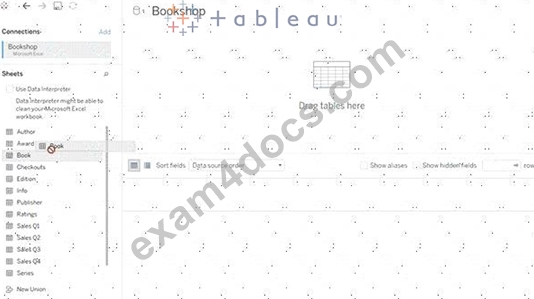
Tables that you drag to the logical layer of the Data Source page canvas must be related to each other. When you drag additional tables to the logical layer canvas, Tableau automatically attempts to create the relationship based on existing key constraints and matching fields to define the relationship. If it can't determine the matching fields, you will need to select them.
If no constraints are detected, a Many-to-many relationship is created and referential integrity is set to Some records match. These default settings are a safe choice and provide the most a lot of flexibility for your data source.
NEW QUESTION # 76
......
Flexible TDS-C01 Learning Mode: https://www.exam4docs.com/TDS-C01-study-questions.html