Databricks-Certified-Professional-Data-Engineer:Databricks Certified Professional Data Engineer Exam collect & ExamCollection Databricks-Certified-Professional-Data-Engineer bootcamp
Our company is a professional certificate exam materials provider, therefore we have rich experiences in offering exam dumps. Databricks-Certified-Professional-Data-Engineer study materials are famous for high quality, and we have received many good feedbacks from our customers, and they think highly of our Databricks-Certified-Professional-Data-Engineer exam dumps. Moreover, we also pass guarantee and money back guarantee, and if you fail to pass the exam, we will give you refund and no other questions will be asked. Databricks-Certified-Professional-Data-Engineer Training Materials have free update for 365 days after purchasing, and the update version will be sent to you email automatically.
Databricks-Certified-Professional-Data-Engineer exam is a comprehensive assessment that evaluates a candidate's ability to design, implement, and manage data pipelines, as well as leverage advanced analytics and machine learning techniques on the Databricks platform. Databricks-Certified-Professional-Data-Engineer Exam consists of multiple-choice questions and requires candidates to complete a hands-on project that demonstrates their ability to build a data solution on the Databricks platform.
Databricks Certified Professional Data Engineer exam is designed to test the skills and knowledge of individuals who work with big data and cloud computing technologies. Databricks-Certified-Professional-Data-Engineer exam is primarily focused on assessing candidates’ abilities to design, build, and maintain big data solutions using the Apache Spark platform. Databricks Certified Professional Data Engineer Exam certification is highly valued in the industry and can help individuals demonstrate their proficiency in managing big data projects.
Databricks Certified Professional Data Engineer Exam is a comprehensive exam that covers a wide range of topics related to data engineering. These topics include data modeling, data ingestion, data integration, data transformation, data storage, and data analysis. Candidates are required to demonstrate their knowledge and skills in these areas by completing a series of tasks and exercises.
>> New Databricks-Certified-Professional-Data-Engineer Test Registration <<
Real Databricks Databricks-Certified-Professional-Data-Engineer Question - Upgrade Databricks-Certified-Professional-Data-Engineer Dumps
Are you still feeling uncomfortable about giving up a lot of time to entertain, work or accompany your family and friends in preparation for the exam? Using Databricks-Certified-Professional-Data-Engineer Quiz torrent, you can spend less time and effort reviewing and preparing, which will help you save a lot of time and energy. When some candidates trying to overcome an exam, they will all first think of choosing a good study material to prepare for their exam. The Databricks Certified Professional Data Engineer Exam prep torrent has a variety of self-learning and self-assessment functions to test learning outcome, which will help you increase confidence to pass exam.
Databricks Certified Professional Data Engineer Exam Sample Questions (Q94-Q99):
NEW QUESTION # 94
The data engineering team maintains a table of aggregate statistics through batch nightly updates. This includes total sales for the previous day alongside totals and averages for a variety of time periods including the 7 previous days, year-to-date, and quarter-to-date. This table is named store_saies_summary and the schema is as follows:
The table daily_store_sales contains all the information needed to update store_sales_summary. The schema for this table is:
store_id INT, sales_date DATE, total_sales FLOAT
If daily_store_sales is implemented as a Type 1 table and the total_sales column might be adjusted after manual data auditing, which approach is the safest to generate accurate reports in the store_sales_summary table?
- A. Use Structured Streaming to subscribe to the change data feed for daily_store_sales and apply changes to the aggregates in the store_sales_summary table with each update.
- B. Implement the appropriate aggregate logic as a Structured Streaming read against the daily_store_sales table and use upsert logic to update results in the store_sales_summary table.
- C. Implement the appropriate aggregate logic as a batch read against the daily_store_sales table and append new rows nightly to the store_sales_summary table.
- D. Implement the appropriate aggregate logic as a batch read against the daily_store_sales table and use upsert logic to update results in the store_sales_summary table.
- E. Implement the appropriate aggregate logic as a batch read against the daily_store_sales table and overwrite the store_sales_summary table with each Update.
Answer: A
Explanation:
The daily_store_sales table contains all the information needed to update store_sales_summary. The schema of the table is:
store_id INT, sales_date DATE, total_sales FLOAT
The daily_store_sales table is implemented as a Type 1 table, which means that old values are overwritten by new values and no history is maintained. The total_sales column might be adjusted after manual data auditing, which means that the data in the table may change over time.
The safest approach to generate accurate reports in the store_sales_summary table is to use Structured Streaming to subscribe to the change data feed for daily_store_sales and apply changes to the aggregates in the store_sales_summary table with each update. Structured Streaming is a scalable and fault-tolerant stream processing engine built on Spark SQL. Structured Streaming allows processing data streams as if they were tables or DataFrames, using familiar operations such as select, filter, groupBy, or join. Structured Streaming also supports output modes that specify how to write the results of a streaming query to a sink, such as append, update, or complete. Structured Streaming can handle both streaming and batch data sources in a unified manner.
The change data feed is a feature of Delta Lake that provides structured streaming sources that can subscribe to changes made to a Delta Lake table. The change data feed captures both data changes and schema changes as ordered events that can be processed by downstream applications or services. The change data feed can be configured with different options, such as starting from a specific version or timestamp, filtering by operation type or partition values, or excluding no-op changes.
By using Structured Streaming to subscribe to the change data feed for daily_store_sales, one can capture and process any changes made to the total_sales column due to manual data auditing. By applying these changes to the aggregates in the store_sales_summary table with each update, one can ensure that the reports are always consistent and accurate with the latest data. Verified Reference: [Databricks Certified Data Engineer Professional], under "Spark Core" section; Databricks Documentation, under "Structured Streaming" section; Databricks Documentation, under "Delta Change Data Feed" section.
NEW QUESTION # 95
Which of the following is true of Delta Lake and the Lakehouse?
- A. Primary and foreign key constraints can be leveraged to ensure duplicate values are never entered into a dimension table.
- B. Views in the Lakehouse maintain a valid cache of the most recent versions of source tables at all times.
- C. Z-order can only be applied to numeric values stored in Delta Lake tables
- D. Delta Lake automatically collects statistics on the first 32 columns of each table which are leveraged in data skipping based on query filters.
- E. Because Parquet compresses data row by row. strings will only be compressed when a character is repeated multiple times.
Answer: E
Explanation:
Explanation
This is the correct answer because it is true of Delta Lake and the Lakehouse. Delta Lake uses Parquet as the underlying storage format for data files. Parquet is a columnar format that compresses data by column rather than by row. This means that Parquet can achieve high compression ratios for columns that have low cardinality or high repetition of values, such as integers, booleans, or dates. However, for columns that have high cardinality or low repetition of values, such as strings, Parquet cannot compress data very well.
Therefore, strings will only be compressed when a character is repeated multiple times within a row. Verified References:[Databricks Certified Data Engineer Professional], under "Delta Lake" section; Databricks Documentation, under "Delta Lake core features - Schema enforcement and evolution" section.
NEW QUESTION # 96
A data team is implementing an append-only Delta Lake pipeline that processes both batch and streaming data. They want to ensure that schema changes in the source data are automatically incorporated without breaking the pipeline.
Which configuration should the team use when writing data to the Delta table?
- A. ignoreChanges = false
- B. validateSchema = false
- C. overwriteSchema = true
- D. mergeSchema = true
Answer: D
Explanation:
Comprehensive and Detailed Explanation From Exact Extract of Databricks Data Engineer Documents:
When writing data to Delta Lake tables, the option mergeSchema = true allows automatic evolution of the table schema by merging new columns or data types introduced in the incoming data with the existing table definition. This ensures pipelines remain resilient to upstream schema changes, especially in append-only or streaming ingestion scenarios. The Databricks documentation specifies that this option should be enabled for schema-on-write flexibility, while overwriteSchema replaces the existing schema entirely and ignoreChanges applies only to CDC operations. validateSchema ensures consistency and does not handle evolution. Therefore, B (mergeSchema = true) is the correct configuration for handling automatic schema evolution safely.
NEW QUESTION # 97
A Delta Lake table was created with the below query: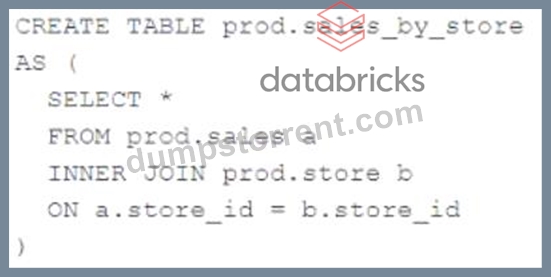
Consider the following query:
DROP TABLE prod.sales_by_store -
If this statement is executed by a workspace admin, which result will occur?
- A. Data will be marked as deleted but still recoverable with Time Travel.
- B. The table will be removed from the catalog but the data will remain in storage.
- C. The table will be removed from the catalog and the data will be deleted.
- D. An error will occur because Delta Lake prevents the deletion of production data.
- E. Nothing will occur until a COMMIT command is executed.
Answer: C
Explanation:
When a table is dropped in Delta Lake, the table is removed from the catalog and the data is deleted. This is because Delta Lake is a transactional storage layer that provides ACID guarantees. When a table is dropped, the transaction log is updated to reflect the deletion of the table and the data is deleted from the underlying storage. References:
* https://docs.databricks.com/delta/quick-start.html#drop-a-table
* https://docs.databricks.com/delta/delta-batch.html#drop-table
NEW QUESTION # 98
A junior data engineer is working to implement logic for a Lakehouse table named silver_device_recordings. The source data contains 100 unique fields in a highly nested JSON structure.
The silver_device_recordings table will be used downstream to power several production monitoring dashboards and a production model. At present, 45 of the 100 fields are being used in at least one of these applications.
The data engineer is trying to determine the best approach for dealing with schema declaration given the highly-nested structure of the data and the numerous fields.
Which of the following accurately presents information about Delta Lake and Databricks that may impact their decision-making process?
- A. Because Databricks will infer schema using types that allow all observed data to be processed, setting types manually provides greater assurance of data quality enforcement.
- B. Human labor in writing code is the largest cost associated with data engineering workloads; as such, automating table declaration logic should be a priority in all migration workloads.
- C. The Tungsten encoding used by Databricks is optimized for storing string data; newly-added native support for querying JSON strings means that string types are always most efficient.
- D. Schema inference and evolution on .Databricks ensure that inferred types will always accurately match the data types used by downstream systems.
- E. Because Delta Lake uses Parquet for data storage, data types can be easily evolved by just modifying file footer information in place.
Answer: A
Explanation:
This is the correct answer because it accurately presents information about Delta Lake and Databricks that may impact the decision-making process of a junior data engineer who is trying to determine the best approach for dealing with schema declaration given the highly-nested structure of the data and the numerous fields. Delta Lake and Databricks support schema inference and evolution, which means that they can automatically infer the schema of a table from the source data and allow adding new columns or changing column types without affecting existing queries or pipelines. However, schema inference and evolution may not always be desirable or reliable, especially when dealing with complex or nested data structures or when enforcing data quality and consistency across different systems. Therefore, setting types manually can provide greater assurance of data quality enforcement and avoid potential errors or conflicts due to incompatible or unexpected data types. Verified Reference: [Databricks Certified Data Engineer Professional], under "Delta Lake" section; Databricks Documentation, under "Schema inference and partition of streaming DataFrames/Datasets" section.
NEW QUESTION # 99
......
You can download a small part of PDF demo, which is in a form of questions and answers relevant to your coming Databricks-Certified-Professional-Data-Engineer exam; and then you may have a decision about whether you are content with it. In fact, there are no absolutely right Databricks-Certified-Professional-Data-Engineer exam questions for you; there is just a suitable learning tool for your practices. Therefore, for your convenience and your future using experience, we sincere suggest you to have a download to before payment. Moreover, Databricks-Certified-Professional-Data-Engineer Exam Questions have been expanded capabilities through partnership with a network of reliable local companies in distribution, software and product referencing for a better development. That helping you pass the Databricks-Certified-Professional-Data-Engineer exam successfully has been given priority to our agenda.
Real Databricks-Certified-Professional-Data-Engineer Question: https://www.dumpstorrent.com/Databricks-Certified-Professional-Data-Engineer-exam-dumps-torrent.html