My Future York
York’s reputation as a heritage city makes it one of the most desirable and unaffordable places to live in the north of England. Therefore, the need to build new housing is a pressing issue but one which has been highly contested in recent years. Concerns about losing York’s historic character have dominated discussions of local planning and development.
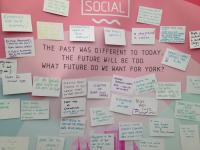
The My Future York project explores how collaboratively produced histories can be used to create a space of critical engagement and possibility thinking, in the hope that more people become involved in local decision-making. The project encompasses a range of temporal perspectives; from thinking about housing plans that didn’t happen to inviting ideas for the future development of the city. The critical and transformative aspects of this approach make it a properly utopian form of inquiry, opening up conversations and ways of thinking otherwise about York’s future.
My Future York has been developed through a partnership between York Environment Forum, York Past and Present, York Explore Libraries and Archives and the Centre for Critical Studies in Museums, Galleries and Heritage at the University of Leeds.
This page has paths:
- Introduction Elizabeth Stainforth