Gothic Biology
"Gothic Biology". This title must seem strange to most readers. Some might even want to sneak the conjunctive “and” between “gothic” and “biology”, thus making it an additive instead of mutually conditional relationship. But I mean what I wrote. The science of biology is becoming a (neo)gothic form of knowledge.
We will talk about this in more detail soon. For now, as a brief introduction, compare these two illustrations. On the left we have the well known rose window from the Northern transept of the Chartres Cathedral. Created around 1235, the rose windows in Chartres are often used as examples of how stained glass in the gothic period don't so much show pictures, but offers stories with spiritual and moral significance. This rose window is dedicated to the Virgin Mary and features her and her child in the central panel. Radiating outwards is a concentric series of different panels. On the inside is a ring of winged creatures, doves and angels. Beyond that is a ring of twelve panels containing the Old Testament's twelve kings of Judah, followed by a series of small panels with the arms for France and the kingdom of Castile. The outer ring is a series of semi-circles each containing a prophet from the Old Testament. Underneath the rose are eight small and five large lancet windows. Small lancet windows pay an homage to the patron of the cathedral, in this case Queen Blanche of Castille. The center window of the larger lancet windows on the bottom, depicts the Virgin Mary holding her child. She is flanked on either side by the other four large lancet windows, each of which depicts an Old Testament prophet overcoming an enemy.
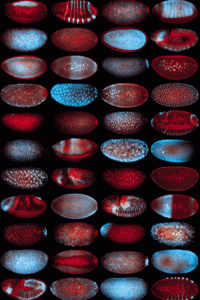
The illustration on the right appeared on the cover of the October 5, 2007 issue of Cell magazine with little explanation. In this illustration we have a series of drosophila embryos, stained to differently illuminate the expression of messenger RNA. The beautiful array of patterns in the embryos are created by immunoflorescent stains for specific RNA sequences. Impressively, each of these embryos tells a story about the developing fly, where the patterns of mRNA expression will show the place and time of the expression of this molecule. The likeness of the two images is surprising. Both images use the same color palette of red, violet, and blue projected over a dark or black background. Both illustrations present a storied understanding of birth and transformation. In the rose window the transformation is spiritual as a virgin birth suggests a break in the worldly cycle of life and death. In the illustration of the embryos, the transformation is earthly, as the goal is to use a combination of special circumstances and tools to understand biological transformation and development. Perhaps most importantly, both illustrations don't just represent an event, they provide a cosmology within events occur, and each of these cosmologies use wings in different ways. The first image envisions a universe where wings are used to soar through the heavens. The second image envisions a cosmology where the events can help us understand how some animals might not have wings, despite the molecular potential for that transformation to occur. Thus, each illustration depicts a striving, what the art historian Wilhelm Worringer called a "will to form", or what I've described in my book on the role of graphic illustration in evolutionary and developmental biology, a process of "information" as a development of form. While the striving of the gothic might be angelic, in order to be closer to god; the goal of the biological neo-gothic is to renounce one’s wings and to seek the earth and the patterns it generates.
Now we need to ask, what what exactly makes these illustrations gothic and why is this important?