A Networked Society
With the rise of technology in the 1990’s, the Internet quickly became integrated into people's lives. The development of the Internet is remarkably important because it was one of the first instances generating a global network that was accessible to the masses. This global network can be the same as a “network society,” proposed by Nicholas Mirzoeff. Mirzoeff explains that the networked society has bridged relationships between different cultures making individuals united (Mirzoeff, 218). Similarly, Seth Masket explains, “our increasing on-line connectedness has changed our perceptions of our social world. Decades ago, our social networks were decidedly local; we primarily spoke with our neighbors and nearby friends and family members. More recently, we have become, in Wellman’s words, “glocalized,” simultaneously involved in both local and long-distance relationships” (Masket). With this, the Internet established relationships and communication that was not possible due to extreme distance. Using the web fore more than search, but for social interaction like online classes or dating, the Internet has become essential in maintaining our networked society.
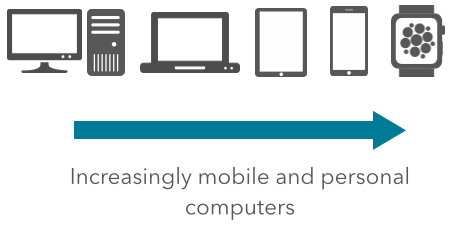
In a networked society, the streamline of products facilitating Internet access transformed the desktop computer into products like the laptop and smartphone. At one time, people were mandated to use the Internet in a stagnant place with the desktop computer. Therefore, the mobility of laptops and smartphones has increased the interactive nature of a networked society. This constant advancement in technology can be explained through Bolter and Grusin’s process of remediation. Bolter and Grusin write that with remediation, “new media are doing exactly what their predecessors have done: presenting themselves as refashioned and improved versions of other media” (Bolter and Grusin, 15). With this, remediation can be seen as a continuous cycle producing breakthroughs in media and technology resulting in a societal abandonment of prior medias and technologies. Thus, the innovation of mobile media within smartphones makes people forget prior technologies like desktop computers and landlines that are reliant on one stationary place.
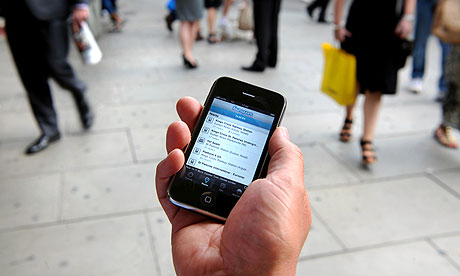
In remediating the computer, mobile technologies are more prevalent because they sustain an improved networked society. Masket writes, “the rise of personal cell phones and social media have allowed us to stay in touch with other individuals regardless of location. This, according to Wellman, is “networked individualism.” “We no longer require homes, offices, or cafes to stay in touch with people; we can do it wherever we happen to be” (Masket). Because the smartphone has compacted Internet access into a mobile interface, the networked society continues evolve because of how integral the smartphone has become.
| Previous page on path | Introduction, page 1 of 1 |
Discussion of "A Networked Society"
Add your voice to this discussion.
Checking your signed in status ...