Thanks for your patience during our recent outage at scalar.usc.edu. While Scalar content is loading normally now, saving is still slow, and Scalar's 'additional metadata' features have been disabled, which may interfere with features like timelines and maps that depend on metadata. This also means that saving a page or media item will remove its additional metadata. If this occurs, you can use the 'All versions' link at the bottom of the page to restore the earlier version. We are continuing to troubleshoot, and will provide further updates as needed. Note that this only affects Scalar projects at scalar.usc.edu, and not those hosted elsewhere.
Ex Libris: Annotating Books from the William A. Clark Memorial LibraryMain MenuIntroductionIntroduction by Professor McClendon, with a map and a timeline of annotated books included in this course project.Student ProjectsMuriel C. McClendon7d0d078698cd80d923d8ef12ec1584c2cc8c35e2Jonathan Abraham1951edb1c10a4e0fd1d4c6055bc120deaec1ac3eLuis Alonso224e5f6e7a735c76336fa3dd876079621b634152David Perez Hernandezf35a4d075920538e1a642ce5ad79e60ad2cfad23Adam Jacobsendb1596193330f6ec27a260c3b1c0516e5b16e336Kyle Martinich969d84e3df940a458ce331be950dc44cb6cf190aArthur Ian Michiec975d52e0462a57a8b1be034c3b720b039744e53Pierce Monahan00718a49b8540237c348cef2d7e1bdf22cc5cafbCarson Turnerbe5a97c4b1fb2f144cd3788a6dd117d2485fe221Raymond Valdeze8c1ee8b19789548651d2769a9f2026c455c2f92
Finding Gold in the Flowers: Rebellious Formatting As Well As Content
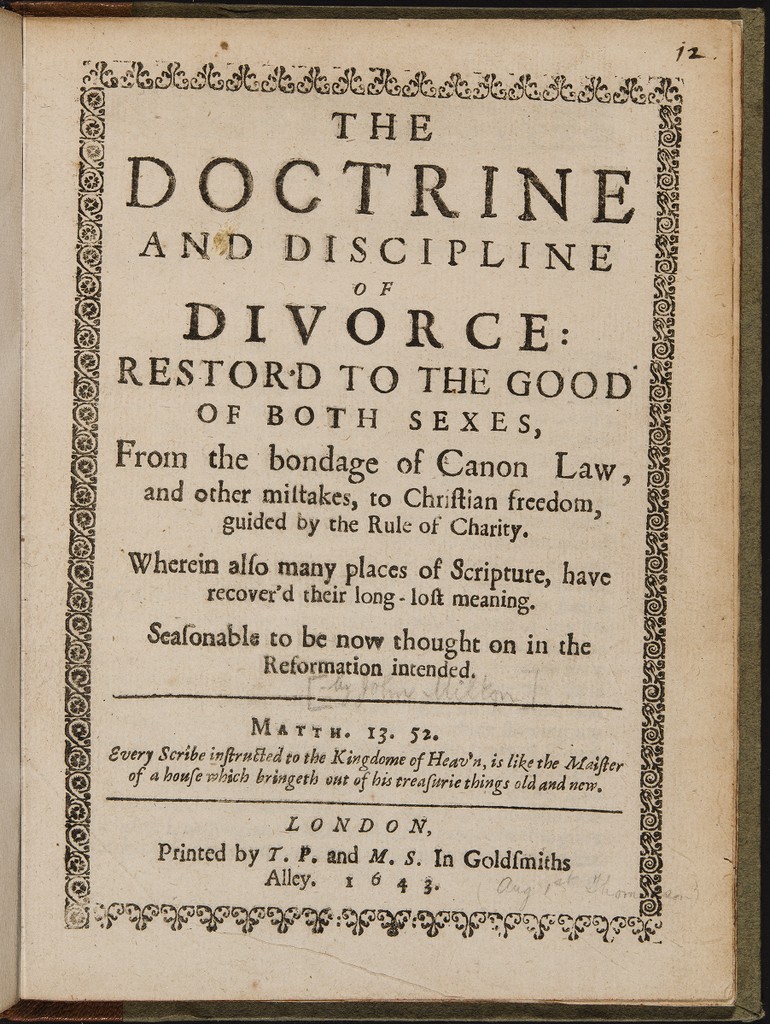
12021-04-29T15:55:36-07:00Adam Jacobsendb1596193330f6ec27a260c3b1c0516e5b16e3363911656The Doctrine and Discipline of Divorce, at first glance, may not seem to be an historically significant piece of literature, but its simple structure and critical content serve as a reflection of English culture during its civil war. It is for this reason the original text must be preserved.plain2021-06-03T10:28:18-07:00Christopher Gilman1985b99a2acd541caa12a10c3ebf6896565283abThe English Civil War was a moment where nearly 1000 years of tradition were being questioned through both military action and literary practice. John Milton, an infamous critic of the English government, was heavily impacted by this time of revolution in his critical works on political and religious tradition, specifically in that of The Doctrine and Discipline of Divorce (1643). In addition to the condemnation of social views of divorce in English politics and religion, the letter-like structure of the text was also rebellious in that it refused to follow elitist standards and aimed at attracting diverse audiences. With Doctrine’s content and format being a reflection of its time period, historical archivists like Arthur Kay found it significant and focused their annotations on preserving the physical condition of the original text.
Milton wrote his work in the midst of the English Civil War: a time where the very foundations of English politics and religion were being brought into question, so it was only natural that his work would reflect the same revolutionary attitudes. In 1642, a group of rebels known as The Parliamentarians declared war on the English government, calling for the abolition of the English monarchy in favor of a democratic government. John Milton was one of these rebels. Milton is better known for the masterpiece, Paradise Lost: an epic which retells the story of the Original Sin from the perspective of Satan. The point of this work was not to glorify the demonic arts, but rather to show how different history can look when viewed from the perspective of the losers. Milton was certainly one to bring the status quo into question, and he does it all the same in Doctrine. Writing this short and seemingly insignificant work in 1643, a year after the beginning of the English Civil War, it is reasonable to conclude that Milton was very much influenced by his time. While there is nothing verifying what exactly inspired Milton to write on divorce specifically, the failure of his own marriage only a year prior provides a rational hypothesis as to his inspiration. When the words “divorce” and “England” are used together, most people’s minds turn to King Henry VIII, who famously broke from the Catholic Church to form the Church of England all so he could obtain a divorce from his wife, Catherine of Aragon. Despite what that narrative may imply, divorce was not widely accepted in England, even after the Reformation. When England broke from Rome, a resolution was introduced to widen the qualifications for divorce, but it was never formally adopted. “Thus, by default, the old canon law remained, and a valid marriage continued to be indissoluble” (Couch 514). Those few who were able to obtain a divorce were hardly ever allowed to remarry. The only time where one could get remarried after getting a divorce “were when the original ‘marriage’ was not valid” (Wolfram 157), essentially saying that a marriage could never truly be dissolved unless it never existed in the first place. In Doctrine, Milton finds this tradition within the Church, perpetuated by its head, the monarch, and Parliament, to be utterly ridiculous. As the full title of the essay states: divorce is a way of righting the mistakes people make and bringing them closer to “Christian Freedom." Milton lived in a time of revolution, so he wrote a revolutionary work that questioned tradition.
In discussing the influence that Doctrine and texts like it had on English culture, it is important how the format of the text made it appealing to the public. Doctrine is a relatively short text, only being a little over 50 pages long. That may seem like a reasonably large text, but compared to some of the insanely long treatises that dominated 17th century academia, this was hardly anything. This short-text format of sharing ideas became increasingly popular in the mid-17th century with the arrival of a new literary invention: the newspaper. Henry Muddiman founded The London Gazette in 1665, creating what many consider to be the first British newspaper. Muddiman was only editor for a short time, but his style of “assembling short, discrete items out of personal letters and foreign newspapers” (King 23) would be influential on future newspapers. These collections of information, what we call “articles,” were very attractive to the common population, allowing for the information within the text to spread rapidly. Letters themselves were the foundation of this journalistic style. Letters, above all else, were methods of spreading information. This information transcended social borders, serving “as a means of connection, bridging rural and urban scenes” (King 36). Letters were a simple structure that the newly literate could easily pick up in both reading and writing. “[W]hile the best and most educated writers could flout the rules and disdain the use of formulas, for the newly or barely literate the [letter-writing] guides provided a standard to which to aspire” (King 32). The elites of society had no desire to spread new ideas to populations below their status. To inform the population would ruin the dynamic that had benefited them for so long. Letters between social groups were revolutionary, so structures similar to it were attractive to the unfortunate. Newspaper editors like Muddiman and socialites like Milton knew this, so they adopted the literary style into their own work in the hopes that their message would spread to a wider audience despite criticisms from the elite. Not only was the content of Milton’s work revolutionary in its blatant defiance of tradition, but even the simplistic style of it questioned the hierarchy and sought to bring information to an audience so often ignored in classical academia.
From the subject matter to the formatting, The Doctrine and Discipline of Divorce is truly a symbol of its time, so it is no wonder why archivists like Arthur Kay were so concerned with preserving the original text. On the back of the cover of the book, Kay has left a stamp with his name and a Latin phrase: Floriferis ut apes in saltibus omnia libant omnia nos itidem despascimur aurea dicta (As bees taste of everything, they offer everything which they call gold). Interpreted in the context of Kay being an archivist, this proverb could refer to how he is preserving and sharing with the world a piece of history which he believes is vitally important and worthy of regard. Looking through the pages of the text, Kay leaves few annotations, only occasionally making note of omitted passages and damages to the text. He is focused on the physical condition of the text and for good reason: Doctrine, while not the most important text in the history of English thought, is important in understanding the religious practices and social conflicts of Milton’s time.
Works Cited
Couch, Harvey. "The Evolution of Parliamentary Divorce in England." Tulane Law Review, vol. 52, 1977-1978, pp. 513-40.
King, Rachel Scarborough. "Circulating News: Letters in Manuscript and Print, 1665-1695." Writing to the World: Letters and the Origins of Modern Print Genres, John Hopkins UP, 2018, pp. 23-49.
Wolfram, Sybil. "Divorce in England 1700-1857." Oxford Journal of Legal Studies, vol. 5, no. 2, 1985, pp. 155-86.
This page has paths:
12021-04-28T14:52:14-07:00Muriel C. McClendon7d0d078698cd80d923d8ef12ec1584c2cc8c35e2Student ProjectsLuis Alonso28structured_gallery10773442021-06-03T17:07:46-07:00Luis Alonso224e5f6e7a735c76336fa3dd876079621b634152
This page references:
12021-04-29T15:32:51-07:00The Doctrine and Discipline of Divorce10Manuscript annotations in a first edition on Milton's Doctrine and discipline of divorce. A roughly contemporary anonymous reader has corrected all of the items listed on the errata sheet in manuscript, supplies words lost because of a hole in the center of G₃, and supplies a note regarding an omitted passage (with a rare letterpress leaf of that passage). Condition: Bound in 19th or 20th century half rust colored morocco.plain2021-06-03T15:13:48-07:00
12021-05-31T15:00:22-07:00Doctrine and Discipline of Divorce (Page 2)5Page 2 of manuscript annotations in a first edition on Milton's Doctrine and discipline of divorce. A roughly contemporary anonymous reader has corrected all of the items listed on the errata sheet in manuscript, supplies words lost because of a hole in the center of G₃, and supplies a note regarding an omitted passage (with a rare letterpress leaf of that passage). Condition: Bound in 19th or 20th century half rust colored morocco.plain2021-06-01T12:19:14-07:00
12021-05-27T17:33:27-07:00Portrait of King Henry VIII4A half-length, full-face portrait in a gold doublet, embroidered and slashed, a black bejewelled hat with a white feather and jewels, and a red coat with fur trimming. Round his neck he wears a pendant depicting St George and the Dragon - a motif of national identity. Henry VIII, second son of Henry VII - the founder of the Tudor dynasty - was born in the medieval palace of Placentia at Greenwich, itself completely rebuilt as Greenwich Palace by his father during his childhood. It was also his principal palace during the early years of his reign. Henry took great interest in his navy. His father had founded Portsmouth dockyard and he created those at Woolwich and Deptford (near Greenwich), and at Chatham, in all of which ships were built primarily for fighting purposes instead of being converted merchantmen. This required a more developed administration and he is generally regarded as the founder of the Royal Navy as distinct from the 'navy royal' of his medieval predecessors. The king is shown with a shaven head and a beard, innovations he adopted in May 1535 in imitation of François I of France. The careful and elaborate painting of the gemmed costume and jewellery is a reminder not only of Henry's passion for such ornaments but was intended to serve as a demonstration of his status and wealth. The portrait is closest to another Holbein-pattern half length in the Galleria Nazionale, Rome, and is inscribed 'HENRICUS VIII ANG. REX'.plain2021-06-02T07:28:06-07:00
12021-05-27T15:58:47-07:00Omission on Page 244Page 24 of manuscript annotations in a first edition on Milton's Doctrine and discipline of divorce. A roughly contemporary anonymous reader has corrected all of the items listed on the errata sheet in manuscript, supplies words lost because of a hole in the center of G₃, and supplies a note regarding an omitted passage (with a rare letterpress leaf of that passage). Condition: Bound in 19th or 20th century half rust colored morocco.plain2021-06-01T12:20:10-07:00
12021-05-27T15:42:18-07:00Kay Ex Libris4Back of front cover of manuscript annotations in a first edition on Milton's Doctrine and discipline of divorce. A roughly contemporary anonymous reader has corrected all of the items listed on the errata sheet in manuscript, supplies words lost because of a hole in the center of G₃, and supplies a note regarding an omitted passage (with a rare letterpress leaf of that passage). Condition: Bound in 19th or 20th century half rust colored morocco.plain2021-06-01T12:20:55-07:00
12021-05-27T15:55:21-07:00Hole on Page 463Page 46 of manuscript annotations in a first edition on Milton's Doctrine and discipline of divorce. A roughly contemporary anonymous reader has corrected all of the items listed on the errata sheet in manuscript, supplies words lost because of a hole in the center of G₃, and supplies a note regarding an omitted passage (with a rare letterpress leaf of that passage). Condition: Bound in 19th or 20th century half rust colored morocco.plain2021-06-01T12:23:18-07:00