Databricks-Certified-Professional-Data-Engineer Test Questions, Databricks-Certified-Professional-Data-Engineer Authorized Exam Dumps
If you are motivated to pass Databricks-Certified-Professional-Data-Engineer certification exams and you are searching for the best practice material for the Databricks-Certified-Professional-Data-Engineer exam; then you are at the right place. We provide 100% guaranteed success for Databricks-Certified-Professional-Data-Engineer exams. With our Databricks-Certified-Professional-Data-Engineer PDF dumps questions and practice test software, you can increase your chances of getting successful in multiple Databricks-Certified-Professional-Data-Engineer Exams. Databricks-Certified-Professional-Data-Engineer brain dumps exams can provide you a golden ticket to land a dream job in popular companies.
Databricks Certified Professional Data Engineer certification is recognized by the industry as a standard for measuring the skills and expertise of data engineers who work with Databricks. It demonstrates that the candidate has the knowledge and skills required to design and build data solutions using Databricks that meet the highest standards of performance, scalability, and reliability. Databricks Certified Professional Data Engineer Exam certification is valuable for data engineers who want to advance their careers by demonstrating their proficiency in using Databricks and for organizations that want to ensure that their data engineers have the skills and expertise needed to build and maintain data solutions using Databricks.
>> Databricks-Certified-Professional-Data-Engineer Test Questions <<
Databricks - Useful Databricks-Certified-Professional-Data-Engineer - Databricks Certified Professional Data Engineer Exam Test Questions
The Databricks Databricks-Certified-Professional-Data-Engineer exam material is getting updated on a daily basis according to the real Databricks Databricks-Certified-Professional-Data-Engineer exam questions so that the students don't face any issues while preparing themselves for the Databricks Certified Professional Data Engineer Exam (Databricks-Certified-Professional-Data-Engineer) certification exam and pass it with ease. We guarantee our customers that they will pass Databricks-Certified-Professional-Data-Engineer exam on the first try with our given Databricks-Certified-Professional-Data-Engineer exam material.
Databricks Certified Professional Data Engineer Exam Sample Questions (Q106-Q111):
NEW QUESTION # 106
Each configuration below is identical to the extent that each cluster has 400 GB total of RAM, 160 total cores and only one Executor per VM.
Given a job with at least one wide transformation, which of the following cluster configurations will result in maximum performance?
- A. * Total VMs: 8
* 50 GB per Executor
* 20 Cores / Executor - B. * Total VMs; 1
* 400 GB per Executor
* 160 Cores / Executor
Answer: A
Explanation:
C.
* Total VMs: 4
* 100 GB per Executor
* 40 Cores/Executor
D.
* Total VMs:2
* 200 GB per Executor
* 80 Cores / Executor
Explanation:
This is the correct answer because it is the cluster configuration that will result in maximum performance for a job with at least one wide transformation. A wide transformation is a type of transformation that requires shuffling data across partitions, such as join, groupBy, or orderBy. Shuffling can be expensive and time-consuming, especially if there are too many or too few partitions. Therefore, it is important to choose a cluster configuration that can balance the trade-off between parallelism and network overhead. In this case, having 8 VMs with 50 GB per executor and 20 cores per executor will create 8 partitions, each with enough memory and CPU resources to handle the shuffling efficiently. Having fewer VMs with more memory and cores per executor will create fewer partitions, which will reduce parallelism and increase the size of each shuffle block. Having more VMs with less memory and cores per executor will create more partitions, which will increase parallelism but also increase the network overhead and the number of shuffle files. Verified Reference: [Databricks Certified Data Engineer Professional], under "Performance Tuning" section; Databricks Documentation, under "Cluster configurations" section.
NEW QUESTION # 107
A CHECK constraint has been successfully added to the Delta table named activity_details using the following logic: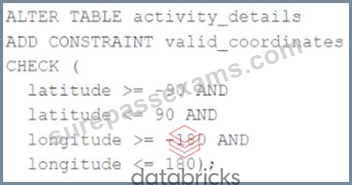
A batch job is attempting to insert new records to the table, including a record where latitude = 45.50 and longitude = 212.67.
Which statement describes the outcome of this batch insert?
- A. The write will include all records in the target table; any violations will be indicated in the boolean column named valid_coordinates.
- B. The write will insert all records except those that violate the table constraints; the violating records will be recorded to a quarantine table.
- C. The write will fail completely because of the constraint violation and no records will be inserted into the target table.
- D. The write will insert all records except those that violate the table constraints; the violating records will be reported in a warning log.
- E. The write will fail when the violating record is reached; any records previously processed will be recorded to the target table.
Answer: C
Explanation:
The CHECK constraint is used to ensure that the data inserted into the table meets the specified conditions. In this case, the CHECK constraint is used to ensure that the latitude and longitude values are within the specified range. If the data does not meet the specified conditions, the write operation will fail completely and no records will be inserted into the target table. This is because Delta Lake supports ACID transactions, which means that either all the data is written or none of it is written. Therefore, the batch insert will fail when it encounters a record that violates the constraint, and the target table will not be updated. References:
* Constraints: https://docs.delta.io/latest/delta-constraints.html
* ACID Transactions: https://docs.delta.io/latest/delta-intro.html#acid-transactions
NEW QUESTION # 108
You noticed that colleague is manually copying the notebook with _bkp to store the previous ver-sions, which of the following feature would you recommend instead.
- A. Databricks notebooks should be copied to a local machine and setup source control locally to version the notebooks
- B. Databricks notebooks support change tracking and versioning
- C. Databricks notebook can be exported as HTML and imported at a later time
- D. Databricks notebooks can be exported into dbc archive files and stored in data lake
Answer: B
Explanation:
Explanation
Answer is Databricks notebooks support automatic change tracking and versioning.
When you are editing the notebook on the right side check version history to view all the changes, every change you are making is captured and saved.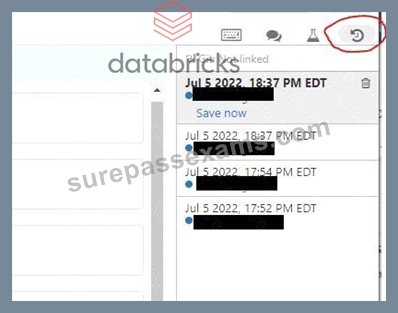
NEW QUESTION # 109
The data engineering team has configured a Databricks SQL query and alert to monitor the values in a Delta Lake table. The recent_sensor_recordings table contains an identifying sensor_id alongside the timestamp and temperature for the most recent 5 minutes of recordings.
The below query is used to create the alert:
The query is set to refresh each minute and always completes in less than 10 seconds. The alert is set to trigger when mean (temperature) > 120. Notifications are triggered to be sent at most every 1 minute.
If this alert raises notifications for 3 consecutive minutes and then stops, which statement must be true?
- A. The average temperature recordings for at least one sensor exceeded 120 on three consecutive executions of the query
- B. The recent_sensor_recordingstable was unresponsive for three consecutive runs of the query
- C. The maximum temperature recording for at least one sensor exceeded 120 on three consecutive executions of the query
- D. The source query failed to update properly for three consecutive minutes and then restarted
- E. The total average temperature across all sensors exceeded 120 on three consecutive executions of the query
Answer: A
Explanation:
This is the correct answer because the query is using a GROUP BY clause on the sensor_id column, which means it will calculate the mean temperature for each sensor separately. The alert will trigger when the mean temperature for any sensor is greater than 120, which means at least one sensor had an average temperature above 120 for three consecutive minutes. The alert will stop when the mean temperature for all sensors drops below 120. Verified References: [Databricks Certified Data Engineer Professional], under "SQL Analytics" section; Databricks Documentation, under "Alerts" section.
NEW QUESTION # 110
A data engineer is configuring a Lakeflow Declarative Pipeline to process CDC (Change Data Capture) data from a source. The source events sometimes arrive out of order, and multiple updates may occur with the same update_timestamp but with different update_sequence_id.
What should the data engineer do to ensure events are sequenced correctly?
- A. O Use a window function to sort update_sequence_id within the same partition, i.e., update_timestamp in the LDP pipeline.
- B. O Use dropDuplicates() to remove out-of-order and duplicate records in LDP.
- C. O Set track_history_column_list to [event_timestamp, event_id] in AUTO CDC APIs.
- D. O Use SEQUENCE BY STRUCT(event_timestamp, update_sequence_id) in AUTO CDC APIs.
Answer: D
Explanation:
Comprehensive and Detailed Explanation from Databricks Documentation:
When handling CDC data, sequencing is critical because updates may arrive out of order or multiple changes may occur for the same record at the same timestamp. Databricks' AUTO CDC APIs provide built-in constructs to handle ordering logic.
The correct mechanism is to use the SEQUENCE BY clause in the CDC configuration. Specifically, when both update_timestamp and update_sequence_id exist, the recommended approach is:
SEQUENCE BY STRUCT(event_timestamp, update_sequence_id)
This ensures that within the same record key, the engine applies updates in the exact sequence they occurred, resolving conflicts where multiple updates share the same timestamp but differ in sequence ID.
Option A (track_history_column_list) is used for historical tracking and auditing changes, not for sequencing logic. It ensures lineage but does not enforce correct event order.
Option B (dropDuplicates()) only removes exact duplicates; it cannot guarantee sequencing correctness when multiple updates exist.
Option C is correct: SEQUENCE BY STRUCT(event_timestamp, update_sequence_id) explicitly enforces ordering, as recommended by the CDC pipeline guidelines.
Option D (window function) would be a manual approach in Spark Structured Streaming, but Lakeflow Declarative Pipelines already provide native CDC sequencing support, making this unnecessary.
Thus, the best practice per Databricks CDC documentation is to use Option C with SEQUENCE BY STRUCT.
NEW QUESTION # 111
......
To get better condition of life, we all need impeccable credentials of different exams to prove individual’s capacity. However, weak Databricks-Certified-Professional-Data-Engineer practice materials may descend and impair your ability and flunk you in the real exam unfortunately. And the worst condition is all that work you have paid may go down the drain for those Databricks-Certified-Professional-Data-Engineer question torrent lack commitments and resolves to help custDatabricks-Certified-Professional-Data-Engineeromers. Moreover, only need toDatabricks-Certified-Professional-Data-Engineer spend 20-30 is it enough for you to grasp whole content of Databricks-Certified-Professional-Data-Engineer practice materials that you can pass the exam easily, this is simply unimaginable.
Databricks-Certified-Professional-Data-Engineer Authorized Exam Dumps: https://www.surepassexams.com/Databricks-Certified-Professional-Data-Engineer-exam-bootcamp.html