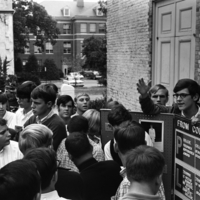
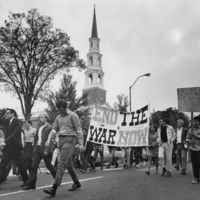
“October 1969: Photograph, antiwar demonstration on Franklin Street (Anne Queen at left)”
1 media/image77_thumb.jpg 2021-09-02T07:50:53-07:00 Grant Glass 107afcf8873f422898a9c2e07c49ae3f625fc644 37354 1 in “Documents and Photographs” in “Vietnam Protests.” I Raise my Hand to Volunteer. The Wilson Library, The University of North Carolina at Chapel Hill, https://exhibits.lib.unc.edu/exhibits/show/protest/vietnam-essay/vietnam-docs. plain 2021-09-02T07:50:53-07:00 Grant Glass 107afcf8873f422898a9c2e07c49ae3f625fc644This page is referenced by:
-
1
media/image73.jpg
2021-08-26T12:09:18-07:00
1962 - 1973 U.S. Involvement in the Vietnam War Prompts Student Protests
4
U.S. involvement in the Vietnam War began in 1954, when American advisors and military aid were sent to South Vietnam to support the government in its war against communist North Vietnam. President Kennedy increased the American military presence in 1962, and President Johnson escalated the war in the mid-1960s, sending hundreds of thousands of combat troops to support the South Vietnamese army. A growing anti-war movement and rising death tolls eventually led to a peace agreement between the U.S. and North Vietnam in January 1973. However, hostilities between North and South Vietnam continued until April 30, 1975. More than three million people, including 58,000 Americans, died over the course of the war, more than half of them Vietnamese civilians (Britannica).
plain
2021-09-02T07:51:12-07:00
01/01/1962
U.S. involvement in the Vietnam War began in 1954, when American advisors and military aid were sent to South Vietnam to support the government in its war against communist North Vietnam. President Kennedy increased the American military presence in 1962, and President Johnson escalated the war in the mid-1960s, sending hundreds of thousands of combat troops to support the South Vietnamese army. A growing anti-war movement and rising death tolls eventually led to a peace agreement between the U.S. and North Vietnam in January 1973. After most U.S. troops were withdrawn, however, hostilities between North and South Vietnam continued until April 30, 1975. More than three million people, including 58,000 Americans, died over the course of the war, more than half of them Vietnamese civilians (Spector). Another two million Vietnamese refugees fled the country in the 20 years after the war (Spector).
The war was especially concerning to American young men who were eligible for the draft and increasingly opposed to what seemed an un-winnable conflict costing thousands of lives. Anti-war protests began with small groups of intellectuals and college students shortly after President Kennedy deployed combat troops to South Vietnam in 1962. Marches, teach-ins, walk-outs, and protest songs attracted an increasingly large base of support that peaked in the late 1960s.
In Chapel Hill the movement was also fueled by protests against segregation and in support of women’s rights. Many UNC students wanted more opportunities to study African American history and culture; they opposed the Speaker Ban Law; they advocated for better working conditions for campus cafeteria workers. They pressed administrators for change on many fronts. Students held regular marches down Franklin Street, on campus, and through classroom buildings while classes were in progress. Teach-ins about the war and other social justice issues took place on Polk Place, and a sizeable group of students and faculty members boarded chartered buses for Washington, D.C., to explain to lawmakers that the demonstrations on many campuses were substantive and not a subversive anti-American activity led by “commies and hippies.”
By October 1967, as American troop strength in Vietnam was approaching 500,000 and U.S. casualties had reached 15,058 killed and 109,527 wounded, one of the most prominent anti-war demonstrations took place in Washington D.C. Some 100,000 protesters gathered at the Lincoln Memorial and about 30,000 of them marched on the Pentagon that night (“Vietnam War”). At UNC the anti-war fervor reached a crisis after the May 4, 1970, shooting of four students at Kent State University and a second shooting of two students 10 days later at Jackson State University in Mississippi. “An estimated 11,000 UNC-Chapel Hill students (well over half of the student body) left class as part of a nationwide effort to protest the war” (Graham 3). Faculty members and administrators generally supported the boycott, postponing spring semester final exams until later in the summer.
SOURCES
Graham, Nicholas, and Cecelia Moore. “Activism.” UNC A to Z: What Every Tar Heel Needs to Know about the First State University. Chapel Hill, N.C.: U of North Carolina P, 2020. 2-4.
History.com editors. “Vietnam War.” A&E Television Networks, May 18, 2021, https://www.history.com/topics/vietnam-war/vietnam-war-history.
Spector, Ronald H. "Vietnam War." Encyclopedia Britannica, July 6, 2021, https://www.britannica.com/event/Vietnam-War.
“Student Protest Movements at the University of North Carolina at Chapel Hill.” UNC Libraries, July 15, 2021, https://guides.lib.unc.edu/protests-unc.