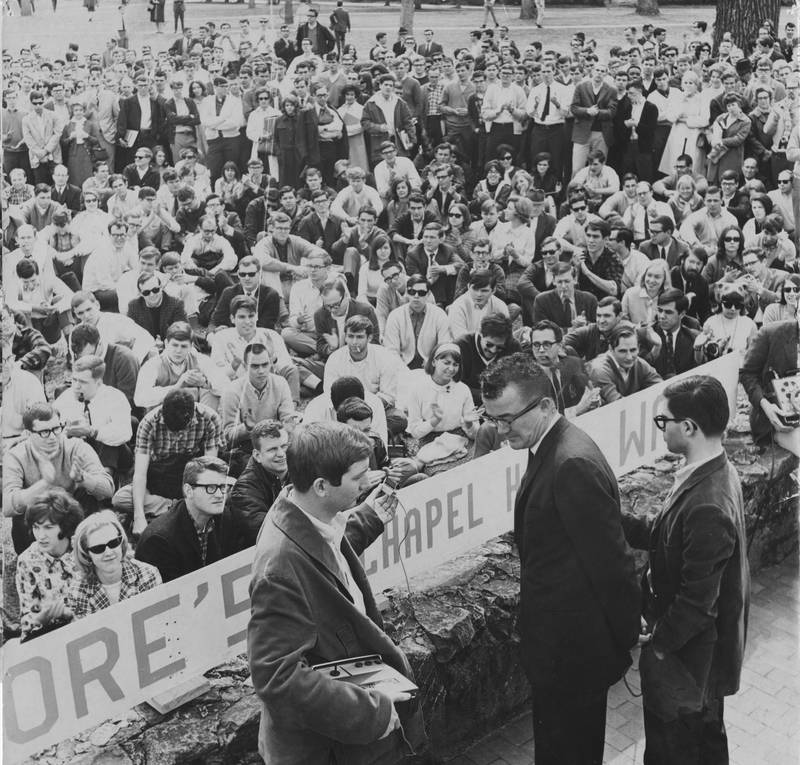
“Frank Wilkinson Speaks From Behind the Wall”
1 media/image71_thumb.jpg 2021-08-26T12:12:59-07:00 Grant Glass 107afcf8873f422898a9c2e07c49ae3f625fc644 37354 1 The Carolina Story: A Virtual Museum of University History. 2006. Carolina Digital Library and Archives, The University of North Carolina at Chapel Hill, https://museum.unc.edu/exhibits/show/speaker-ban-law/frank-wilkinson-speaks-from-be. plain 2021-08-26T12:12:59-07:00 Grant Glass 107afcf8873f422898a9c2e07c49ae3f625fc644This page is referenced by:
-
1
media/image71.jpg
2021-08-26T12:12:02-07:00
1963, June 26 - Speaker Ban Law Passes; Protests Ensue
3
The Act to Regulate Visiting Speakers is adopted on June 26, 1963, and bars speakers on any UNC system campus who are members of the Communist Party, among other alleged activities. Students protested the so-called Speaker Ban Law and challenged it by inviting Frank Wilkinson and Herbert Aptheker to speak on campus in March 1966. Students listened as the speakers stood on the public sidewalk bordering McCorkle Place. A lawsuit, Dickson v. Sitterson, overturned the law in 1968.
plain
2021-09-02T07:51:57-07:00
06/26/1963
On June 26, 1963, the NC General Assembly passes the Act to Regulate Visiting Speakers, later known as the Speaker Ban Law, barring speakers on any UNC system campus who are members of the Communist Party, or who had invoked the Fifth Amendment in connection with alleged subversive activities, or who advocated overthrowing the U.S. Constitution.
Students protested the law as a violation of free speech and academic freedom. Under the threat of losing University accreditation, the law was amended in 1965 to give trustees authority to approve campus speakers. To challenge the amended law, Study Body President Paul Dickson III (d. 1972) and other student leaders invited Frank Wilkinson and Herbert Aptheker to speak on campus on March 2 and March 9, 1966, respectively. When Chancellor J. Carlyle Sitterson (1911-1995) denied them permission, hundreds of students gathered on McCorkle Place to hear the speakers, who stood on the Franklin Street side of the campus wall. The event formed the basis of a lawsuit, Dickson v. Sitterson, which declared the Speaker Ban Law invalid in 1968.
SOURCES
Graham, Nicholas, and Cecelia Moore. “Speaker Ban Law.” UNC A to Z: What Every Tar Heel Needs to Know about the First State University. Chapel Hill, N.C.: U of North Carolina P, 2020. 202-203.
“Part 2: Speaker Ban Controversy.” I Raised My Hand to Volunteer. Manuscript Department, The Wilson Library, The University of North Carolina at Chapel Hill, 2007, https://exhibits.lib.unc.edu/exhibits/show/protest/speaker-essay.
Snider, William D. “The Speaker Ban Law, 1963-1968.” Light on the Hill: A History of the University of North Carolina at Chapel Hill. Chapel Hill, N.C.: U of North Carolina P, 1992. 271-279.