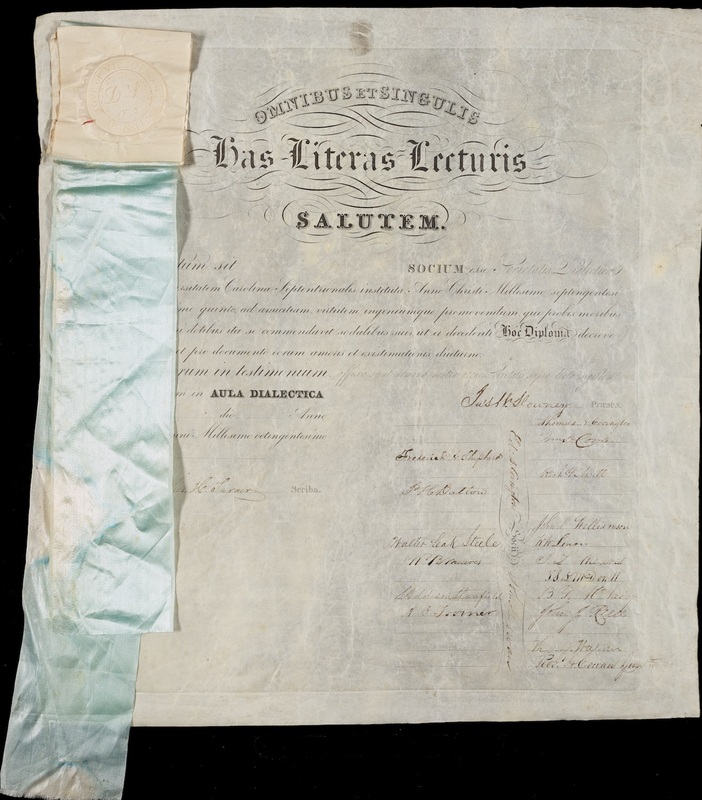
“Dialectic Society Diploma”
1 media/image95_thumb.jpg 2021-08-26T08:04:44-07:00 Grant Glass 107afcf8873f422898a9c2e07c49ae3f625fc644 37354 1 Carolina Story: Virtual Museum of University History , accessed August 13, 2021, https://museum.unc.edu/items/show/2082. plain 2021-08-26T08:04:44-07:00 Grant Glass 107afcf8873f422898a9c2e07c49ae3f625fc644This page is referenced by:
-
1
media/image95.jpg
2021-08-03T09:28:29-07:00
1795 - The Debating Society Founded
4
Charles Wilson Harris (1771-1804) forms a student-run literary and debating group called The Debating Society, emphasizing reading, writing, and debate. At its third meeting, on June 25, a motion was made to divide the society into The Debating Society and The Concord Society; the motion passed on July 2.
plain
2021-09-01T07:04:39-07:00
05/01/1795
Charles Wilson Harris forms a student-run literary and debating group called The Debating Society, emphasizing reading, writing, and debate. At its third meeting, on June 25, a motion was made to divide the society into The Debating Society and The Concord Society; the motion passed on July 2. Although the reasons for this division are unclear, historians suggest the division might have been motivated by political differences or a disagreement regarding the power of the Censor Morum, the officer in the Debating Society responsible for inspecting the morals and conduct of the members. The division might also have been motivated by a desire to have more frequent opportunities for debate.
The Debating Society consisted primarily of students from the western portion of North Carolina while the Concord Society consisted primarily of students from the eastern portion of the state, who were generally more affluent and Episcopalian. Both societies participated in similar activities however.
In 1796, the Debating and Concord Societies changed their names to the Dialectic Society and the Philanthropic Society respectively. Until the 1890’s, students were required to join one of the two societies, and an intense rivalry developed. In 1959, the two Societies united in a Joint Senate, “but they continue to maintain their rivalry in a much more congenial way” (The Dialectic and Philanthropic Societies).
SOURCES
“Dialectic Society of the University of North Carolina Records, 1795-1964” [finding aid]. Collection no. 40152, University Archives, The Wilson Library, The University of North Carolina at Chapel Hill, https://finding-aids.lib.unc.edu/40152/.
The Dialectic and Philanthropic Societies. “History.” The Dialectic and Philanthropic Societies, 2020,http://diphi.web.unc.edu/history/.
Lindemann, Erika. Personal interview. May 5, 2020.