Alexis Rockman by Patrick Hackett
Manifest Destiny, (2004)
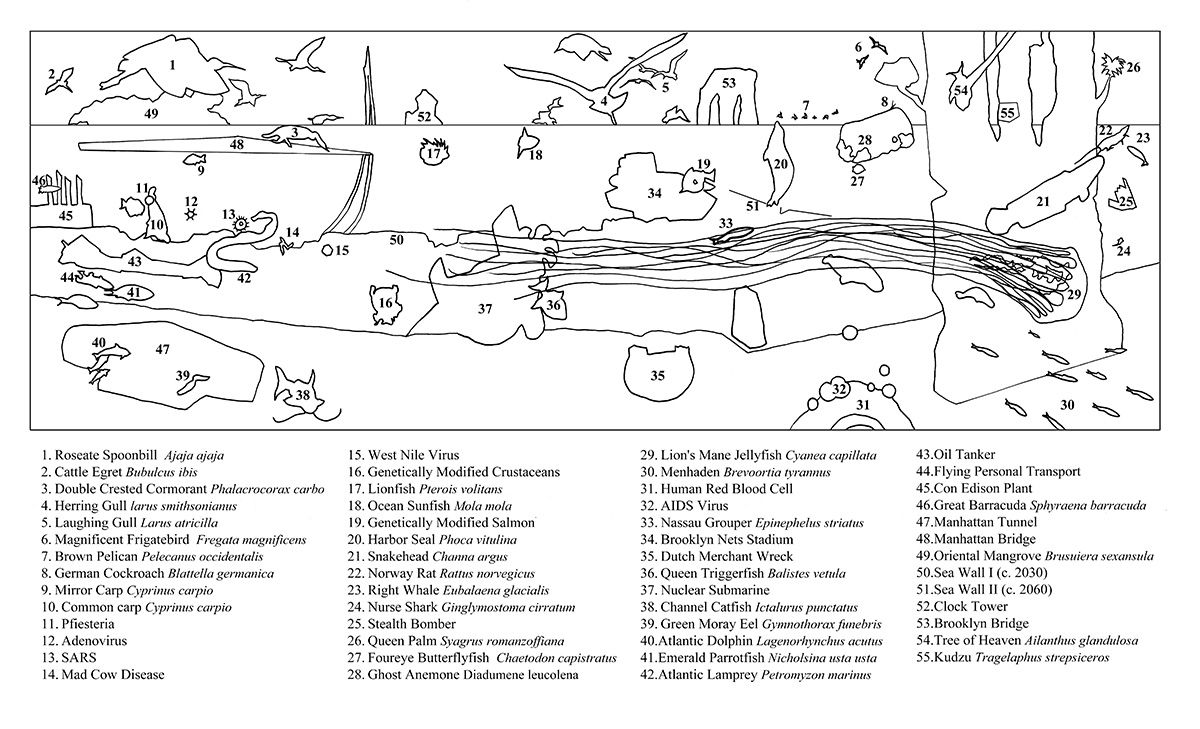
This detailed portrait of a post-apocalyptic New York City shoreline is exemplary of Rockman's American Icons album and one of his most famous works of art. It depicts a very polluted, desolate world missing something we could never fathom, us. In our absence though, one can see the continuation of life, it may not be pretty, but nonetheless it has found a way to adapt and overcome the challenges created by us. There are some resilient animals we can recognize, but the rest seem deformed or mutated. This is the result of our meddling in their genetics, as well as the pollution we've left/created for them. There are also remnants of the Brooklyn bridge, the New Jersey pipeline, and a New York City underwater. The scene is also ridden with heavy pollution as well as multiple diseases, bacteria, and viruses that plagued our existence. It seems like an unusual approach to incorporate so many different aspects of human's existence, what could Rockman be getting at in adding these? How are these remaining anthropocentric items related? It may be that these are included to show the brevity of human existence, represented in the animals and buildings that have outlasted us. Another possibility is that the disease, mutation, and pollution are all that represent our lasting impact we've had on the world. I believe the purpose of this painting, including the scrupulous details, can be extrapolated from the combination of the relation of these ideas as well as their reason for incorporation. I feel as though he adds all these different aspects of human nature to not only show just how fragile our existence is, but also that our lasting impact on the world is solely negative. This combination of human brevity and negligence compels viewers to be impacted emotionally, in the hopes that they will try to prevent this possible future scenario depicted. This experience of shock and awe compels people to think about their impact on the environment and whether they would've helped contribute to this desolate future or not. Stirring the thoughts of the audience and compelling them to reflect upon their actions in relation to the environment can be considered a win in itself, but the true aims of this kind of art is to elicit action as well. For contemplation is a great thing, but if we don't do anything to fix the damage we've done to the Earth and the environment, have we accomplished anything at all? Ultimately, therefore I think Rockman's ecocentric art is of such importance, because it already provides a contemplative image of what's possible if no change is made. This idea, I feel, is why Rockman's art is so successful at eliciting action because it uses an emotional appeal to leave a profound impact on the viewers. Of all the appeals an emotional one seems to be the most influential as well as longest lasting, due to it's ability to bypass logic or thought calling for immediate action. This could be the reason visual art is so moving, it appeals to emotions more than anything. This allows people to experience the artists true intentions of the painting in its rawest form, something I experience firsthand when looking at Rockman's works.
Background and Influence of Alexis Rockman
Background
Rockman was born and grew up in New York City, as a child, Rockman frequented the American Museum of Natural History in New York City, where his mother, Diana Wall, worked for anthropologist Margaret Mead. Rockman has a particular fascination with cockroaches and rats, and admires their ability to shadow human civilization (Wikipedia). At a young age Rockman's fascination for nature, animals, and our interactions with them was fostered by a large interest in Natural History and Science. He later gained a desire for film, animation, and art going on to study animation at Rhode Island School of Design. He later continued art studies at the School of Visual Arts in Manhattan, receiving a BFA in fine arts in 1985 (Wikipedia).Influences and Travels
He has exhibited his work in the United States since 1985, including a 2004 exhibition at the Brooklyn Museum, and internationally since 1989. Many of Alexis Rockman's works have been inspired by his travels around the world, including to Costa Rica, Brazil, Madagascar, Guyana, Tasmania, and Antarctica. In his work, Rockman uses the language of natural history to examine our relationship to it as a culture. He is influenced by the 19th century Hudson River School, and identifies his work as pop art, "using natural history as his iconography”. Hudson River School artists portrayed American landscapes, in a Utopian way, as a haven for Europeans escaping oppression. Rockman turns this idea upside down, depicting apocalyptic scenes, while incorporating realism of the Hudson River School. Rockman has also collaborated on a book with Author and Scientist Peter Douglass Ward called "Future Evolution”. Rockman and Ward portray the future as abundant with plants and animals, but they are descendants of weedy species or feral domestics. (Wikipedia) Other influences include, Chesley Bonestell's 1950 Collier's magazine illustration Atom Bombing of New York City, which depicts Manhattan amidst destruction and a glowing orange aura of an atomic bomb. As well as, Charles R. Knight who has a special place in Rockman's development, as he almost single-handedly created the genre of reconstructions of extinct ecosystems. (Wikipedia) One can see the quite obvious layout for what has become of Rockman's work by simply analyzing his influences. It seems as though all his influences, travels, and interests since he was a young boy have foreshadowed the genre of work he was, seemingly born to, make. These artists influences can be seen directly in Rockman's work, his prior experiences truly shaping what he puts on canvas. He seeks to impact those with these extravagant scenes of a extinction ecosystems as profoundly as his idols have impacted him. This passion and intent is truly what makes Rockman's work so moving. He pours his emotions and full effort into all of his paintings to allow the audience to experience the raw emotions he embeds into them.This page has paths:
- striking images for a challenging time students at Xavier University