Margaret Atwood: A Novelist of the Anthropocene
by Azl Saeed
Atwood at a Glance
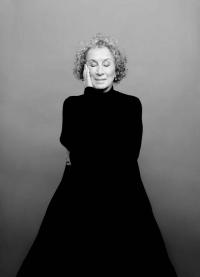
Born in 1939, Margaret Atwood is arguable one of the most influential novelists of our time. From the time she was six months old, Atwood spent the majority of her childhood travelling around different parts of Canada with her family so that her father could pursue his entomology research. As a result of this constant travel, Atwood did not enroll in formal school and instead relied on her own reading and exploration, simultaneously falling in love with literature and the natural world. This early love of literature stuck with Atwood as she went on to study English at the University of Toronto, and then later on, a master’s degree from Radcliffe. Following that, she taught at several institutions, including the University of British Columbia, the Sir George Williams University, the University of Alberta, York University, the University of Alabama, and New York University. Now at the age of 78, Atwood has published over 20 novels, several children’s books, essays, poems, and other collections. Not only that, but this accomplished activist, writer, poet, and inventor has many honorary degrees from institutions ranging from Oxford to Harvard, and has won countless awards throughout her life thus far. Her passionate background with nature and the environment can also be seen through her Twitter, in which she often she retweets environmental and climate change related tweets.Check out this documentary to her about Atwood's life from her own perspective, and also from the perspective of her parents!
Speculative Fiction
Speculative fiction can explore consequences of new technologies, the nature of what it means to be a human being, the relationship between humans and the universe, changes in social organization, or the realms of our own imaginations.For me, the science fiction label belongs on books with things in them that we can't yet do, such as going through a wormhole in space to another universe; and speculative fiction means a work that employs the means already to hand and that takes place on Planet Earth.
As Atwood herself claims in the quote above, many of works, especially the more recent ones, fall in this intriguing genre of literature. Unlike many science fiction dystopian works, speculative fiction takes place in the not-too-distant future. Essentially, these stories could be taking place right now in an alternate version of our own reality.
In fact, it is because Atwood’s works are speculative fiction that she is an Anthropocentric novelist. Speculative fiction of the Anthropocene aims to reveal how human exploitation of the natural world is inextricable from human exploitation of humanity. What makes this specific form of dystopia so unique is that it invites us to connect our current power struggles with the world it represents. All of this is done to effectively provoke alarm and a sense of urgency in its audience.
When asked about her speculative fiction, Atwood stated, "You don't write those books you hope those things will happen, you write those books because you think they might happen, but you would rather they didn't." Check out the interview here to hear more about her thoughts on the topic!
Atwood's Themes
This page has paths:
- dark literature for a dark time? literature of the anthropocene students at Xavier University