Thanks for your patience during our recent outage at scalar.usc.edu. While Scalar content is loading normally now, saving is still slow, and Scalar's 'additional metadata' features have been disabled, which may interfere with features like timelines and maps that depend on metadata. This also means that saving a page or media item will remove its additional metadata. If this occurs, you can use the 'All versions' link at the bottom of the page to restore the earlier version. We are continuing to troubleshoot, and will provide further updates as needed. Note that this only affects Scalar projects at scalar.usc.edu, and not those hosted elsewhere.
Early Indigenous Literatures
Main Menu
The Child Who Would be Sovereign: Settler Colonial Frustrations and the Figure of the Child in Gertrude Simmons Bonnin's American Indian Stories
By: Kai Chase
Illicit Relations: The Challenges and Possibilities of Black and Indigenous Relations
soumya rachel shailendra
Legibility and Ambivalence in 19th Century Indigenous Women's Writing
An exhibit on E. Pauline Johnson and Sarah Winnemucca by Emma Cohen
Lyric Histories: An Investigation of Early Black (and) Native America through Poetic Vignettes
by Kira Tucker
Marriage and Empire in 19th Century Native American Women's Literature
by Angad Singh
Not-not blood quantum: the Dawes Act and ambivalent Indigeneity
by Yasmin Yoon
Reading Indigenous Authorial Presence in 18th- and 19th-century Paratexts
Title Page for Isabel Griffith-Gorgati's Exhibit
Resistance on and off the Page: A Collaborative Conversation between Black and Indigenous Literary Contributors
Featuring James Printer, Katherine Garret, Phillis Wheatley, and John Marrant (17th-18th Century Early Print Culture Participants)- By Lauren Johnson
Spiritual Armies, Resurrected Bones, and “Boundless” Continents: How Indigenous Activists in Early New England Reconfigured Puritan Millennialist Narratives
Featuring texts of Samson Occom, William Apess, and the Wampanoag Bible. By Surya Milner
Sovereignty or Removal: The Conflicting Indigenous Policies of 1835 in the Continental United States
Julia Gilman
What Does Water Do For Indigenous Peoples of the Great Lakes Region?
Featuring Heid E. Erdrich, Simon Pokagon, Black Hawk, and Simon Kofe by Sarah Nisenson
(Re)introducing Black Hawk and The Life (1833)
BHR 1-Intro
Yasmin Yoon
f7f231e474bf43796f973cd0ee560919050f7427
Lydia Abedeen
321b94302eca10e499769fd0179e64cd33bc4cd5
Kira Tucker
acf97d948460e98cd439646cc2db7ae17c5ebd9d
sarah nisenson
7cb5d2c1682fbd145e76716f3924f03bf25c616a
Kai Chase
d7cab5968a3a916efd1a14a48cc4832d5d5514ae
Soumya Shailendra
86c246fcc4aea83787381bffd2b839885bef5096
Bennett Herson-Roeser
c8289125445a56c819045a0091daf0402b3e0875
Surya Milner
077f837f3d662fd5ef9055f8258e5c47bb11f714
Julia Gilman
b860a8277eea484f91a1a9e0423cab4b52bae522
Lauren Johnson
98dac03e7c9c1ad41e1c0a8583704e55802f98ba
Angad Singh
d2b8d1d68ec374981c9e99b7cb400803bc678231
Emma Cohen
146e757b9fc3b3b416edecbf79592e8d743d4ba1
Charlotte Goddu
2d4c020870148128c7824ece179e04cffe180d95
Isabel Griffith-Gorgati
985a05928a67a856791fffac3dbba8acc85f6f37
Wabash Map
1 media/Wabashrivermap_thumb.png 2022-12-06T07:47:17-08:00 sarah nisenson 7cb5d2c1682fbd145e76716f3924f03bf25c616a 41696 1 plain 2022-12-06T07:47:17-08:00 sarah nisenson 7cb5d2c1682fbd145e76716f3924f03bf25c616aThis page is referenced by:
-
1
2022-12-01T11:40:39-08:00
Life of Black Hawk and Watery Dispossession
7
plain
2022-12-06T07:47:56-08:00
As expressed in Life of Black Hawk water is a method of place-making and as such, watery terminology is the language Black Hawk (Sauk) employs for his peoples’ dispossession. Black Hawk describes the traditional summering location for his people in terms of the rivers that constitute this space. He bounds this geographic space using waterways: “our village was situate on the north side of Rock river, at the foot of its rapids, and on the point of land between Rock river and the Mississippi” (45). In explaining the sustenance that the “best island on the Mississippi” provided for Sauk peoples, Black Hawk likens it to a “garden” that supplied his people with “strawberries, blackberries, gooseberries” and moves from land-based provisions to “its waters [which] supplied us with fine fish, being situated in the rapids of the river” (45). The distinction between land and water as places that provide for the Sauk peoples becomes less easily differentiated; it is not clear if Black Hawk only considers the “garden” as something constituted by land-based provisions, or if he extends the garden’s scope to include the fish from the river. This distinction becomes even less clear as he notes that “the rapids of Rock river furnished us with an abundance of excellent fish, and the land, being good, never failed to produce good crops” (45-6). Though the river cannot be as easily possessed through manipulation as land can be, for Black Hawk, this does not preclude the river from providing for his people in the same way.
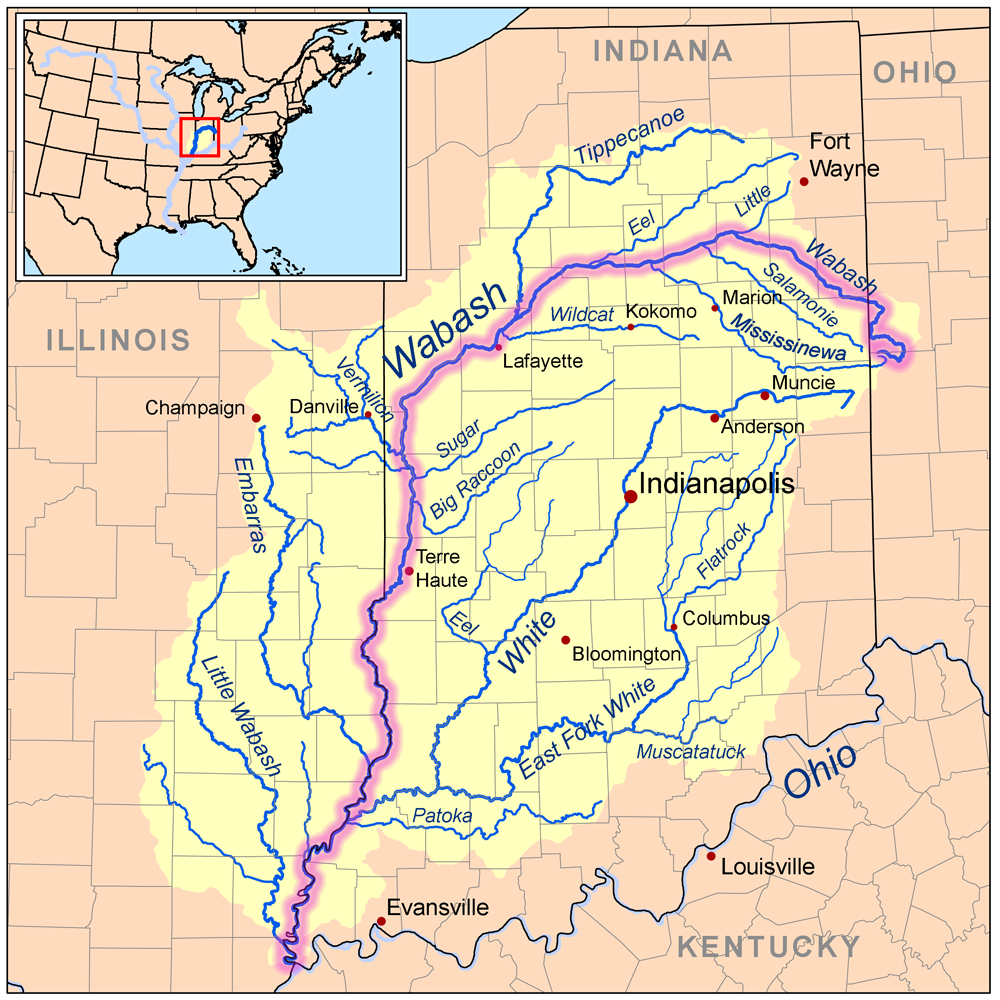
Black Hawk offers another application of Yazzie and Baldy’s suggestion to adopt “a worldview [that] is ‘water view’ a view from the river not a view of the river” (2). When relaying messages about methods of resistance to encroaching settler occupation of Indigenous spaces, “runners came to our village [Rock river] from Shawnee Prophet (whilst others were despatched by him to the villages of the Winnebagoes,) with invitations for us to meet him on the Wabash. Accordingly a party went from each village… I remember well him saying—‘if you do not join your friends on the Wabash, the Americans will take this very village from you!’” (20-1). The Wabash River is a site on which a meeting occurs; it is not merely a method of transportation to the next land-based area, but an area itself, with distinct meeting points that offer resistance in ways land cannot. The existential threat of dispossession is only countered by an inhabitance of place, by rooting oneself on the very space threatened, the Wabash River.
Since land and water are not distinct in their potential for place-making, it is not entirely clear what specific geographic area, land or water, Black Hawk refers to when he explains how his “reason teaches [him] that land cannot be sold. The Great Spirit gave it to his children to live upon, and cultivate, as far as is necessary for the subsistence; and so long as they occupy and cultivate it, they have the right to the soil—but if they voluntarily leave it, then any other people have a right to settle upon it. Nothing can be sold, but such things can be carried away” (56). Although words like “land” and “soil” suggest this place as one constituted by agrarian land, this idea of place seems inherently fused with water. As Black Hawk explains elsewhere, the Sauk people use the river as markers of places where provisions are stored (24). Returning to Black Hawk’s articulation about the possibility of dispossession, he notes that “nothing can be sold, but such things can be carried away” (56). The phrase “carried away” may suggest a person doing the act of carrying, but it also invokes the flow of a river that carries things. Black Hawk does not make it explicit who is doing this carrying and he creates space for the possibility that the river is the entity to whom he refers as possessing that power. Rivers cannot be sold in that they cannot be contained and packaged for possession, but in their watery movement, they have the capacity to be “carried away” and carry away.
Black Hawk then expresses the “sacred reverence” he feels for his homeland, remarking that he “could never consent to leave it, without be forced therefrom” (62). For Black Hawk, rivers connect Sauk peoples to place. He articulates this as the place he was born and the place which contains “the bones of many friends and relations” (62). In addition to the proximity of graves to specific points along the river, Black Hawk expands which bodies of water contribute to place-making for Sauk people by invoking the Great Spirit: “we thank the Great Spirit for all the benefits he has conferred upon us. For myself, I never take a drink of water from a spring, without being mindful of his goodness” (50). The Great Spirit permeates all bodies of water, requiring care and respect anytime Sauk peoples drink water from any spring. Despite the situatedness of Sauk peoples to specific areas bounded by and containing rivers, water as an entity connects these spaces to all watery spaces.