Thanks for your patience during our recent outage at scalar.usc.edu. While Scalar content is loading normally now, saving is still slow, and Scalar's 'additional metadata' features have been disabled, which may interfere with features like timelines and maps that depend on metadata. This also means that saving a page or media item will remove its additional metadata. If this occurs, you can use the 'All versions' link at the bottom of the page to restore the earlier version. We are continuing to troubleshoot, and will provide further updates as needed. Note that this only affects Scalar projects at scalar.usc.edu, and not those hosted elsewhere.
Early Indigenous Literatures
Main Menu
The Child Who Would be Sovereign: Settler Colonial Frustrations and the Figure of the Child in Gertrude Simmons Bonnin's American Indian Stories
By: Kai Chase
Illicit Relations: The Challenges and Possibilities of Black and Indigenous Relations
soumya rachel shailendra
Legibility and Ambivalence in 19th Century Indigenous Women's Writing
An exhibit on E. Pauline Johnson and Sarah Winnemucca by Emma Cohen
Lyric Histories: An Investigation of Early Black (and) Native America through Poetic Vignettes
by Kira Tucker
Marriage and Empire in 19th Century Native American Women's Literature
by Angad Singh
Not-not blood quantum: the Dawes Act and ambivalent Indigeneity
by Yasmin Yoon
Reading Indigenous Authorial Presence in 18th- and 19th-century Paratexts
Title Page for Isabel Griffith-Gorgati's Exhibit
Resistance on and off the Page: A Collaborative Conversation between Black and Indigenous Literary Contributors
Featuring James Printer, Katherine Garret, Phillis Wheatley, and John Marrant (17th-18th Century Early Print Culture Participants)- By Lauren Johnson
Spiritual Armies, Resurrected Bones, and “Boundless” Continents: How Indigenous Activists in Early New England Reconfigured Puritan Millennialist Narratives
Featuring texts of Samson Occom, William Apess, and the Wampanoag Bible. By Surya Milner
Sovereignty or Removal: The Conflicting Indigenous Policies of 1835 in the Continental United States
Julia Gilman
What Does Water Do For Indigenous Peoples of the Great Lakes Region?
Featuring Heid E. Erdrich, Simon Pokagon, Black Hawk, and Simon Kofe by Sarah Nisenson
(Re)introducing Black Hawk and The Life (1833)
BHR 1-Intro
Yasmin Yoon
f7f231e474bf43796f973cd0ee560919050f7427
Lydia Abedeen
321b94302eca10e499769fd0179e64cd33bc4cd5
Kira Tucker
acf97d948460e98cd439646cc2db7ae17c5ebd9d
sarah nisenson
7cb5d2c1682fbd145e76716f3924f03bf25c616a
Kai Chase
d7cab5968a3a916efd1a14a48cc4832d5d5514ae
Soumya Shailendra
86c246fcc4aea83787381bffd2b839885bef5096
Bennett Herson-Roeser
c8289125445a56c819045a0091daf0402b3e0875
Surya Milner
077f837f3d662fd5ef9055f8258e5c47bb11f714
Julia Gilman
b860a8277eea484f91a1a9e0423cab4b52bae522
Lauren Johnson
98dac03e7c9c1ad41e1c0a8583704e55802f98ba
Angad Singh
d2b8d1d68ec374981c9e99b7cb400803bc678231
Emma Cohen
146e757b9fc3b3b416edecbf79592e8d743d4ba1
Charlotte Goddu
2d4c020870148128c7824ece179e04cffe180d95
Isabel Griffith-Gorgati
985a05928a67a856791fffac3dbba8acc85f6f37
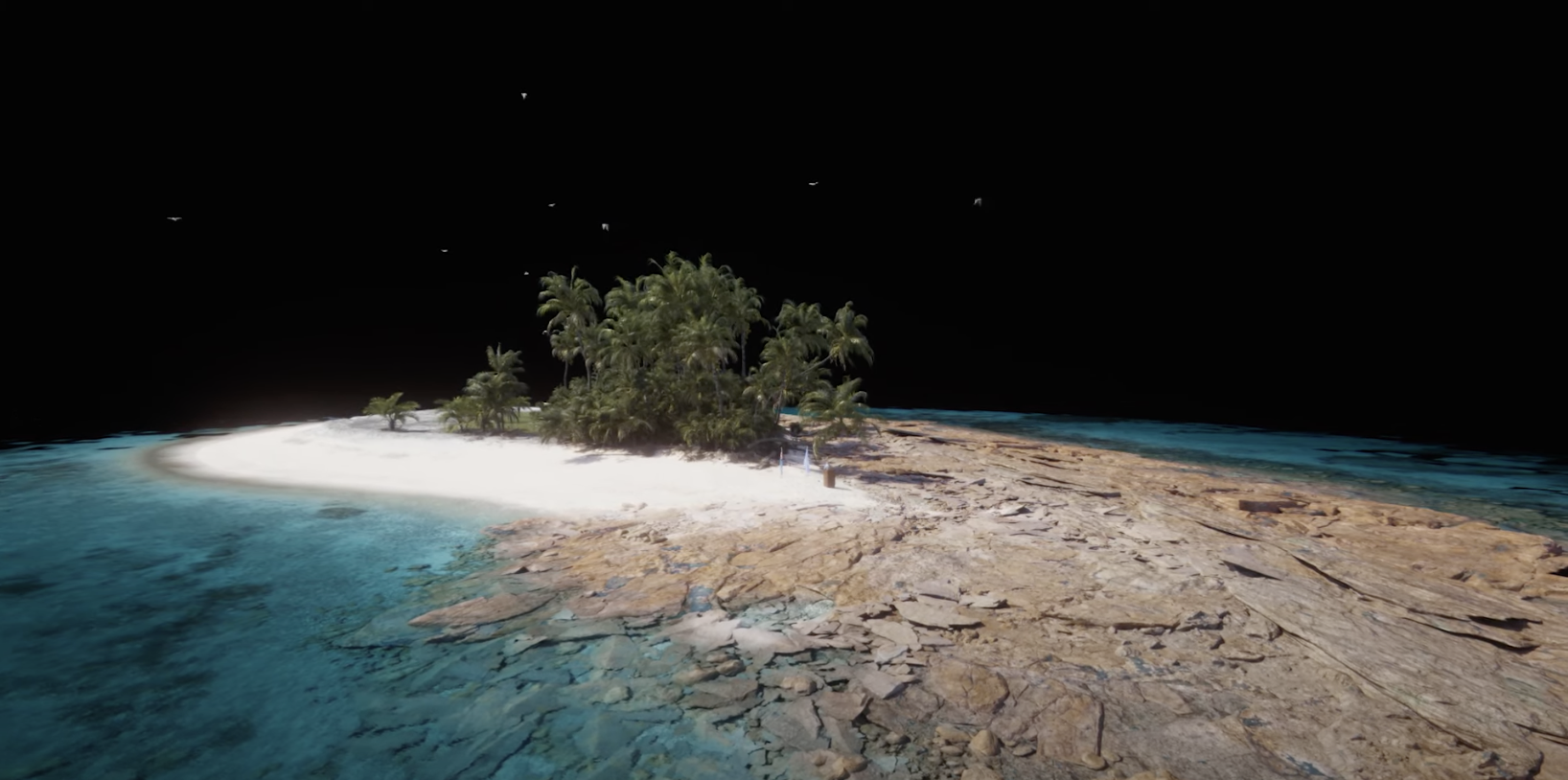
Tuvalu metaverse still
1 media/Screenshot 2022-12-02 at 4.34.02 PM_thumb.png 2022-12-02T14:35:32-08:00 sarah nisenson 7cb5d2c1682fbd145e76716f3924f03bf25c616a 41696 1 plain 2022-12-02T14:35:32-08:00 Lauren Johnson 98dac03e7c9c1ad41e1c0a8583704e55802f98baThis page is referenced by:
-
1
2022-12-01T11:41:37-08:00
Tuvalu's Entrance to the Metaverse
11
plain
2022-12-06T12:33:12-08:00
Taking its place as the most recent technological innovation, the metaverse is radically transforming what survivance and endurance looks like in the face of climate change. Since the metaverse is still taking shape, it is impossible to precisely articulate what it is. Broadly, though, the metaverse “can include virtual reality—characterized by persistent virtual worlds that continue to exist even when you’re not playing—as well as augmented reality that combines aspects of the digital and physical worlds” (Ravenscraft).
While the other primary sources of this exhibit are geographically centered around the Great Lakes region, in an effort to anticipate where new technologies may lead Indigenous peoples, I shift my focus to Tuvalu, an island in the South Pacific. While the technologies Indigenous authors in this exhibit use have been methods of resisting settler colonialism, the existential threat facing Tuvalu is less explicitly related to colonialism, but entangled nonetheless. Positing climate change as an effect of global capitalism, I will consider the mapping of Tuvalu in the metaverse along similar lines of resistance and endurance.
Simon Kofe, a Tuvaluan Minister, pioneered Tuvalu’s metaversal existence in his COP27 address in which he explains that “as our land disappears, we have no choice but to become the world’s first digital nation” (0:57). As Kofe continues speaking, the background of the video, which at first is impossible to distinguish from the real physical island, begins to pixelate, stuttering and jumping, insisting on the virtual existence of this place. Kofe explains the urge to relocate Tuvalu to the metaverse because “our land, our ocean, our culture are the most precious assets of our people” which necessitate digital preservation to “provide solace to our people and remind our children and our grandchildren what our home once was” (1:26). As Kofe delivers his speech, the view expands, beginning with a tight focus on him at the podium and ultimately drifting backwards so that viewers can see the entire islet surrounded by blackness.
While this blackness evokes feelings of isolation and marks Tuvalu’s existence in the otherwise unpopulated void of the metaverse, it also practically conveys the space available for the rest of the island’s relocation. Not simply a recreation of the geographic space and aesthetics of Tuvalu, the metaverse also incorporates sound to contribute another aspect of situatedness. Birds squawk as Kofe delivers his speech, waves audibly but gently lap the shore, and foreboding music begins softly and becomes more pronounced throughout the video.
While other Indigenous authors in this exhibit have been less specific in explaining how the particular technologies they use speak to their methods of resistance and endurance, Kofe explicitly notes that “this is also a matter of sovereignty” (1:28). He explains that the digital recreation ensures the persistence and permanent maintenance of the island’s maritime borders and statehood. While rising sea levels in the “physical realm” will obfuscate these borders, leaving Tuvaluans vulnerable to dispossession, erasure, and absorption into capitalist nation-states, the stable delineation of borders and boundaries in the metaverse offers some level of protection against this. The metaverse also ensures future generations have the ability to see their ancestral lands long after their expected underwater submergence. In positioning Tuvalu’s existence in the metaverse as both a protective method for current generations, a “solace” for older generations, and a “reminder” for future generations, Kofe renders legible Lisa Brooks’ invocation of simultaneity. Brooks paraphrases Virginia Jackson to explain simultaneities as “a new plane of historicity on which several temporalities unfold at once’” which is made possible “by the present moment, the (relatively) new technologies we have in our midst” (308). Implicitly and explicitly, Kofe’s address situates Tuvalu in this kind of simultaneity, something the technological promise of the metaverse makes possible.