Thanks for your patience during our recent outage at scalar.usc.edu. While Scalar content is loading normally now, saving is still slow, and Scalar's 'additional metadata' features have been disabled, which may interfere with features like timelines and maps that depend on metadata. This also means that saving a page or media item will remove its additional metadata. If this occurs, you can use the 'All versions' link at the bottom of the page to restore the earlier version. We are continuing to troubleshoot, and will provide further updates as needed. Note that this only affects Scalar projects at scalar.usc.edu, and not those hosted elsewhere.
Early Indigenous Literatures
Main Menu
The Child Who Would be Sovereign: Settler Colonial Frustrations and the Figure of the Child in Gertrude Simmons Bonnin's American Indian Stories
By: Kai Chase
Illicit Relations: The Challenges and Possibilities of Black and Indigenous Relations
soumya rachel shailendra
Legibility and Ambivalence in 19th Century Indigenous Women's Writing
An exhibit on E. Pauline Johnson and Sarah Winnemucca by Emma Cohen
Lyric Histories: An Investigation of Early Black (and) Native America through Poetic Vignettes
by Kira Tucker
Marriage and Empire in 19th Century Native American Women's Literature
by Angad Singh
Not-not blood quantum: the Dawes Act and ambivalent Indigeneity
by Yasmin Yoon
Reading Indigenous Authorial Presence in 18th- and 19th-century Paratexts
Title Page for Isabel Griffith-Gorgati's Exhibit
Resistance on and off the Page: A Collaborative Conversation between Black and Indigenous Literary Contributors
Featuring James Printer, Katherine Garret, Phillis Wheatley, and John Marrant (17th-18th Century Early Print Culture Participants)- By Lauren Johnson
Spiritual Armies, Resurrected Bones, and “Boundless” Continents: How Indigenous Activists in Early New England Reconfigured Puritan Millennialist Narratives
Featuring texts of Samson Occom, William Apess, and the Wampanoag Bible. By Surya Milner
Sovereignty or Removal: The Conflicting Indigenous Policies of 1835 in the Continental United States
Julia Gilman
What Does Water Do For Indigenous Peoples of the Great Lakes Region?
Featuring Heid E. Erdrich, Simon Pokagon, Black Hawk, and Simon Kofe by Sarah Nisenson
(Re)introducing Black Hawk and The Life (1833)
BHR 1-Intro
Yasmin Yoon
f7f231e474bf43796f973cd0ee560919050f7427
Lydia Abedeen
321b94302eca10e499769fd0179e64cd33bc4cd5
Kira Tucker
acf97d948460e98cd439646cc2db7ae17c5ebd9d
sarah nisenson
7cb5d2c1682fbd145e76716f3924f03bf25c616a
Kai Chase
d7cab5968a3a916efd1a14a48cc4832d5d5514ae
Soumya Shailendra
86c246fcc4aea83787381bffd2b839885bef5096
Bennett Herson-Roeser
c8289125445a56c819045a0091daf0402b3e0875
Surya Milner
077f837f3d662fd5ef9055f8258e5c47bb11f714
Julia Gilman
b860a8277eea484f91a1a9e0423cab4b52bae522
Lauren Johnson
98dac03e7c9c1ad41e1c0a8583704e55802f98ba
Angad Singh
d2b8d1d68ec374981c9e99b7cb400803bc678231
Emma Cohen
146e757b9fc3b3b416edecbf79592e8d743d4ba1
Charlotte Goddu
2d4c020870148128c7824ece179e04cffe180d95
Isabel Griffith-Gorgati
985a05928a67a856791fffac3dbba8acc85f6f37
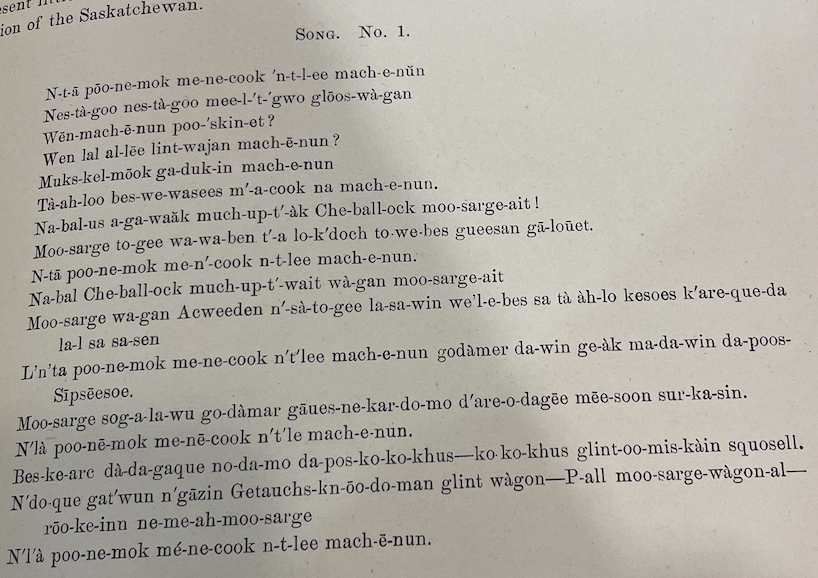
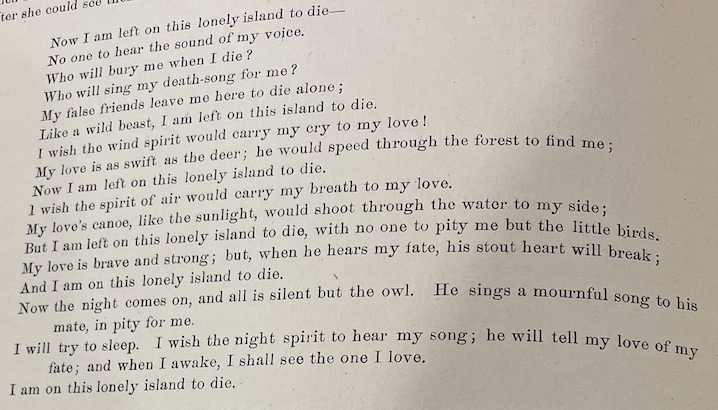
Some Wabanaki Songs, Song No. 1 (Translated)
1 media/Screen Shot 2022-12-05 at 3.35.19 PM_thumb.png 2022-12-05T13:35:58-08:00 Isabel Griffith-Gorgati 985a05928a67a856791fffac3dbba8acc85f6f37 41696 1 Excerpt from Reade's Some Wabanaki Songs plain 2022-12-05T13:35:58-08:00 Lauren Johnson 98dac03e7c9c1ad41e1c0a8583704e55802f98baThis page is referenced by:
-
1
2022-12-04T20:52:44-08:00
John Reade and Ethnographic Authority
6
Isabel's Page 6
plain
2022-12-05T21:04:14-08:00
In the 19th century, the modes in which Indigenous people came to print were changing, and a major force in this change was the advent of ethnography in North America.[1] Audra Simpson describes ethnology in the 1800’s as “the early study of ‘cultural’ difference.”[2] In 1887, Irish-born Canadian settler John Reade published an ethnographic text for the Transactions of the Royal Society of Canada entitled I. Some Wabanaki Songs [and] II. Aboriginal American Poetry. This page focuses on the first chapter, which shares a selection of songs and stories that other settler ethnographers collected from Wabanaki communities and shared with Reade.
In considering this text, I draw from Simpson’s framework in her chapter on “Writing of the Iroquis Confederacy”: Simpson argues, “When desire and fetishized authenticity set the research agenda … it places the analyst in a position of cultural appraisal (and ownership) rather than analysis.”[3] Simpson’s framework is useful when applied to the question of how Indigenous authorial presence and authority feature in a settler-produced ethnographic text such as Reade’s. Although Reade’s text is ostensibly dedicated to transmitting examples of the creative output of the Wabanaki people, he subordinates Indigenous authorial and authoritative presence to the authority of settler ethnographers and the supremacy of settler history.
At the outset of the chapter, Reade ascribes “the greatest historical importance” to “the Algonquin” people because they “presented to the first comers along the whole Atlantic coast those earliest specimens of the red man which have become typical in modern history and romance.”[4] Reade thus positions himself and all of North American settler society in a posture of domination and “ownership”[5] over Indigenous cultures. The importance of Indigenous groups and traditions depends to Reade on how they figure in settler histories and imaginations. His use of the word “specimen” further dehumanizes Native peoples as objects rather than subjects within cultural history. Reade goes on to appraise the historical value of the “north-eastern branch of the far-spreading Algonquin family” based on the extent to which their “legends and traditions” hold “traces of intercourse with the Northmen who came to the New World” before Columbus.[6]
In addition to presenting Indigenous traditions as of peripheral interest within Anglo- and Euro-centric frameworks of cultural value, Reade positions settler ethnographers as authorities over the Indigenous people whose cultures they study. Settler terminology and naming practices are granted supremacy over the naming practices of Indigenous peoples, for example: “‘I call the tribe of which the Passamaquoddies are a division Wabanaki,’ writes Mrs. W. Wallace Brown, ‘though the name is not accepted by all ethnologists, most of them preferring the term Abenaki.’”[7] When Indigenous figures’ contributions are cited in the text, settlers still retain authority: "In his list of authorities we find … 'a manuscript collection of Passomaquoddy legends and folklore, by Mrs. W. Wallace Brown, all given with the greatest accuracy as narrated by Indians, some in broken Indian-English.' Under the head of 'persons' consulted in the preparation for the book we find the name of ‘Sapiel Selmo, keeper of the Wampum Record, formerly read every four years at the kindling of the great fire at Canawagha.'"[8]
Settler ethnologists are thus “authorities,” Indigenous people merely “persons consulted.” When Reade discusses the “poetic facult[ies]” of different Indigenous groups, he does not describe the poetry of Indigenous people in terms of authorship, but again subordinates the creative traditions of Native peoples to the appraising power of ethnologists: “To all the Wabanaki, Mr. Leland ascribes a large share of the poetic nature. Mrs. Brown thinks that her protegés, the Passamaquoddies, surpass all their kindred tribes in the strength and development of their poetic faculty.”[9] Rather than position the Passamaquoddies as authorities over their own poetic works, Reade represents them as “protegés” under the guidance of a settler ethnographer, Mrs. Brown. Mr. Leland and Mrs. Brown adopt clear positions of “appraisal” and “ownership” of the communities they study.
Despite the mediating hands of the ethnographers who brought the featured songs and stories to print, as well as their efforts to diminish the authority of Indigenous people as representatives of their own cultures and traditions, Reade’s text is indebted to the collective authorship of Indigenous communities. Versions of collective Indigenous authorial presence persist through a text that seeks to undermine Indigenous sovereignty. The songs and stories featured in this text also attest to modes of storytelling circulated within Indigenous communities independently of their transmission through settler print culture.[1] Kelly Wisecup, in conversation, November 23, 2022.[2] Audra Simpson, “Chapter Three: Constructing Kahnawà:ke as an ‘Out-of-the-Way’ Place,” in Mohawk Interruptus: Political Life Across the Borders of Settler States (Duke University Press, 2014), 78.[3] Ibid., 76.[4] John Reade, I. Some Wabanaki Songs II. Aboriginal American Poetry, from the Transactions of the Royal Society of Canada Volume V, Section II, 1887 (Dawson Brothers, Montreal, 1888), 1.[5] Audra Simpson, “Chapter Three: Constructing Kahnawà:ke as an ‘Out-of-the-Way’ Place,” 76.[6] John Reade, I. Some Wabanaki Songs II. Aboriginal American Poetry, 2.[7] Ibid., 1.[8] Ibid., 2.[9] Ibid., 4.