Thanks for your patience during our recent outage at scalar.usc.edu. While Scalar content is loading normally now, saving is still slow, and Scalar's 'additional metadata' features have been disabled, which may interfere with features like timelines and maps that depend on metadata. This also means that saving a page or media item will remove its additional metadata. If this occurs, you can use the 'All versions' link at the bottom of the page to restore the earlier version. We are continuing to troubleshoot, and will provide further updates as needed. Note that this only affects Scalar projects at scalar.usc.edu, and not those hosted elsewhere.
Early Indigenous LiteraturesMain MenuThe Child Who Would be Sovereign: Settler Colonial Frustrations and the Figure of the Child in Gertrude Simmons Bonnin's American Indian StoriesBy: Kai ChaseIllicit Relations: The Challenges and Possibilities of Black and Indigenous Relationssoumya rachel shailendraLegibility and Ambivalence in 19th Century Indigenous Women's WritingAn exhibit on E. Pauline Johnson and Sarah Winnemucca by Emma CohenLyric Histories: An Investigation of Early Black (and) Native America through Poetic Vignettesby Kira TuckerMarriage and Empire in 19th Century Native American Women's Literatureby Angad SinghNot-not blood quantum: the Dawes Act and ambivalent Indigeneityby Yasmin YoonReading Indigenous Authorial Presence in 18th- and 19th-century ParatextsTitle Page for Isabel Griffith-Gorgati's ExhibitResistance on and off the Page: A Collaborative Conversation between Black and Indigenous Literary ContributorsFeaturing James Printer, Katherine Garret, Phillis Wheatley, and John Marrant (17th-18th Century Early Print Culture Participants)- By Lauren JohnsonSpiritual Armies, Resurrected Bones, and “Boundless” Continents: How Indigenous Activists in Early New England Reconfigured Puritan Millennialist NarrativesFeaturing texts of Samson Occom, William Apess, and the Wampanoag Bible. By Surya MilnerSovereignty or Removal: The Conflicting Indigenous Policies of 1835 in the Continental United StatesJulia GilmanWhat Does Water Do For Indigenous Peoples of the Great Lakes Region?Featuring Heid E. Erdrich, Simon Pokagon, Black Hawk, and Simon Kofe by Sarah Nisenson(Re)introducing Black Hawk and The Life (1833)BHR 1-IntroYasmin Yoonf7f231e474bf43796f973cd0ee560919050f7427Lydia Abedeen321b94302eca10e499769fd0179e64cd33bc4cd5Kira Tuckeracf97d948460e98cd439646cc2db7ae17c5ebd9dsarah nisenson7cb5d2c1682fbd145e76716f3924f03bf25c616aKai Chased7cab5968a3a916efd1a14a48cc4832d5d5514aeSoumya Shailendra86c246fcc4aea83787381bffd2b839885bef5096Bennett Herson-Roeserc8289125445a56c819045a0091daf0402b3e0875Surya Milner077f837f3d662fd5ef9055f8258e5c47bb11f714Julia Gilmanb860a8277eea484f91a1a9e0423cab4b52bae522Lauren Johnson98dac03e7c9c1ad41e1c0a8583704e55802f98baAngad Singhd2b8d1d68ec374981c9e99b7cb400803bc678231Emma Cohen146e757b9fc3b3b416edecbf79592e8d743d4ba1Charlotte Goddu2d4c020870148128c7824ece179e04cffe180d95Isabel Griffith-Gorgati985a05928a67a856791fffac3dbba8acc85f6f37
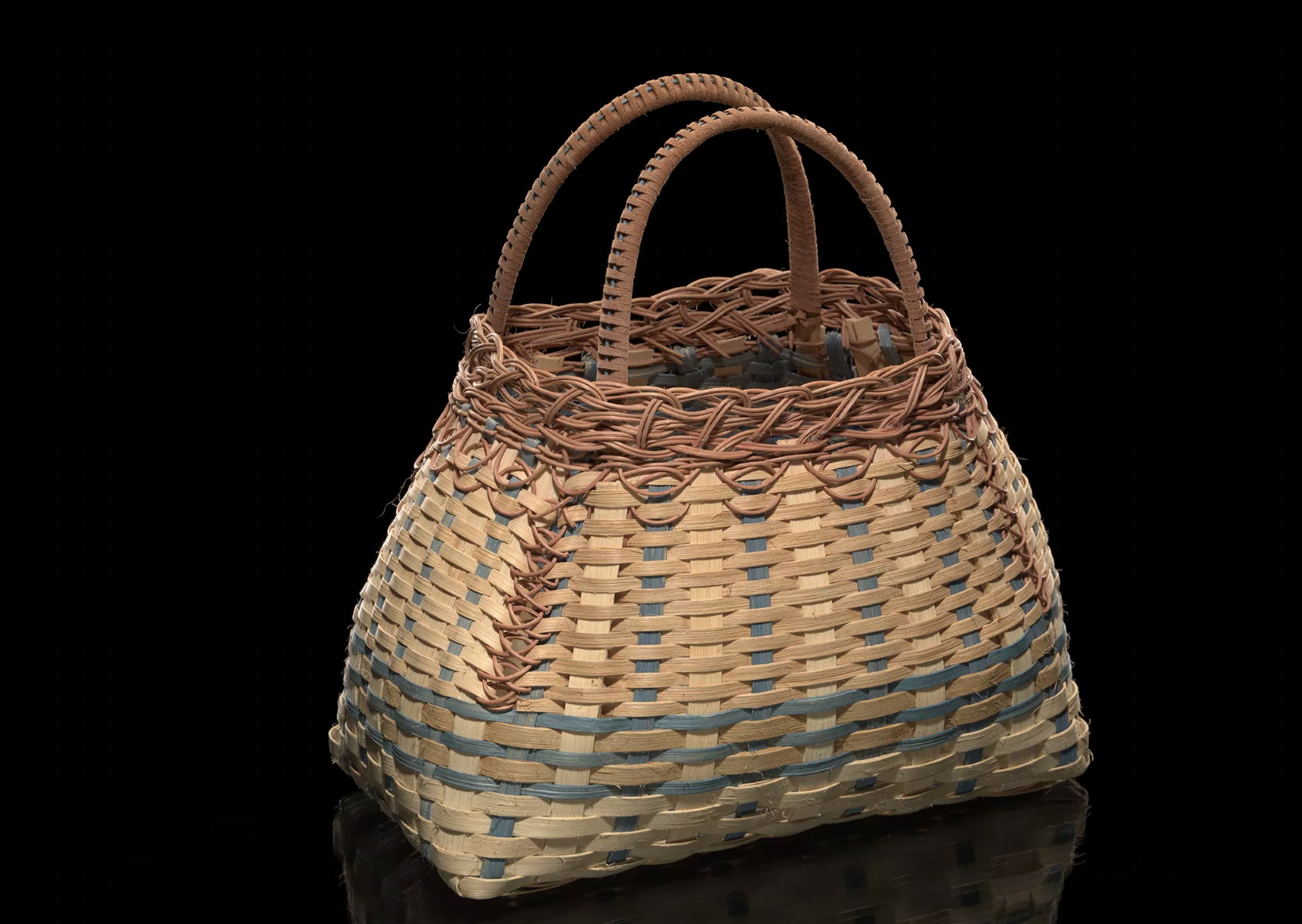
Lace Moxie's Purse (Side View)
1media/Screen Shot 2022-12-07 at 3.05.51 PM_thumb.png2022-12-07T13:26:53-08:00Soumya Shailendra86c246fcc4aea83787381bffd2b839885bef5096416961plain2022-12-07T13:26:53-08:00Soumya Shailendra86c246fcc4aea83787381bffd2b839885bef5096
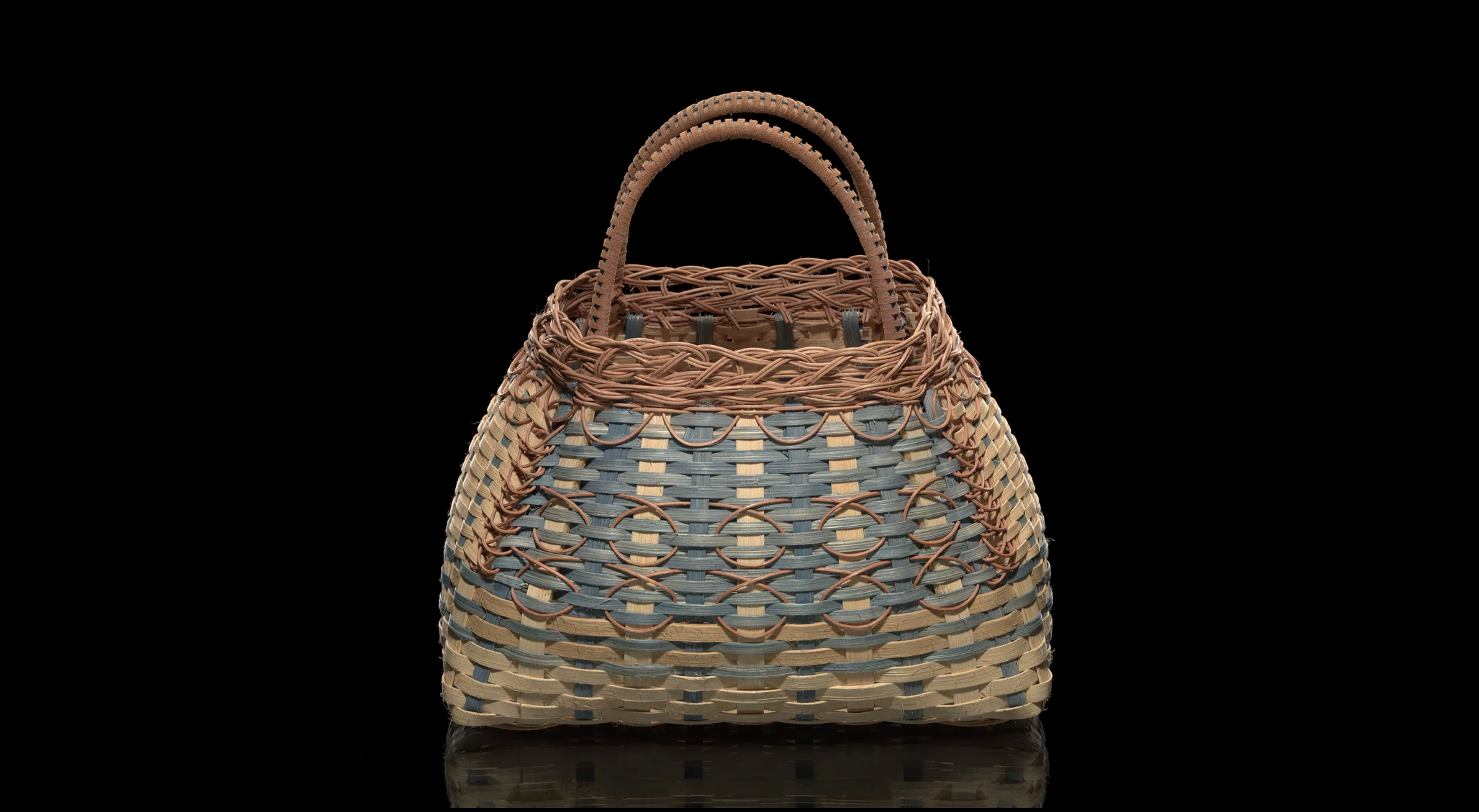
The Cherokee Nation followed the Muscogee and the Choctaw Nation in 2007 in exclude descendants of freed people from the rights and privileges of tribal citizenship. Revealing the tension of anti-blackness within the community, Phillip Deloria understands this move across tribal nations as a struggle to “reconcile citizenship claims with tribal-sovereignty claims” (Deloria 6). While much of this legal battle was legislated upon by the Cherokee Supreme Court, which decided to remove the phrase “by blood” in its constitution, this decision reflected the effects of blood quantum and genetics in legalizing kinship relations within the Cherokee community. In this context, Cherokee artist and basket weaver, Rodslen Brown’s “Lace Moxie’s Purse”, takes up the Indigenous art of weaving to express that “whether by blood or through kinship, freedmen are … relatives”, and that freedmen and Black-Native histories are central to Indigenous histories.
In her study of the history of basketry amongst Cherokees, Sarah Hill notes that the art of basketry needs to be approached with a dynamic perspective towards the changes in dietary habits, living conditions, gender roles, and waves of dispossessions that altered the utility and the form of the basket. She writes, “Within and between households, women bridged the differences between past and present, prosperous and sparse, and Indian and white…They did not merge passively into new identities, nor hold intractably to old ones. Rather they engaged fully in the complexities of change” (Hill 133). At the intersection of gender, labor, and intramural tribal politics, Hill highlights the influence of identity in shaping the preservation of traditional basketry practices by working within contemporary resonances of representational politics. Yet, Sherry Farrell Racette in “Tuft Life: Stitching Sovereignty in Contemporary Indigenous Art” underlines that traditional Indigenous art have also been subjected to both “continuous and broken ‘lines of descent’ as the knowledge for gathering and processing materials, techniques, and patterns has survived and transformed over generations” (Racette 115). The simple act of retaining and protecting Indigenous knowledge is political, as it stems from the premise that the materials used for weaving are “living and present”, and the gestures and movements involved in creation are historically inherited, yet deeply personal and meditative (Ibid.).
Commenting on the materials used in Lace Moxie’s Purse — root runners, flat reed, dye, hide — Amber Starks (Muscogee Creek Nation) notes that the interplay of each material “speaks to the care and attention that goes into observing, learning, and translating culture” (Starks 2022). The contrasting colors, centrally wound by a brown reed symbolizes that the notion of Black and Indigeneous harmony is not antithetical Native sovereignty, but integral to its shared futurity. Moreover, the utility of the basket as a carrier and keeper, most evident in the leather handles, speaks to the care and stewardship that form the literal social and political ties between Black and Indigeneous people. Starks further remarks, “This basket, with its modest shape but interlocking details, cautions us not to forget the struggle, resilience, and solidarity it has taken for Native people to still be here” (Ibid.)
Qwo Driskill (Cherokee) in their essay, “ Doubleweaving Two Spirit Critiques: Building Alliances between Native and Queer Studies”, use doubleweaving as a rhetorical strategy that creates stories and models newer ways of reading between and beyond disciplinary boundaries. Although Driskill’s critique positions Native Studies as embedded within queer-of-color critique, it is helpful to extend this analysis to Black and Native studies to speculate on the embodied, aesthetic, and erotic grounds upon which Black-Native identity is fashioned. Doubleweaving, to reiterate Lisa Lowe’s vocabulary, points to an “emergent formation” (Lowe 20), which communicates “a story much more complex and durable than its original and isolated splints, a story both unique and rooted in ancient and enduring form” (Driskill 74). Rodslen basketry exhibits the radical relational possibilities that can be nurtured by honing the techniques, corporeal histories, and even tensed interactions that have carried Indidgenous arts into the present.